According to a new report, published by KBV research, The Global Smart Water Meters Market size is expected to reach $16.54 billion by 2032, rising at a market growth of 10.0% CAGR during the forecast period.
The smart water meters market stands as a cornerstone of the global movement toward sustainable water management and digital transformation in utilities. As the world faces mounting water scarcity, urbanization, and aging infrastructure, the demand for smarter, more efficient water monitoring and management systems has never been greater. Smart water meters are digital devices that not only measure water consumption with exceptional accuracy but also collect, transmit, and analyze consumption data in real time, empowering utilities, municipalities, and consumers to manage water resources more judiciously.
The Ultrasonic Meter segment is anticipating a CAGR of 10.4% during (2025 - 2032). Ultrasonic meters utilize advanced ultrasonic technology to measure water flow by sending and receiving sound waves through the water within the pipe. This method ensures extremely high accuracy and allows for the detection of even minor fluctuations in water usage, making these meters an excellent choice for applications requiring detailed monitoring and analytics. One of the major advantages of ultrasonic meters is their non-intrusive, solid-state design, which eliminates moving parts and therefore minimizes wear and tear over time. This design leads to greater longevity and reduced maintenance needs. Ultrasonic meters also excel at detecting leaks and providing real-time consumption data, which is highly valuable in efforts to conserve water and improve efficiency.
The AMR segment is leading the Global Smart Water Meters Market by Technology in 2024, thereby, achieving a market value of $9.58 billion by 2032. This growth can be attributed to the widespread adoption of AMR technology due to its cost-effectiveness and ease of implementation. AMR systems enable utilities to automatically collect consumption data from water meters without the need for manual readings, thereby reducing operational costs and minimizing human errors. The technology is favoured in regions looking to upgrade their existing infrastructure with minimal disruption, offering a straightforward path to digitalization and improved resource management.
The Residential segment shows a CAGR of 9.5% during (2025 - 2032). The rapid growth in this segment is driven by the increasing demand for precise water usage monitoring among households, rising urbanization, and a global push toward water conservation. Many municipal governments and water utilities are deploying smart water meters in residential areas to help consumers track their water consumption, quickly detect leaks, and promote responsible usage. These meters enable households to receive real-time information about their water usage patterns, empowering residents to make informed decisions and reduce wastage. Additionally, the implementation of smart water metering in residential settings is often supported by government initiatives, subsidies, and public awareness campaigns focused on sustainable water management.
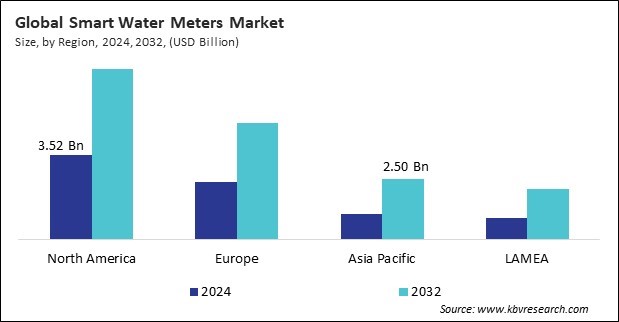
The North America region dominated the Global Smart Water Meters Market by Region in 2024, and would continue to be a dominant market till 2032; thereby, achieving a market value of $7.01 billion by 2032. The Europe region is experiencing a CAGR of 9.6% during (2025 - 2032). Additionally, The Asia Pacific region would exhibit a CAGR of 11.5% during (2025 - 2032).
By Technology
By Meter Type
By Application
By Geography
 Unique Offerings

