According to a new report, published by KBV research, The Global Sensing Cable Market size is expected to reach $1.68 billion by 2032, rising at a market growth of 6.6% CAGR during the forecast period.
The global sensing cable market has its roots in the growing need for real-time monitoring of infrastructure, pipelines, tunnels, and industrial installations — particularly in sectors where safety, environmental protection, and structural integrity are critically important. As civil infrastructure expanded worldwide over the 20th and early 21st centuries, engineers and asset owners increasingly recognized the limitations of periodic visual inspection or localized sensors for detecting leaks, structural stress, thermal anomalies, or pipeline failures.
The Leak & Spill Detection segment captured the maximum revenue in the Global Sensing Cable Market by Application in 2024, thereby, achieving a market value of $718.3 million by 2032. The leak & spill detection segment represents a major area of application within the sensing cable market. Its prominence is driven by the critical need for real-time monitoring in industries such as oil & gas, chemicals, and water management. The ability of sensing cables to instantly detect fluid leaks or hazardous spills enhances operational safety, minimizes environmental damage, and reduces downtime, positioning this segment as a key contributor to overall market adoption.
The Oil and Gas segment is experiencing a CAGR of 6 % during the forecast period. The oil and gas segment plays a central role in the sensing cable market, driven by the industry's strong need for continuous monitoring and enhanced safety practices. Sensing cables are widely implemented in pipelines, storage facilities, drilling operations, and refineries to detect leaks, temperature variations, and structural changes. Their ability to provide accurate, real-time data supports risk mitigation and operational efficiency, making this segment a key user of advanced sensing technologies.
The Distributed Temperature Sensing (DTS) segment led the maximum revenue in the Global Sensing Cable Market by Sensing Technology in 2024, thereby, achieving a market value of $598.9 million by 2032. This is driven by its extensive adoption across critical industries such as oil & gas, power utilities, and industrial manufacturing. DTS technology enabled continuous, real-time temperature monitoring over long distances, making it highly suitable for pipeline integrity management, power cable monitoring, and fire detection systems. Its reliability, accuracy, and ability to operate in harsh environments supported widespread global deployment, reinforcing its dominant revenue position in the market.
The Fiber-Optic Sensing Cables segment is growing at a CAGR of 6.2 % during the forecast period. In North America, the fiber-optic sensing cables segment stands out due to the region’s strong adoption of advanced monitoring technologies across industries such as energy, infrastructure, and security. These cables are valued for their high sensitivity, long-distance measurement capabilities, and reliability in harsh environments. They are widely deployed for applications including pipeline monitoring, structural health assessment, perimeter security, and power grid diagnostics.
Full Report: https://www.kbvresearch.com/sensing-cable-market/
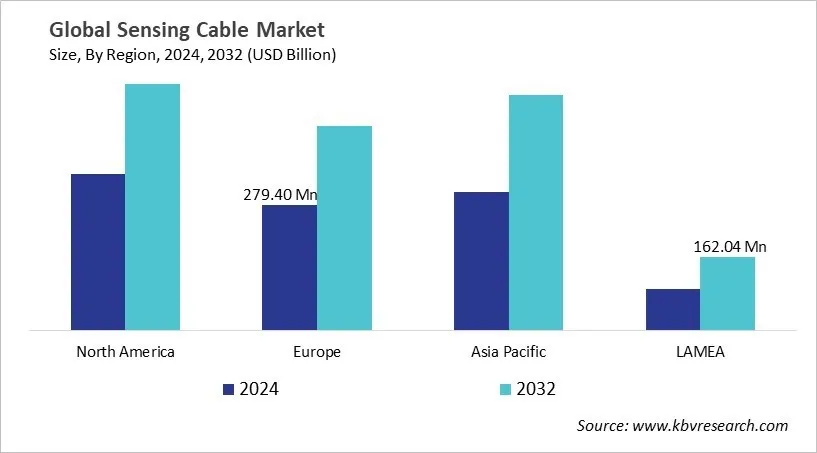
The North America region dominated the Global Sensing Cable Market by Region in 2024, and would continue to be a dominant market till 2032; thereby, achieving a market value of $547.8 million by 2032. The Asia Pacific region is anticipated to grow at a CAGR of 7.1% during (2025 - 2032). Additionally, The Europe region would witness a CAGR of 6.4% during (2025 - 2032).
By Application
By End-Use Industry
By Sensing Technology
By Cable Type
By Geography



 Unique Offerings

