According to a new report, published by KBV research, The Global Passive Optical Component Market size is expected to reach $140.37 billion by 2032, rising at a market growth of 13.3% CAGR during the forecast period.
The Global Passive Optical Component Market has evolved from the early days of fiber-optic communication when government-funded research and defense programs in the United States, Europe, and Japan first demonstrated the potential of optical fibers for long-distance, high-capacity data transmission. In the 1970s and 1980s, national laboratories such as Bell Labs, Japan’s NTT research arms, and European telecom agencies focused on developing low-loss fibers, optical connectors, and couplers that could support the growing demand for cross-continental communication.
The Planar Lightwave Circuit (PLC) Technology segment is experiencing a CAGR of 11.8 % during the forecast period. Planar Lightwave Circuit (PLC) technology forms a fundamental part of the global passive optical component market, driven by its critical role in enabling high-density optical signal distribution across large-scale fiber networks. As nations worldwide continue expanding broadband access, increasing cloud adoption, and upgrading backbone communication infrastructure, PLC components are widely integrated into optical splitters, multiplexing systems, and advanced passive network architectures.
The Optical Couplers segment led the maximum revenue in the Global Passive Optical Component Market by Component Type in 2024, thereby, achieving a market value of $41.2 billion by 2032. The Optical Couplers segment represents a major portion of the passive optical component market and plays a central role in enabling efficient splitting and combining of optical signals within fiber networks. Globally, this segment benefits from strong adoption driven by expanding fiber-optic communication infrastructure, rising data transmission requirements, and the continuous evolution of broadband and enterprise networks.
The Telecommunications segment is growing at a CAGR of 11.7 % during the forecast period. The Telecommunications Segment Represents A Foundational Area Of Adoption Within The Global Passive Optical Component Market, Supported By The Continuous Expansion Of High-Speed Communication Networks Worldwide. As countries strengthen their broadband infrastructure, upgrade mobile backhaul systems, and enhance long-distance data transmission capabilities, passive optical components play a central role in enabling efficient, high-capacity signal flow.
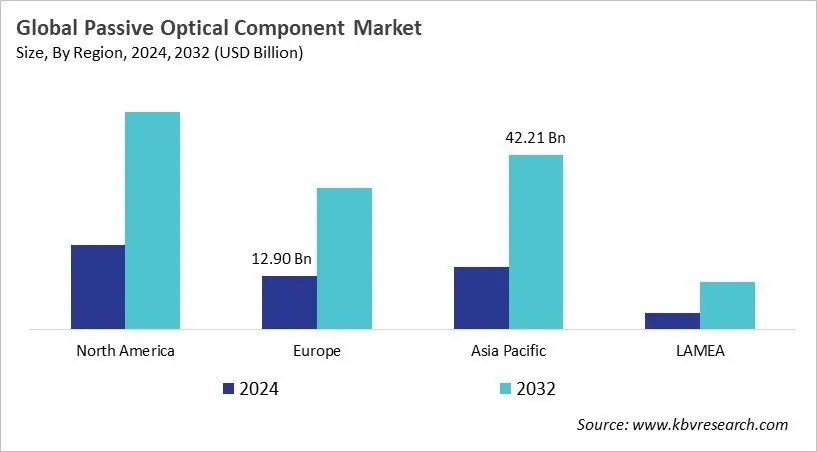
The North America region dominated the Global Passive Optical Component Market by Region in 2024, and would continue to be a dominant market till 2032; thereby, achieving a market value of $52.6 billion by 2032. The Europe region is anticipated to grow at a CAGR of 13% during (2025 - 2032). Additionally, The Asia Pacific region would witness a CAGR of 13.8% during (2025 - 2032).
By Technology
By Component Type
By Application
By Geography




 Unique Offerings

