According to a new report, published by KBV research, The Global Multi-access Edge Computing Market size is expected to reach $104.46 billion by 2032, rising at a market growth of 46.6% CAGR during the forecast period.
Multi-access Edge Computing (MEC) is a telco-centric approach to edge computing that brings cloud-like compute, storage and application services close to end users and devices at the network edge — for example inside or adjacent to radio access networks, central offices, on-premises enterprise sites, and other localized facilities. The ETSI industry specification group that popularized the term framed MEC as an architecture and API-layer that enables application developers and content providers to deploy services with very low latency, local context awareness and control over data locality, while allowing operators to expose network capabilities to third parties.
The Large Enterprises segment captured the maximum revenue in the Global Multi-access Edge Computing Market by Enterprise Size in 2024, thereby, achieving a market value of $67.5 billion by 2032. Across sectors like global manufacturing, logistics, and major telecom services, large enterprises require MEC to deploy mission-critical, ultra-low latency applications—such as high-speed robotics control, real-time video analytics, and autonomous systems—across their vast, often geographically distributed, operational footprints.
The Hardware segment dominated is experiencing a CAGR of 45.7 % during the forecast period. This is driven by the massive initial capital expenditure (CAPEX) required to build the physical foundation of distributed edge networks worldwide. This substantial investment includes the procurement of specialized edge servers, ruggedized micro data centers, accelerators (like GPUs/FPGAs) for edge AI workloads, and high-performance 5G networking equipment (routers, gateways).
The Wireless MEC segment led the maximum revenue in the Global Multi-access Edge Computing Market by Network Type in 2024, thereby, achieving a market value of $74.7 billion by 2032. This leadership is driven by the global, massive-scale deployment and commercialization of 5G networks by major telecom operators worldwide. The wireless segment, often called Mobile Edge Computing (MEC), integrates edge resources directly into the cellular network infrastructure, which is crucial for delivering the ultra-low latency and high bandwidth required by next-generation applications.
The IT & Telecom segment is growing at a CAGR of 44.9 % during the forecast period. Major global telecom carriers and cloud providers are undertaking massive, foundational capital expenditure to embed computing and storage resources directly into their widespread network infrastructure (cell towers, central offices, and access points). This strategy allows them to significantly reduce network latency for all their services, and crucially, to monetize the excess compute capacity by offering high-speed, localized, and dedicated MEC-as-a-Service to enterprises worldwide, positioning them as the largest initial revenue driver for the market.
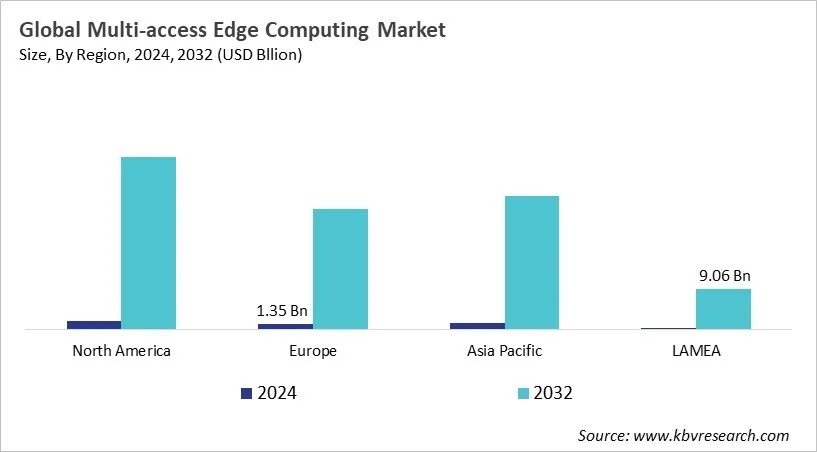
The North America region dominated the Global Multi-access Edge Computing Market by Region in 2024, and would continue to be a dominant market till 2032; thereby, achieving a market value of $38.6 billion by 2032. The Asia Pacific region is anticipated to grow at a CAGR of 47.3% during (2025 - 2032). Additionally, The Europe region would witness a CAGR of 46% during (2025 - 2032).
By Enterprise Size
By Solution Type
By Network Type
By End-Use
By Geography
 Unique Offerings

