According to a new report, published by KBV research, The Global Marketing Automation Market size is expected to reach USD 82.14 billion by 2032, rising at a market growth of 11.2% CAGR during the forecast period.
The global marketing automation market has developed as a direct response to the growing need for businesses to engage customers more efficiently across multiple channels. Initially, marketing teams relied on manual efforts such as direct mail campaigns, call centers, and basic database marketing to maintain customer relationships. As technology advanced during the late twentieth century, businesses began to adopt customer relationship management systems that provided more systematic ways to organize customer data, track leads, and monitor campaign results.
The On-premise segment is leading the Global Marketing Automation Market by Deployment in 2024; thereby, achieving a market value of $55.55 billion by 2032. This is largely driven by organizations that prioritize control, security, and customization in their technology infrastructure. Many enterprises continue to rely on on-premise systems as they allow integration with legacy platforms, ensure compliance with strict data regulations, and offer greater flexibility in tailoring solutions to business-specific needs. Its strong presence reflects the ongoing demand from companies that value in-house management and direct oversight of their marketing automation tools.
The Large Enterprises segment dominated the Global Marketing Automation Market by Enterprise Size in 2024, growing at a CAGR of 10.8 % during the forecast period. This is supported by their greater financial capacity and advanced technological infrastructure. These organizations often invest heavily in automation tools to streamline complex marketing processes, manage vast customer databases, and drive large-scale campaigns across multiple channels. With a strong emphasis on efficiency, personalization, and data-driven strategies, large enterprises continue to be the primary adopters of robust marketing automation platforms.
The BFSI segment is generating the Global Marketing Automation Market by End-use in 2024, and would continue to be a dominant market till 2032; thereby, achieving a market value of $15.84 billion by 2032. This is driven by the critical role of customer engagement in this sector. Banks, insurance providers, and financial institutions use automation platforms to manage vast client databases, track customer journeys, and deliver personalized services. By streamlining complex communication processes, these tools help institutions strengthen trust, improve retention, and provide real-time offers that align with customer needs, making automation indispensable in an increasingly digital financial ecosystem.
The Email Marketing segment is leading the Global Marketing Automation Market by Solution in 2024, growing at a CAGR of 10 % during the forecast period. This is reflecting its importance as a direct and cost-effective channel for customer communication. Businesses across industries rely on email automation to deliver personalized campaigns, nurture leads, and maintain long-term relationships with clients. The ability to segment audiences, track engagement, and optimize content has made email marketing one of the most powerful tools for driving customer loyalty and conversions.
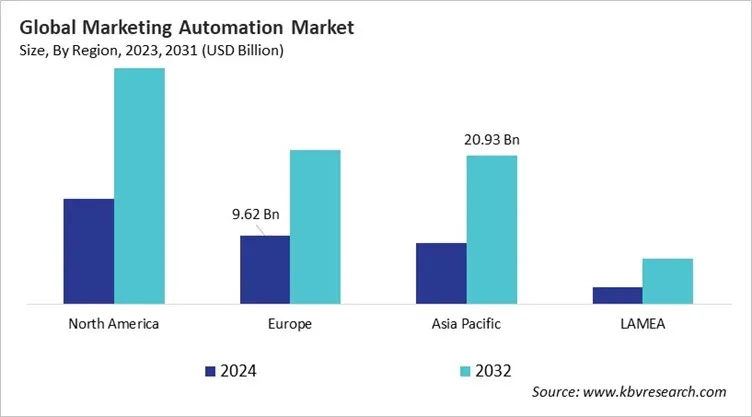
The North America region dominated the Global Marketing Automation Market by Region in 2024, and would continue to be a dominant market till 2032; thereby, achieving a market value of $33.20 billion by 2032. The Europe region is experiencing a CAGR of 10.8% during (2025 - 2032). Additionally, The Asia Pacific region would exhibit a CAGR of 11.9% during (2025 - 2032).
By Deployment
By Enterprise Size
By End-use
By Solution
By Geography




 Unique Offerings

