According to a new report, published by KBV research, The Global Legacy IT System Modernization Market size is expected to reach $50.32 billion by 2032, rising at a market growth of 17.2% CAGR during the forecast period.
Legacy IT system modernization refers to the strategic transformation of outdated software, hardware, and infrastructure to meet modern business, operational, and technological needs. Modernization is not merely upgrading old systems; it involves rethinking workflows, architectures, and technologies to improve agility, scalability, security, and cost efficiency. Modernization can include re-hosting on cloud platforms, re-architecting into microservices, or fully replacing legacy applications with contemporary equivalents.
The Services segment is poised to grow at a CAGR of 16.9 % during the forecast period. The services segment in the Legacy IT System Modernization Market plays a central role in enabling organizations to transform aging IT infrastructures into agile, secure, and scalable digital environments. This segment encompasses a wide range of offerings such as consulting, system assessment, application reengineering, migration support, integration, testing, deployment, and ongoing maintenance.
The Cloud segment captured the maximum revenue in the Global Legacy IT System Modernization Market by Deployment Type in 2024, thereby, achieving a market value of $30.8 billion by 2032. The cloud segment in the Legacy IT System Modernization Market represents a transformative approach for organizations seeking flexibility, scalability, and operational efficiency in modernizing outdated IT infrastructures. Cloud-based deployment enables enterprises to migrate legacy applications and data to virtualized environments that support rapid innovation, elastic resource allocation, and seamless integration with modern digital tools.
The Large Enterprises segment is experiencing a CAGR of 16.9 % during the forecast period. The large enterprises segment in the Legacy IT System Modernization Market is characterized by complex, large-scale IT environments that often include decades-old systems supporting critical business operations. These organizations typically operate across multiple geographies and business units, making modernization initiatives highly strategic and deeply integrated with long-term digital transformation goals.
The Re-hosting segment led the maximum revenue in the Global Legacy IT System Modernization Market by Modernization Approach in 2024, thereby, achieving a market value of $11.0 billion by 2032. The re-hosting segment in the Legacy IT System Modernization Market focuses on moving existing legacy applications to modern infrastructure environments with minimal or no changes to the underlying code. This approach is often adopted by organizations seeking faster modernization outcomes while reducing operational risk and complexity.
The BFSI segment is growing at a CAGR of 15.4 % during the forecast period. The BFSI segment in the Legacy IT System Modernization Market is driven by the need to enhance system resilience, security, and real-time processing capabilities across banking, financial services, and insurance operations. Organizations in this segment rely heavily on legacy core systems that support transaction processing, customer data management, risk assessment, and regulatory reporting.
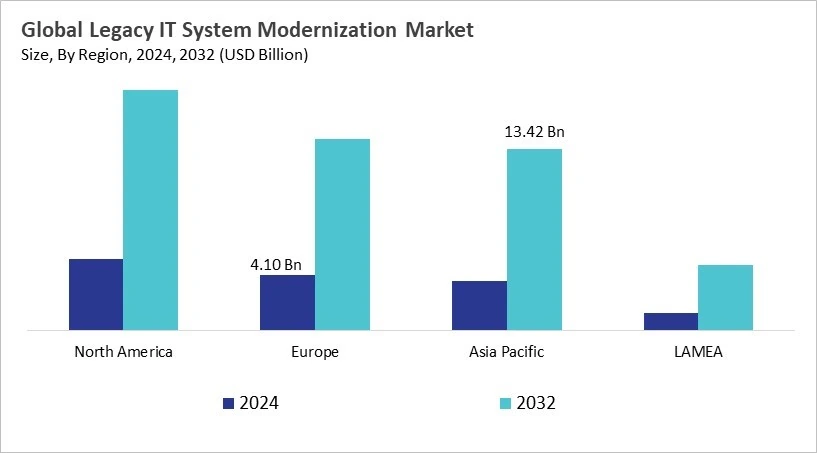
The North America region dominated the Global Legacy IT System Modernization Market by Region in 2024, and would continue to be a dominant market till 2032; thereby, achieving a market value of $17.8 billion by 2032. The Asia Pacific region is anticipated to grow at a CAGR of 17.8% during (2025 - 2032). Additionally, The Europe region would witness a CAGR of 17% during (2025 - 2032).
By Component
By Deployment Type
By Enterprise Size
By Modernization Approach
By End-User Industry
By Geography
 Unique Offerings

