According to a new report, published by KBV research, The Global HMI Sensors In Wearables Market size is expected to reach $9.16 billion by 2032, rising at a market growth of 13.6% CAGR during the forecast period.
Wearable devices have evolved into intelligent systems that continuously interact with users through integrated sensor technologies. Human-Machine Interface (HMI) sensors in wearables enable devices to interpret physical movement, physiological signals, touch, and environmental inputs, converting them into actionable digital outputs. Globally, advancements in microelectronics, wireless connectivity, and embedded processing have transformed wearables from basic step-tracking tools into sophisticated platforms capable of continuous biometric monitoring and adaptive interaction.
The Touch Sensors segment is leading the Global HMI Sensors In Wearables Market by Sensor Type in 2024; thereby, achieving a market value of $2.15 billion by 2032. Their widespread integration in smartwatches, fitness bands, and other touchscreen-enabled devices underscores their critical role in enabling intuitive user interaction. Continuous advancements in capacitive and flexible touch technologies, along with increasing demand for seamless and responsive interfaces, are driving adoption across both premium and mid-range wearable devices.
The Health & Fitness Monitoring segment would register maximum revenue in the Global HMI Sensors In Wearables Market by Application in 2024, growing at a CAGR of 12.8 % during the forecast period. This strong position is driven by increasing consumer focus on preventive healthcare, active lifestyle management, and continuous wellness tracking. Wearable devices integrated with biometric and motion sensors are widely used to monitor heart rate, sleep quality, calorie expenditure, and other vital metrics. The expansion of digital health platforms and growing adoption of remote monitoring solutions further reinforce the global demand for advanced HMI sensor technologies in this segment.
The Consumer Electronics segment led the Global HMI Sensors In Wearables Market by End Use in 2024; thereby, achieving a market value of $4.34 billion by 2032. The widespread adoption of smartwatches, fitness bands, hearables, and other connected wearable devices is a primary driver of this segment’s dominance. Integration of touch, motion, biometric, and audio sensors enhances functionality, user interaction, and personalization features. Growing consumer demand for connected lifestyles, smart ecosystems, and multifunctional wearable devices continues to fuel global expansion in this category.
The Smartwatches & Fitness Bands segment generated maximum revenue share in the Global HMI Sensors In Wearables Market by Device Type in 2024, growing at a CAGR of 12.3 % during the forecast period. Their widespread popularity is driven by increasing consumer demand for health tracking, activity monitoring, and seamless connectivity with smartphones and smart ecosystems. These devices integrate multiple HMI sensors, including touch, motion, and biometric sensors, to deliver enhanced functionality and user experience.
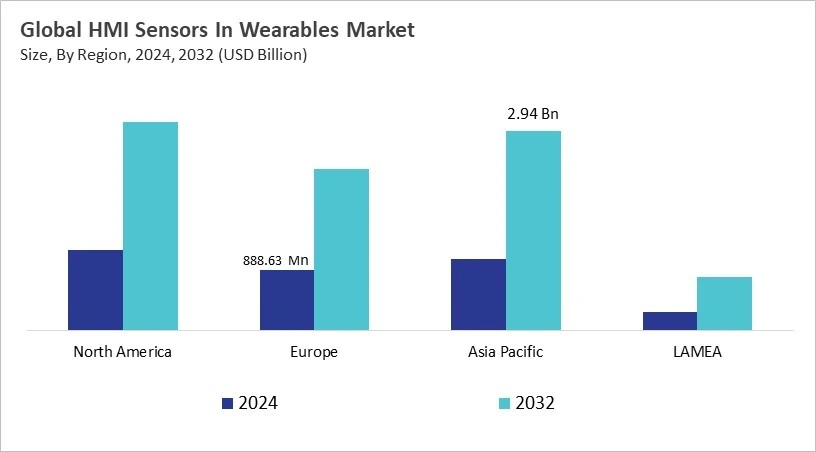
The North America market dominated the Global HMI Sensors In Wearables Market by Region in 2024, and would continue to be a dominant market till 2032; thereby, achieving a market value of $3.06 billion by 2032. The Asia Pacific market is expected to witness a CAGR of 14.1% during (2025 - 2032). Additionally, The Europe market is expected to witness a CAGR of 13.4% during (2025 - 2032).
By Sensor Type
By Application
By End Use
By Device Type
By Geography
 Unique Offerings

