According to a new report, published by KBV research, The Global Explainable AI Market size is expected to reach $22.20 billion by 2032, rising at a market growth of 20.4% CAGR during the forecast period.
The rapid evolution of artificial intelligence (AI) over the past decade has led to its widespread integration across industries, driving advancements in automation, decision-making, and data analysis. However, as AI models become increasingly complex—particularly with the proliferation of deep learning and neural networks—the challenge of understanding and trusting their decisions has come to the forefront.
On-premise segment is leading the Global Explainable AI Market by deployment in 2024; thereby, achieving a market value of $8.01 billion by 2032. Organizations operating in highly regulated industries such as healthcare, finance, and government often prefer on-premise solutions, as they allow complete control over sensitive data and AI model management. On-premise deployment is also favoured by businesses with legacy systems or those requiring customization tailored to unique operational needs. Furthermore, for companies in regions with limited cloud infrastructure or strict data sovereignty laws, on-premise solutions present a viable alternative. The need for low-latency processing in certain use cases also makes on-premise deployment attractive for mission-critical AI applications.
The Drug Discovery & Diagnostics segment is anticipating a CAGR of 20.1% during (2025 - 2032). The complexity and high stakes of medical decision-making require models that clinicians and researchers can interpret and trust. By providing transparency into how conclusions are reached—whether suggesting potential drug candidates or supporting diagnostic decisions—explainable AI helps researchers validate results and doctors ensure patient safety. This transparency is crucial for regulatory approvals and fostering trust among practitioners, patients, and regulatory bodies. As the healthcare industry faces growing demands for faster innovation and more personalized treatments, explainable AI is increasingly recognized as essential for driving safe and effective outcomes.
The Solution segment is leading the Global Explainable AI Market by Component in 2024; thereby, achieving a market value of $17.68 billion by 2032. This is largely due to the increasing demand for robust, ready-to-deploy explainable AI platforms and tools. Organizations are prioritizing investments in XAI solutions that can be quickly integrated into existing AI workflows to provide transparency, auditability, and trust in AI-driven decisions. These solutions often come with built-in visualization tools, reporting modules, and interpretability frameworks, which simplify model analysis and foster regulatory compliance. As explainable AI becomes crucial in regulated sectors such as finance, healthcare, and legal services, the adoption of comprehensive solutions is accelerating.
The Healthcare segment shows a CAGR of 19.2% during (2025 - 2032). Healthcare is one of the most critical sectors for explainable AI, given the life-or-death nature of clinical decisions and the need for transparency in patient care. Explainable AI enables clinicians to understand and trust recommendations for diagnostics, treatment plans, and drug development. This is vital for regulatory compliance, risk management, and building patient confidence in AI-assisted healthcare. The growing integration of AI in imaging, diagnostics, and personalized medicine further fuels the need for interpretability and transparency, resulting in substantial revenue share.
Full Report: https://www.kbvresearch.com/explainable-ai-market/
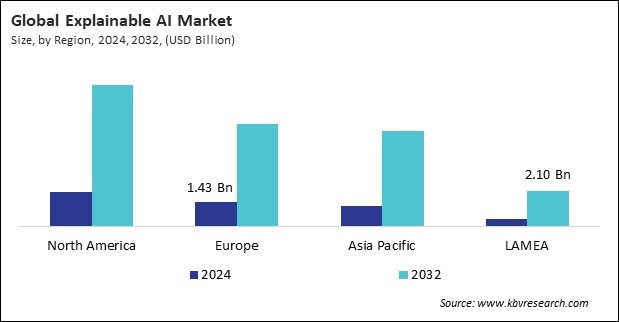
The North America region dominated the Global Explainable AI Market by Region in 2024, and would continue to be a dominant market till 2032; thereby, achieving a market value of $8.39 billion by 2032. The Europe region is experiencing a CAGR of 19.9% during (2025 - 2032). Additionally, The Asia Pacific region would showcase a CAGR of 21.4% during (2025 - 2032).
By Deployment
By Component
By Application
By End-Use
By Geography

 Unique Offerings

