According to a new report, published by KBV research, The Global Enterprise LLM Market size is expected to reach $30.35 billion by 2032, rising at a market growth of 28.0% CAGR during the forecast period.
The global enterprise large language model (LLM) landscape has matured significantly over recent years, evolving from proof-of-concepts to foundational tools embedded in enterprise workflows. Initially, organizations experimented with general natural language processing (NLP) systems—chatbots, translation, and basic text analytics—but the advent of generative AI and foundation models triggered a transformation. Governments have played a key role, for example through frameworks that establish norms of trust, accountability, and risk management.
The Large Enterprises segment is poised to grow at a CAGR of 27.7 % during the forecast period. Large organizations benefit from significant budgets, strong infrastructure, and well-established digital ecosystems, which enable early adoption of advanced AI technologies. They use LLMs to enhance customer service, streamline operations, strengthen data analytics, and improve strategic decision-making. The ability to invest in customized and scalable solutions also allows them to integrate LLMs across multiple functions, further reinforcing their leadership position in the market.
The General-Purpose LLMs segment captured the maximum revenue in the Global Enterprise LLM Market by Model Type in 2024, thereby, achieving a market value of $11.9 billion by 2032. These models are widely used across industries due to their versatility, scalability, and ability to handle diverse tasks such as content generation, customer support, and data analysis. Enterprises prefer general-purpose LLMs for their broad applicability, easy integration, and capacity to reduce operational complexity, making them a dominant choice for large-scale deployments.
The Software segment is experiencing a CAGR of 27.5 % during the forecast period. Enterprises rely heavily on software platforms to integrate LLMs into their workflows for content generation, automation, customer engagement, and advanced analytics. The flexibility and scalability of these solutions allow businesses to adapt quickly to evolving demands. Continuous improvements through software updates and cloud-based deployments further enhance performance and usability. Software also enables enterprises to experiment with new applications and scale efficiently without significant infrastructure costs.
The Cloud segment led the maximum revenue in the Global Enterprise LLM Market by Deployment Type in 2024, thereby, achieving a market value of $15.9 billion by 2032. Enterprises are increasingly adopting cloud-based deployments for their scalability, flexibility, and cost-efficiency. Cloud platforms enable businesses to access powerful LLMs without investing heavily in infrastructure, making them attractive for both large organizations and SMEs. The ability to support remote operations, seamless updates, and integration with diverse applications further enhances their adoption.
The BFSI segment is growing at a CAGR of 25.6 % during the forecast period. Financial institutions are increasingly leveraging large language models to handle high volumes of transactions, deliver personalized customer support, and enhance fraud detection systems. LLMs also assist in credit risk assessment, compliance reporting, and regulatory adherence, which are critical in this highly regulated sector. By automating manual processes, banks and insurers reduce operational costs while improving service quality.
Full Report: https://www.kbvresearch.com/enterprise-llm-market/
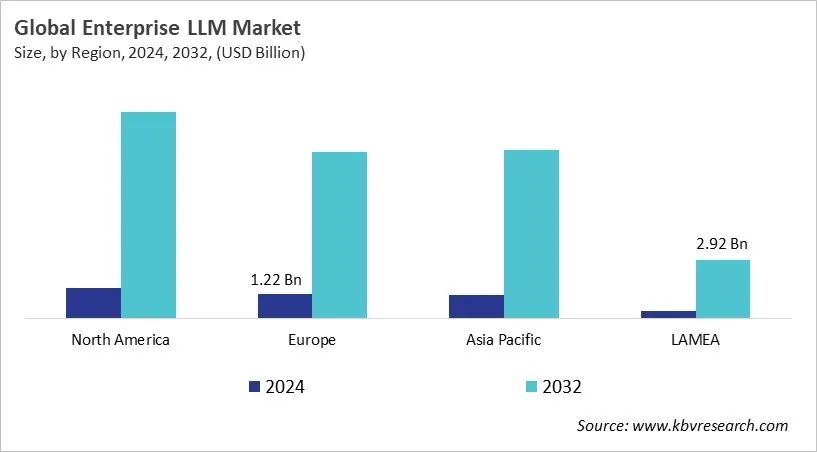
The North America region dominated the Global Enterprise LLM Market by Region in 2024, and would continue to be a dominant market till 2032; thereby, achieving a market value of $10.5 billion by 2032. The Europe region is anticipated to grow at a CAGR of 27.6% during (2025 - 2032). Additionally, The Asia Pacific region would witness a CAGR of 28.7% during (2025 - 2032).
By Enterprise Size
By Model Type
By Component
By Deployment Type
By Industry Vertical
By Geography

 Unique Offerings

