According to a new report, published by KBV research, The Global E-Compass Market size is expected to reach $3.43 billion by 2032, rising at a market growth of 10.3% CAGR during the forecast period.
The global e-compass market traces its roots to the convergence of micro-electro-mechanical systems and advanced signal processing, which enabled three-axis magnetometers to be packaged alongside inertial sensors and temperature elements on compact chips. Early electronic compasses served basic heading determination in handheld navigation and consumer electronics, but their value rose sharply once sensor fusion algorithms combined magnetic readings with accelerometers and gyroscopes to correct for tilt and motion.
The 3-Axis segment captured the maximum revenue in the Global E-Compass Market by Axis Orientation in 2024, thereby, achieving a market value of $1.8 billion by 2032. The 3-axis e-compass segment represents the most widely adopted configuration within the market, designed to provide precise heading and orientation by measuring magnetic fields across three perpendicular axes. This configuration enables accurate tilt-compensated direction sensing, making it essential for smartphones, tablets, wearables, and navigation systems.
The Hall-Effect segment is experiencing a CAGR of 9 % during the forecast period. The hall-effect segment represents one of the most established technologies within the e-compass market, relying on the principle of voltage generation in response to magnetic fields. Hall-effect sensors are valued for their robustness, compact size, and cost-effectiveness, which make them well suited for integration in consumer electronics, automotive navigation systems, and handheld devices. Their ability to function reliably in a range of environmental conditions and temperatures has made them a preferred choice for mass-market applications.
The Integrated Sensor-Combo (Accel + Mag) segment led the maximum revenue in the Global E-Compass Market by Form Factor in 2024, thereby, achieving a market value of $1.4 billion by 2032. The integrated sensor-combo segment represents a highly adopted form factor within the e-compass market, combining accelerometers and magnetometers into a single compact package. This configuration enables precise tilt-compensated heading measurements and reduces board space, power consumption, and cost for device manufacturers. Such integration is ideal for smartphones, wearables, drones, and gaming controllers, where motion and orientation data must be processed in real time.
The Consumer Electronics segment is growing at a CAGR of 8.9 % during the forecast period. The consumer electronics segment represents one of the most prominent applications of e-compass technology, powering everyday devices such as smartphones, tablets, laptops, smartwatches, and gaming consoles. These sensors enhance user experience by enabling navigation, augmented reality, gesture recognition, and device orientation features. As digital ecosystems expand and mobile computing becomes integral to daily life, e-compasses serve as vital components for spatial awareness and motion-based functionality.
Full Report: https://www.kbvresearch.com/e-compass-market/
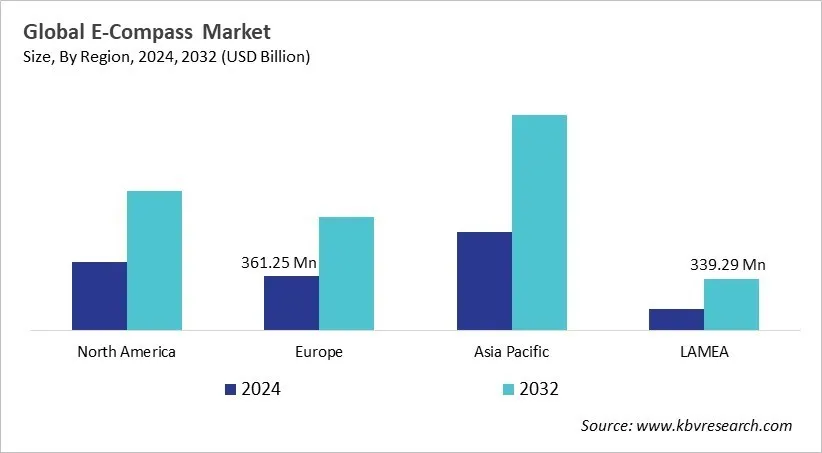
The Asia Pacific region dominated the Global E-Compass Market by Region in 2024, and would continue to be a dominant market till 2032; thereby, achieving a market value of $1.4 billion by 2032. The North America region is anticipated to grow at a CAGR of 9.6% during (2025 - 2032). Additionally, The Europe region would witness a CAGR of 9.8% during (2025 - 2032).
By Axis Orientation
By Technology
By Form Factor
By Application
By Geography




 Unique Offerings

