The Distributed Temperature Sensing Market is Predict to reach USD 1.20 Billion by 2032, at a CAGR of 8.2%
Special Offering :
Industry Insights | Market Trends | Highest number of Tables | 24/7 Analyst Support
Distributed Temperature Sensing Market Growth, Trends and Report Highlights
According to a new report, published by KBV research, The Global Distributed Temperature Sensing Market size is expected to reach $1.20 billion by 2032, rising at a market growth of 8.2% CAGR during the forecast period.
The Distributed Temperature Sensing (DTS) market has gained significant momentum across various industries due to its capability to provide real-time and continuous temperature profiling over long distances. DTS technology, which relies on optical fibers as sensing elements rather than conventional point sensors, enables precise and distributed monitoring of temperature along the length of the fiber. This technique employs Raman scattering phenomena, detecting the backscattered light variations as a function of temperature changes, allowing industries to gain critical data across pipelines, power cables, oil wells, and other infrastructures where continuous monitoring is essential.
The Optical Frequency Domain Reflectometry (OFDR) segment is experiencing a CAGR of 7.8 % during the forecast period. Optical Frequency Domain Reflectometry (OFDR) is an advanced distributed sensing technology that leverages the interference of light waves to measure backscattered signals within optical fibers. Unlike traditional point sensors, OFDR provides high-resolution, continuous temperature profiles along the length of the fiber, offering precise data over short to medium ranges. This operating principle uses tunable lasers to vary the frequency and accurately analyze Rayleigh backscatter, enabling the detection of even minor changes in temperature and strain.
The Single-mode Fiber segment is leading the Global Distributed Temperature Sensing Market by Fiber in 2024; thereby, achieving a market value of $728.6 million by 2032. Single-mode fiber is a core component in distributed temperature sensing (DTS) systems where long-range, high-precision monitoring is critical. These fibers have a small core diameter, typically around 8 to 10 microns, allowing only one mode of light to propagate. This minimizes dispersion and attenuation over long distances, providing superior measurement accuracy even over hundreds of kilometers.
The Oil & Gas segment is growing at a CAGR of 7.3 % during the forecast period. The industry has been a pivotal adopter of Distributed Temperature Sensing (DTS) technology due to its unparalleled ability to provide continuous, real-time, and long-distance temperature monitoring. DTS systems utilize fiber optic cables installed along critical infrastructure such as pipelines, wells, and subsea assets, enabling operators to detect temperature anomalies that indicate potential leaks, flow blockages, or integrity failures.
Full Report: https://www.kbvresearch.com/distributed-temperature-sensing-market/
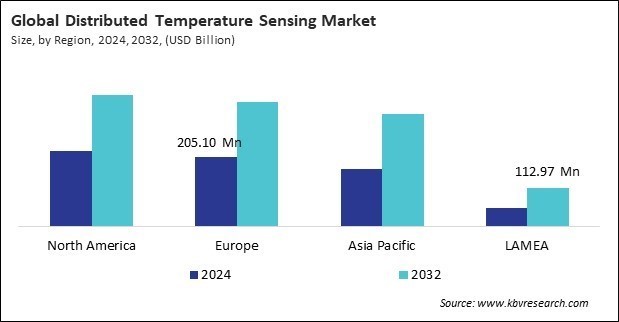
The North America region dominated the Global Distributed Temperature Sensing Market by Region in 2024, and would continue to be a dominant market till 2032; thereby, achieving a market value of $389.1 million by 2032. The Europe region is anticipated to grow at a CAGR of 7.8% during (2025 - 2032). Additionally, The Asia Pacific region would witness a CAGR of 9% during (2025 - 2032).
List of Key Companies Profiled
- Schlumberger Limited
- Halliburton Company
- Yokogawa Electric Corporation
- Weatherford International PLC
- Sumitomo Electric Industries, Ltd.
- Prysmian Group
- Bandweaver Technology Ltd.
- AP Sensing GmbH
- Optromix, Inc.
- Viavi Solutions, Inc.
Distributed Temperature Sensing Market Report Segmentation
By Operating Principle
- Optical Frequency Domain Reflectometry (OFDR)
- Optical Time Domain Reflectometry (OTDR)
By Fiber
- Single-mode Fiber
- Multi-mode Fiber
By Application
- Oil & Gas
- Power Cable Monitoring
- Process & Pipeline Monitoring
- Fire Detection
- Environmental Monitoring
- Other Application
By Geography
- North America
- US
- Canada
- Mexico
- Rest of North America
- Europe
- Germany
- UK
- France
- Russia
- Spain
- Italy
- Rest of Europe
- Asia Pacific
- China
- Japan
- India
- South Korea
- Singapore
- Malaysia
- Rest of Asia Pacific
- LAMEA
- Brazil
- Argentina
- UAE
- Saudi Arabia
- South Africa
- Nigeria
- Rest of LAMEA
Related Reports: