Direct-to-Chip Liquid Cooling Market is Predicted to reach USD 7.48 billion by 2032, at a CAGR of 19.4%
Special Offering :
Industry Insights | Market Trends | Highest number of Tables | 24/7 Analyst Support
Direct-to-chip Liquid Cooling Market Growth, Trends and Report Highlights
According to a new report, published by KBV research, The Global Direct-to-Chip Liquid Cooling Market size is expected to reach $7.48 billion by 2032, rising at a market growth of 19.4% CAGR during the forecast period (2025-2032).
The direct-to-chip liquid cooling market originated from the increasing need to efficiently dissipate heat generated by high-performance computing components, especially as processor speeds and power densities surged in data centers and advanced computing systems. Early development was characterized using traditional air-cooling methods that gradually proved inadequate for next-generation workloads, notably in AI and high-density servers.
The CPU cooling segment is leading the Global Direct-to-Chip Liquid Cooling Market by Component Cooling in 2024, growing at a CAGR of 17.9 % during the forecast period. The CPU cooling segment represents a core component of the global direct-to-chip liquid cooling market, driven by the central role of processors in data center operations and high-performance computing environments. As CPUs continue to handle increasingly complex workloads, including cloud computing and enterprise applications, efficient thermal management becomes essential to maintain performance and reliability.
The Data centers segment is generating maximum revenue share in the Global Direct-to-Chip Liquid Cooling Market by Application in 2024; thereby, achieving a market value of $3.14 billion by 2032. The data centers segment represents a dominant application area within the global direct-to-chip liquid cooling market, driven by the rapid expansion of cloud computing, hyperscale infrastructure, and enterprise data processing needs. As data centers handle increasing volumes of data and computational workloads, managing heat efficiently becomes critical to maintaining performance and reducing energy consumption.
The Single-phase liquid cooling segment led the Global Direct-to-Chip Liquid Cooling Market by Solution Type in 2024, growing at a CAGR of 18.9 % during the forecast period. The single-phase liquid cooling segment represents a widely adopted solution within the global direct-to-chip liquid cooling market, driven by its operational simplicity and effectiveness in managing heat across high-performance computing environments. This method utilizes a հեղuid coolant that remains in a single state while absorbing and transferring heat away from critical components such as CPUs and GPUs.
The Water-based Coolants segment is registering maximum revenue share in the Global Direct-to-Chip Liquid Cooling Market by Liquid Coolant Type in 2024; thereby, achieving a market value of $2.11 billion by 2032. The water-based coolants segment plays a fundamental role in the global direct-to-chip liquid cooling market, driven by its high thermal conductivity and cost-effectiveness. Water-based solutions are widely utilized for efficiently transferring heat away from critical components such as processors and accelerators. These coolants are often integrated with additives to prevent corrosion and biological growth, ensuring system longevity and reliability.
The Telecommunications segment led the Global Direct-to-Chip Liquid Cooling Market by End-Use Industry in 2024, growing at a CAGR of 17.6 % during the forecast period. The telecommunications segment represents a major application area in the global direct-to-chip liquid cooling market, driven by the rapid expansion of network infrastructure and increasing data traffic. With the deployment of advanced technologies such as 5G and the growing demand for low-latency communication, telecom operators require high-performance computing systems that generate significant heat.
Full Report: https://www.kbvresearch.com/direct-to-chip-liquid-cooling-market/
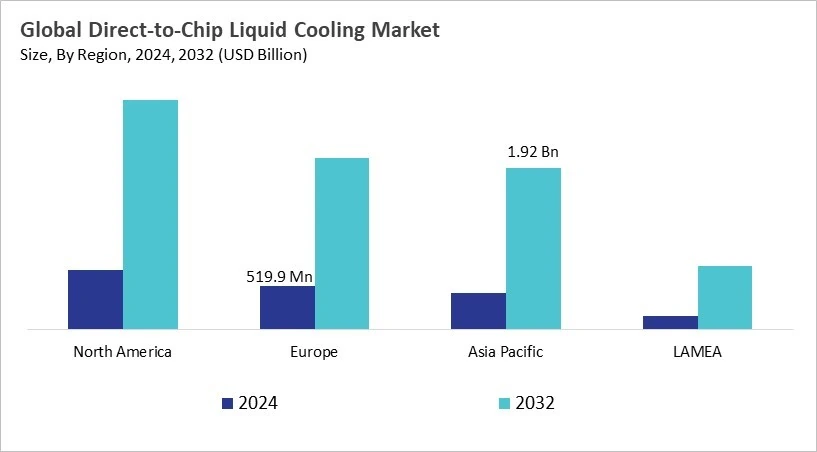
The North America region dominated the Global Direct-to-Chip Liquid Cooling Market by Region in 2024, and would continue to be a dominant market till 2032; thereby, achieving a market value of $2.74 billion by 2032. The Europe region is experiencing a CAGR of 18.9% during (2025 - 2032). Additionally, The Asia Pacific region would exhibit a CAGR of 20.4% during (2025 - 2032).
List of Key Companies Profiled
- Asetek Inc. A/S
- Vertiv Group Corp.
- Schneider Electric SE
- Advanced Micro Devices, Inc.
- Chilldyne, Inc.
- Fujitsu Limited
- CoolIT Systems Inc.
- Iceotope Technologies Limited
- JETCOOL Technologies Inc. (FLEX LTD.)
- LiquidStack Holding B.V. (Bitfury Group Limited)
Direct-to-chip Liquid Cooling Market Report Segmentation
By Component Cooling
- CPU cooling
- GPU cooling
- ASIC cooling
- Memory cooling
- Other Component Cooling
By Application
- Data centers
- High-performance computing (HPC)
- Supercomputers
- Workstations
- Edge computing devices
- Other Application
By Solution Type
- Single-phase liquid cooling
- Two-phase liquid cooling
By Liquid Coolant Type
- Water-based Coolants
- Dielectric Fluids
- Mineral Oils
- Engineered fluids
By End-Use Industry
- Telecommunications
- Financial services
- Healthcare & life sciences
- Aerospace & defense
- Oil & gas
- Other End-Use Industry
By Geography
- North America
- US
- Canada
- Mexico
- Rest of North America
- Europe
- Germany
- UK
- France
- Russia
- Spain
- Italy
- Rest of Europe
- Asia Pacific
- China
- Japan
- India
- South Korea
- Singapore
- Malaysia
- Rest of Asia Pacific
- LAMEA
- Brazil
- Argentina
- UAE
- Saudi Arabia
- South Africa
- Nigeria
- Rest of LAMEA
Related Reports: