According to a new report, published by KBV research, The Global Digital Rights Management Market size is expected to reach USD 12.97 billion by 2032, rising at a market growth of 10.2% CAGR during the forecast period.
Digital Rights Management (DRM) refers to a suite of technologies, policies, and systems designed to control access to and usage of digital content. At its core, DRM ensures that only authorized users can access, view, or interact with protected digital works — including media files, documents, and proprietary software — by enforcing licensing, usage limits, and access policies. DRM mechanisms typically rely on technical methods such as encryption, authentication, and license management to uphold intellectual property rights in digital ecosystems.
The Large Enterprises segment is leading the Global Digital Rights Management Market by Enterprise Size in 2024; thereby, achieving a market value of $7.60 billion by 2032. Large enterprises represent a major adoption base for digital rights management solutions due to the scale and complexity of their digital operations. These organizations manage vast volumes of proprietary data, digital content, and intellectual property across global networks, making robust content protection essential. Digital rights management enables large enterprises to enforce consistent access controls, manage licensing agreements, and safeguard sensitive information across departments and regions.
The Software segment would register highest revenue in the Global Digital Rights Management Market by Component in 2024, growing at a CAGR of 9.8 % during the forecast period. The software component forms the foundation of digital rights management solutions, enabling organizations to enforce content protection, access control, and usage policies across digital platforms. DRM software is widely deployed to encrypt digital assets, manage licenses, authenticate users, and monitor content consumption in real time. Global adoption is driven by the increasing volume of digital content across media, enterprise documentation, software distribution, and online education.
The Cloud segment led the Global Digital Rights Management Market by Deployment in 2024; thereby, achieving a market value of $7.56 billion by 2032. The cloud-based deployment of digital rights management solutions is increasingly adopted across global enterprises due to its scalability, flexibility, and ease of integration with modern digital ecosystems. Organizations leverage cloud-based DRM to securely manage, distribute, and monitor digital content across multiple platforms and geographies without the burden of extensive on-site infrastructure. This deployment model supports rapid updates, centralized policy management, and seamless compatibility with cloud-native applications such as streaming platforms, SaaS solutions, and digital publishing systems.
The Media & Entertainment segment is generating maximum revenue share in the Global Digital Rights Management Market by End-user Industry in 2024, growing at a CAGR of 9.3 % during the forecast period. The media & entertainment segment represents a core application area for digital rights management solutions, driven by the extensive creation, distribution, and monetization of digital content worldwide. Content owners, studios, broadcasters, and streaming platforms rely on DRM technologies to protect intellectual property from unauthorized access, piracy, and illegal redistribution. The increasing popularity of over-the-top platforms, digital music, online gaming, and e-publishing has reinforced the need for secure content delivery and license management.
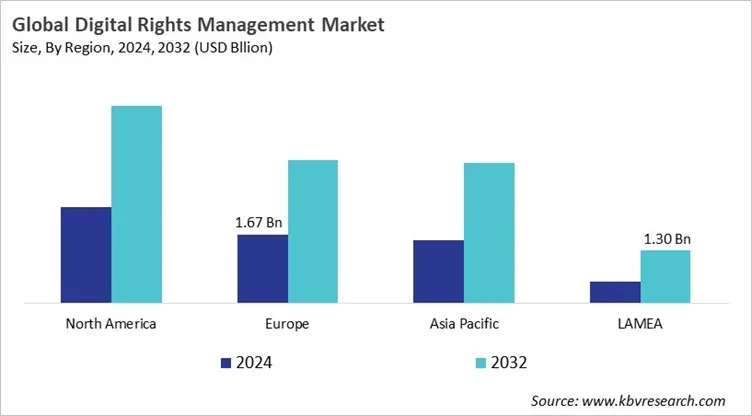
The North America region dominated the Global Digital Rights Management Market by Region in 2024, and would continue to be a dominant market till 2032; thereby, achieving a market value of $4.79 billion by 2032. The Europe region is experiencing a CAGR of 9.8% during (2025 - 2032). Additionally, The Asia Pacific region would exhibit a CAGR of 10.7% during (2025 - 2032).
By Enterprise Size
By Component
By Deployment
By End-user Industry
By Geography


 Unique Offerings

