According to a new report, published by KBV research, The Global Container Handling Equipment Market size is expected to reach $10.96 billion by 2032, rising at a market growth of 4.3% CAGR during the forecast period (2025-2032).
Container handling equipment forms the backbone of global maritime trade by enabling efficient movement, stacking, and transportation of shipping containers within ports, terminals, and intermodal facilities. These machines include ship-to-shore cranes, rubber-tired gantry cranes, rail-mounted gantry cranes, straddle carriers, reach stackers, and terminal tractors. Government port authorities and OEM manufacturers consistently emphasize that container handling equipment is essential for maintaining cargo flow efficiency and minimizing vessel turnaround times in modern ports.
The Manual segment is leading the Global Container Handling Equipment Market by Automation Level in 2024, growing at a CAGR of 3.8 % during the forecast period. The manual automation level segment in the container handling equipment market is characterized by a strong reliance on human operation for core handling, lifting, positioning, and movement activities. Equipment under this segment typically includes manually operated cranes, forklifts, reach stackers, and other handling solutions where operator skill and direct control play a central role in daily port and terminal operations.
The Seaport & River Terminals segment is generating maximum revenue share in the Global Container Handling Equipment Market by End-User in 2024; thereby, achieving a market value of $7,324.2 million by 2032. The seaport and river terminals end-user segment represent a major application area for container handling equipment, driven by the continuous movement of international and domestic cargo across maritime and inland waterways. These terminals require a wide range of heavy-duty equipment such as quay cranes, ship-to-shore cranes, rubber-tired gantry cranes, rail-mounted gantry cranes, straddle carriers, and automated handling systems to manage high container volumes efficiently.
The Diesel segment led the Global Container Handling Equipment Market by Propulsion Type in 2024, growing at a CAGR of 3.9 % during the forecast period. The diesel propulsion type segment in the container handling equipment market is defined by the extensive use of diesel-powered engines to deliver high torque, durability, and reliable performance in demanding operational environments.
The Forklift Truck segment is generating maximum revenue share in the Global Container Handling Equipment Market by Equipment Type in 2024, growing at a CAGR of 3.5 % during the forecast period. The forklift truck equipment type segment plays a vital role in container handling operations by supporting short-distance movement, stacking, and precise positioning of containers and palletized cargo. Forklift trucks are widely utilized across ports, inland depots, container freight stations, and warehouse environments due to their maneuverability, operational simplicity, and adaptability to confined spaces.
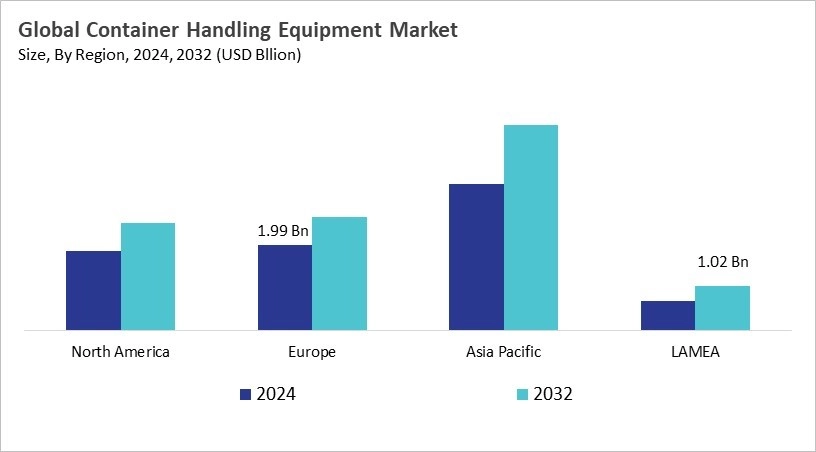
The Asia Pacific market dominated the Global Container Handling Equipment Market by Region in 2024, and would continue to be a dominant market till 2032; thereby, achieving a market value of $4.79 billion by 2032, growing at a CAGR of 4.5 % during the forecast period. The Europe market is expected to witness a CAGR of 3.8% during (2025 - 2032). Additionally, The North America market is expected to witness a CAGR of 4% during (2025 - 2032).
By Automation Level
By End User
By Propulsion Type
By Equipment Type
By Geography
 Unique Offerings

