According to a new report, published by KBV research, The Global Connected Car Market size is expected to reach USD 396.71 billion by 2032, rising at a market growth of 19.3% CAGR during the forecast period.
The connected car market refers to vehicles equipped with internet access and the ability to communicate with external systems such as other vehicles, infrastructure, and cloud platforms. A connected car integrates a mix of computing, communication, and sensor technologies, enabling real-time data exchange that enhances safety, convenience, navigation, and infotainment.
The Vehicle-to-Vehicle (V2V) segment is leading the Global Connected Car Market by Communication Technology in 2024, growing at a CAGR of 18.9% during the forecast period. The Vehicle-to-Vehicle (V2V) communication segment represents a foundational component of the global Connected Car Market, driven by the increasing emphasis on road safety, cooperative driving, and real-time situational awareness. V2V technology enables direct communication between vehicles to exchange critical information such as speed, location, braking status, and driving conditions. This capability supports applications including collision avoidance, blind-spot warnings, lane-change alerts, and cooperative adaptive cruise control.
The OEM segment is generating maximum revenue share in the Global Connected Car Market by Sales Channel in 2024, thereby, achieving a market value of $266.48 billion by 2032. The OEM segment represents a dominant sales channel within the global Connected Car Market, driven by the increasing integration of connected technologies directly at the vehicle manufacturing stage. Automotive manufacturers worldwide are embedding advanced connectivity features such as telematics, infotainment systems, over-the-air software updates, advanced driver assistance functionalities, and remote diagnostics as part of standard or optional vehicle packages.
The Integrated segment led the Global Connected Car Market by Connectivity Solution in 2024, growing at a CAGR of 18.8 % during the forecast period. The Integrated connectivity solution segment represents a major pillar of the global Connected Car Market, driven by the growing demand for seamless, fully unified digital vehicle platforms. Integrated solutions combine connectivity hardware, embedded software, and vehicle systems into a single architecture, enabling advanced capabilities such as real-time navigation, over-the-air updates, vehicle diagnostics, and personalized infotainment experiences.
The 4G/LTE segment is leading the Global Connected Car Market by Technology in 2024, and would continue to be a dominant market till 2032; thereby, achieving a market value of $179.64 billion by 2032. The 4G/LTE technology segment represents a core pillar of the global Connected Car Market, supported by its widespread availability, proven reliability, and cost-effective deployment. This technology enables a broad range of connected car functionalities, including telematics, real-time navigation, infotainment services, vehicle diagnostics, and remote monitoring.
The Vehicle Management segment would register the Global Connected Car Market by Application in 2024, growing at a CAGR of 18.3 % during the forecast period. The Vehicle Management segment represents a fundamental application area within the global Connected Car Market, driven by the growing need for real-time vehicle monitoring, performance optimization, and lifecycle management. Connected vehicle management solutions enable functionalities such as remote diagnostics, predictive maintenance, fuel efficiency tracking, and vehicle usage analytics.
Full Report: https://www.kbvresearch.com/connected-car-market/
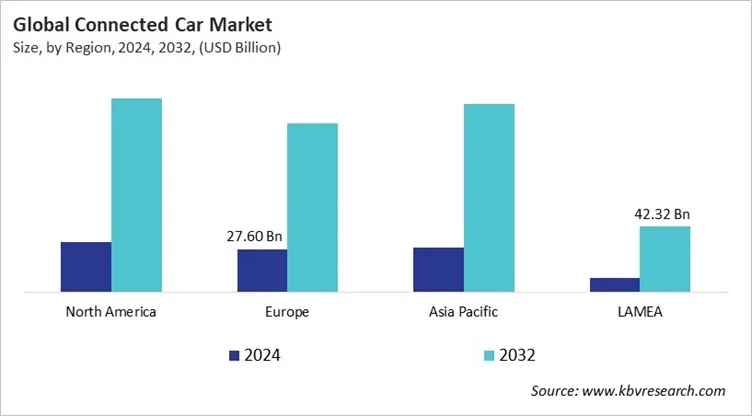
The North America region dominated the Global Connected Car Market by Region in 2024, and would continue to be a dominant market till 2032; thereby, achieving a market value of $124.80 billion by 2032. The Asia Pacific region is experiencing a CAGR of 19.9% during (2025 - 2032). Additionally, The Europe region would exhibit a CAGR of 18.9% during (2025 - 2032).
By Communication Technology
By Sales Channel
By Connectivity Solution
By Technology
By Application
By Geography
 Unique Offerings

