According to a new report, published by KBV research, The Global Computational Fluid Dynamics Market size is expected to reach USD 5.12 billion by 2032, rising at a market growth of 7.5% CAGR during the forecast period.
Computational Fluid Dynamics (CFD) has transformed from a niche engineering tool into a foundational element across industries seeking precision, efficiency, and innovation in fluid-related design challenges. At its core, CFD is the use of numerical algorithms and simulations to analyze and solve problems involving fluid flows—be it gases or liquids. With rising demands for cost-effective product development, efficiency in energy consumption, and increased focus on environmental impact, CFD has gained substantial momentum globally.
The Cloud segment is anticipating a CAGR of 8.1% during (2025 - 2032). The cloud segment, while smaller in comparison, is steadily gaining traction due to its scalability, flexibility, and cost-effectiveness. Cloud-based CFD solutions enable organizations to access powerful computing resources without investing in expensive hardware. They also support collaboration and remote access, which is valuable for globally distributed teams. As cloud security improves and more CFD software becomes cloud-optimized, this segment is expected to see accelerated adoption, especially among startups and small to medium enterprises.
The Software segment is leading the Global Computational Fluid Dynamics Market by Component in 2024; thereby, achieving a market value of $3,674.6 million by 2032. This is largely due to the essential function of simulation tools in analyzing fluid flow, heat transfer, and similar physical processes. Widely adopted across industries like aerospace, automotive, energy, and manufacturing, CFD software enables precise design and optimization of complex systems. It empowers engineers to conduct virtual testing and prototype refinement, significantly minimizing reliance on physical trials and speeding up development timelines.
The Automotive segment is registering a CAGR of 6.8% during (2025 - 2032). The automotive segment is another major contributor to the CFD market, with applications ranging from vehicle aerodynamics to thermal management and internal combustion processes. Automakers use CFD to improve fuel economy, reduce drag, optimize HVAC systems, and support electric vehicle battery cooling. As the industry shifts toward sustainability and electric mobility, the role of simulation in design efficiency and innovation becomes increasingly vital.
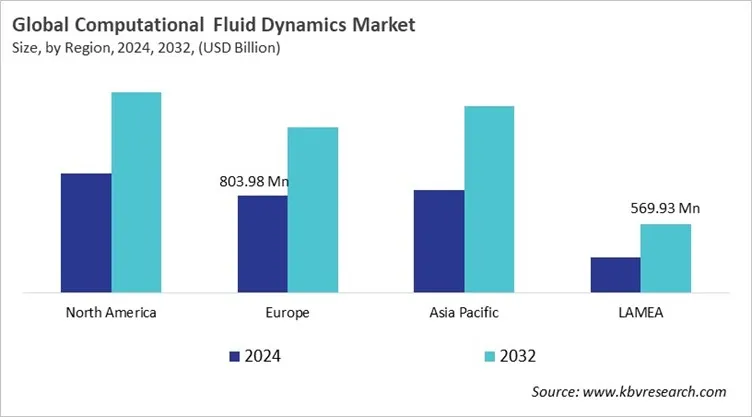
The North America region dominated the Global Computational Fluid Dynamics Market by Region in 2024, and would continue to be a dominant market till 2032; thereby, achieving a market value of $1.65 billion by 2032. The Asia Pacific region is experiencing a CAGR of 8% during (2025 - 2032). Additionally, The Europe region is expected to witness a CAGR of 7.1% during (2025 - 2032).
By Deployment Mode
By Component
By End User
By Geography




 Unique Offerings

