According to a new report, published by KBV research, The Global Beacons Management Software Market size is expected to reach $8.16 billion by 2032, rising at a market growth of 13.4% CAGR during the forecast period.
The beacons management software market has emerged as a critical component in the evolving landscape of location-based services, digital marketing, and smart environments. As organizations increasingly seek to harness the power of real-time location data, the need for robust, scalable, and user-friendly beacon management platforms has grown exponentially.
The Wi-Fi market is anticipating a CAGR of 14.2% during (2025 - 2032). Wi-Fi-based beacon management solutions are valued for their ability to leverage existing wireless network infrastructure, reducing the need for additional hardware investment. This technology is particularly useful in large indoor environments, such as airports, shopping malls, and hospitals, where Wi-Fi coverage is already extensive. Wi-Fi beacons enable broader area coverage and can support integration with other Wi-Fi-enabled systems, making them a practical choice for organizations seeking to expand their location-based services.
The Cloud-Based segment is leading the Global Beacons Management Software Market by Deployment Model in 2024; thereby, achieving a market value of $4,409.3 Million by 2032. This growth can be attributed to the increasing adoption of cloud technology across various industries, driven by its flexibility, scalability, and ease of access. Cloud-based solutions allow businesses to manage beacons remotely, update configurations in real-time, and seamlessly integrate with other digital systems. The preference for cloud deployment is further fuelled by lower upfront costs and reduced need for internal IT infrastructure, making it an attractive choice for organizations aiming for agility and efficiency.
The Analytics & Reporting segment is registering a CAGR of 13.7% during (2025 - 2032). Organizations are increasingly leveraging analytics and reporting tools to gain deeper insights into customer behavior, operational patterns, and the effectiveness of various initiatives. This software helps businesses measure key performance indicators, generate detailed reports, and make data-driven decisions to improve ROI. The demand for advanced analytics capabilities continues to rise as companies seek to enhance transparency, accountability, and strategic planning.
The API Integration segment is generating the maximum revenue in the Global Beacons Management Software Market by Integration Capability in 2024; thereby, achieving a market value of $3.5 billion by 2032. API integration is highly valued for its flexibility and ability to seamlessly connect beacon management platforms with a wide range of enterprise systems and applications. This capability enables organizations to automate workflows, enhance data exchange, and customize functionalities according to specific business needs. The strong demand for API-driven integration is driven by businesses seeking to build scalable and interoperable solutions that easily adapt to evolving technological ecosystems.
The Healthcare segment is showcasing a CAGR of 13.1% during (2025 - 2032). Healthcare providers utilize beacon management software to enhance patient care and improve operational efficiency within medical facilities. Technology enables precise tracking of patients, staff, and critical medical equipment, which helps in reducing waiting times, preventing equipment loss, and ensuring patient safety. Additionally, beacon solutions are used to monitor the movement of personnel in sensitive areas, manage workflows, and provide real-time location information for better resource allocation. Many healthcare organizations also deploy beacon management software to support contactless check-ins, patient flow management, and improved communication between healthcare teams.
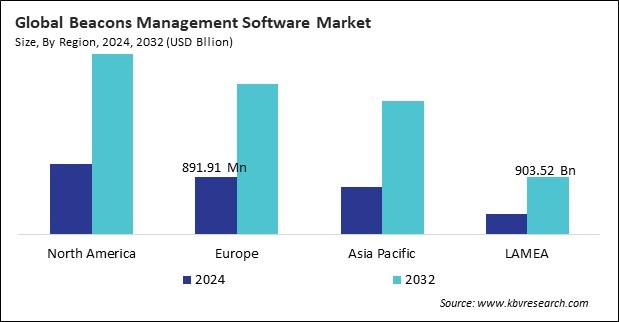
The North America region dominated the Global Beacons Management Software Market by Region in 2024, and would continue to be a dominant market till 2032; thereby, achieving a market value of $2.8 billion by 2032. The Europe region is experiencing a CAGR of 13.2% during (2025 - 2032). Additionally, The Asia Pacific region would exhibit a CAGR of 14.1% during (2025 - 2032).
By Deployment Model
By Technology
By Software
By End-User
By Integration Capability
By Geography


 Unique Offerings

