According to a new report, published by KBV research, The Global Automotive Powertrain Sensors Market size is expected to reach $38.75 billion by 2032, rising at a market growth of 7.9% CAGR during the forecast period.
The evolution of automotive powertrain sensors is closely tied to the transformation of the automobile itself. Early vehicles relied on purely mechanical control systems with limited monitoring. As electronic control units were introduced, sensors became essential in measuring variables like air intake, pressure, and rotational speeds to ensure reliable engine and transmission performance. This shift allowed for more precise fuel injection, improved ignition timing, and optimized efficiency, which in turn reshaped the expectations of vehicle safety, performance, and environmental responsibility.
The Internal Combustion Engine (ICE) Vehicles segment is experiencing a CAGR of 7.4 % during the forecast period. These vehicles rely on sensors to manage important functions such as combustion efficiency, fuel injection, exhaust emissions, and engine performance. By ensuring smooth operation, better fuel economy, and adherence to emission standards, powertrain sensors in ICE vehicles play a central role in enhancing both reliability and safety. This makes them essential to the ongoing demand for conventional vehicles, supported by their widespread availability and established fuel infrastructure.
The Passenger Cars segment led the maximum revenue in the Global Automotive Powertrain Sensors Market by Vehicle Type in 2024, thereby, achieving a market value of $22.8 billion by 2032. This is driven by the large-scale production and widespread adoption of cars across global markets. Powertrain sensors in this segment are used extensively to improve fuel efficiency, reduce emissions, enhance driving comfort, and ensure compliance with safety regulations. With growing consumer demand for advanced features and better performance, the use of sophisticated sensor technologies in passenger cars has become a key factor supporting this segment’s dominance.
The Pressure Sensors segment is growing at a CAGR of 7 % during the forecast period. As these sensors are widely used to monitor and regulate critical functions such as fuel pressure, oil pressure, and air intake. By providing accurate and real-time data, pressure sensors ensure optimal engine performance, improved fuel efficiency, and compliance with emission standards. Their importance lies in enhancing both the reliability and safety of modern vehicles, making them a key component across different propulsion systems.
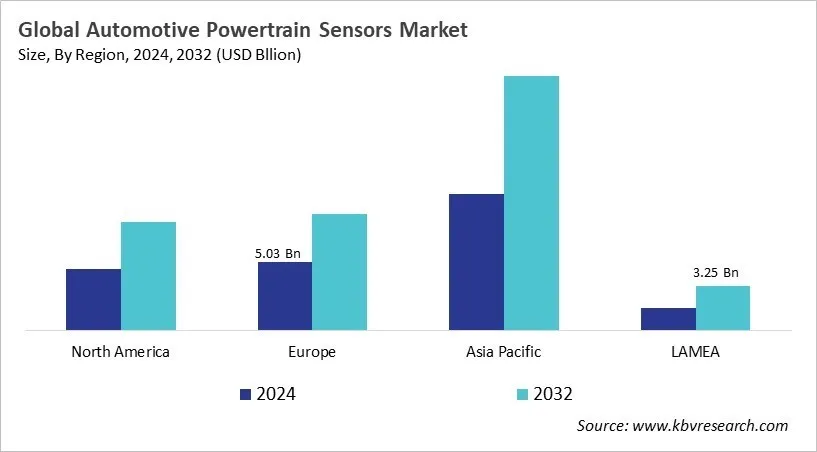
The Asia Pacific region dominated the Global Automotive Powertrain Sensors Market by Region in 2024, and would continue to be a dominant market till 2032; thereby, achieving a market value of $18.9 billion by 2032. The Europe region is anticipated to grow at a CAGR of 7.1% during (2025 - 2032). Additionally, The North America region would witness a CAGR of 7.7% during (2025 - 2032).
By Propulsion Type
By Vehicle Type
By Sensor Type
By Geography




 Unique Offerings

