According to a new report, published by KBV research, The Global AI In Drug Repurposing Market size is expected to reach $4.11 billion by 2032, rising at a market growth of 19.7% CAGR during the forecast period.
Over the past decade, the pharmaceutical landscape has seen a paradigm shift: rather than creating entirely new molecules, drug developers increasingly seek to find new indications for existing molecules. This repurposing concept is not new, but it has gained momentum with the integration of artificial intelligence (AI) and machine learning. In earlier eras, drug repurposing was largely serendipitous—clinicians would observe off-label effects, literature reviews might hint at secondary benefits, or retrospective analyses would uncover unexpected therapeutic relationships.
The Software & Platform segment captured the maximum revenue in the Global AI In Drug Repurposing Market by Component in 2024, thereby, achieving a market value of $2.6 billion by 2032. The software and platform segment forms the technological core of AI in drug repurposing, enabling rapid analysis of complex biomedical and clinical data. These systems apply advanced algorithms, including machine learning and deep learning, to identify potential new uses for existing drugs. They integrate multiple data sources such as genomics, proteomics, and electronic health records, helping researchers uncover meaningful drug–disease associations.
The Machine Learning/Deep Learning segment is experiencing a CAGR of 18.5 % during the forecast period. The machine learning and deep learning segment serves as the foundation of AI in drug repurposing, driving most predictive and analytical capabilities within the field. These algorithms analyze vast datasets—from molecular structures and biological pathways to clinical outcomes—to identify new therapeutic uses for known compounds. Deep neural networks enable high-level pattern recognition, helping uncover hidden relationships between drugs and diseases that traditional methods often miss.
The Pharmaceutical & BioTechnology Companies segment led the maximum revenue in the Global AI In Drug Repurposing Market by End Use in 2024, thereby, achieving a market value of $2.3 billion by 2032. Pharmaceutical and biotechnology companies form the primary end users of AI in drug repurposing, leveraging advanced algorithms to streamline discovery and reduce development timelines. These organizations utilize AI-driven analytics to identify new therapeutic applications for existing compounds, optimizing investment in research and minimizing clinical risk. By integrating AI tools into their R&D pipelines, companies can analyze vast biological and chemical datasets to uncover hidden correlations, predict efficacy, and improve candidate selection.
The Oncology segment is growing at a CAGR of 18.1 % during the forecast period. AI platforms are being utilized to analyze massive genomic and clinical datasets, allowing researchers to identify potential new applications for existing anticancer compounds. The integration of AI with precision medicine frameworks enables more efficient tumor profiling, drug efficacy prediction, and biomarker discovery. Major pharmaceutical companies and research institutions are leveraging machine learning and generative AI to accelerate oncology drug development, resulting in reduced timelines and cost efficiency.
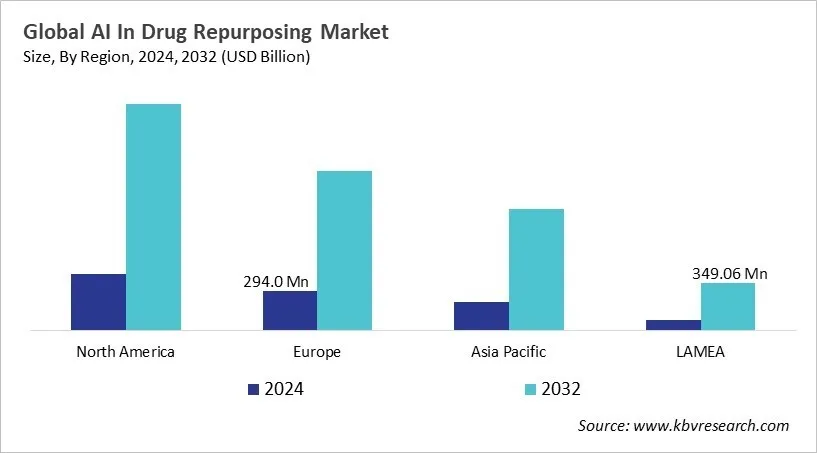
The North America region dominated the Global AI In Drug Repurposing Market by Region in 2024, and would continue to be a dominant market till 2032; thereby, achieving a market value of $1.7 billion by 2032. The Europe market is anticipated to grow at a CAGR of 19.3% during (2025 - 2032). Additionally, The Asia Pacific market would witness a CAGR of 20.5% during (2025 - 2032).
By Component
By Technology
By End Use
By Application
By Geography

 Unique Offerings

