According to a new report, published by KBV research, The Global AI And Machine Learning Operationalization Software Market size is expected to reach $17.96 billion by 2032, rising at a market growth of 35.3% CAGR during the forecast period.
AI and machine learning operationalization software refers to platforms and tools that enable organizations to deploy, manage, monitor, and govern machine learning models in real-world production environments. Often described as MLOps platforms, these solutions bridge the gap between experimental AI development and enterprise-scale deployment by supporting model lifecycle management, automation, monitoring, and compliance.
The On-premises segment is poised to grow at a CAGR of 34.7 % during the forecast period. Organizations across highly regulated and security-sensitive industries such as banking, healthcare, government, defense, and manufacturing continue to prioritize on-premises infrastructure to maintain strict control over data, models, and internal systems. This deployment approach enables enterprises to align AI initiatives with internal governance frameworks, data sovereignty requirements, and customized security protocols.
The Large Enterprises segment captured the maximum revenue in the Global AI And Machine Learning Operationalization Software Market by Enterprise Size in 2024, thereby, achieving a market value of $11.3 billion by 2032. Large organizations are at the forefront of adopting structured MLOps frameworks to manage complex AI ecosystems across multiple departments and geographies. Enterprises in sectors such as banking, healthcare, retail, manufacturing, telecommunications, and technology deploy AI models on a scale for mission-critical applications including fraud detection, predictive maintenance, demand forecasting, and customer analytics.
The Model Deployment & Management is experiencing a CAGR of 34.4 % during the forecast period. Model deployment and management represent a core functionality within the global AI and Machine Learning software market, as organizations increasingly transition AI models from experimental environments into large-scale production systems. Enterprises across industries such as BFSI, healthcare, retail, manufacturing, and telecommunications require structured deployment pipelines to ensure scalability, version control, rollback capabilities, and governance.
The Banking, financial services, and insurance (BFSI) segment led the maximum revenue in the Global AI And Machine Learning Operationalization Software Market by End Use in 2024, thereby, achieving a market value of $4.7 billion by 2032. The BFSI sector represents a major global adopter of AI and Machine Learning operationalization software, driven by the increasing complexity of financial ecosystems and the rapid expansion of digital banking services. Financial institutions are deploying machine learning models for fraud detection, credit risk analysis, algorithmic trading, customer segmentation, and regulatory compliance.
The Predictive Analytics segment is growing at a CAGR of 34.2% during the forecast period. Predictive analytics represents a major application area within the global AI and Machine Learning operationalization software market, as organizations increasingly rely on forward-looking insights to guide strategic and operational decisions. Enterprises across industries such as banking, retail, healthcare, manufacturing, telecommunications, and energy are deploying predictive models for demand forecasting, risk assessment, customer behavior analysis, and operational optimization.
Full Report: https://www.kbvresearch.com/ai-and-machine-learning-operationalization-software-market/
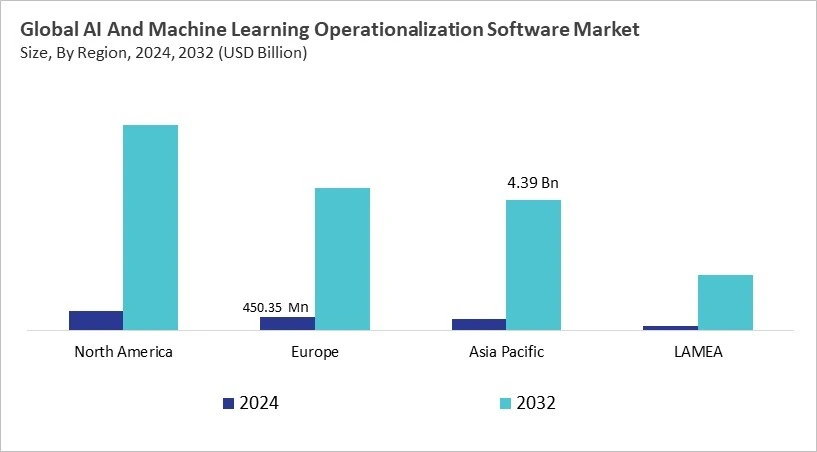
The North America region dominated the Global AI And Machine Learning Operationalization Software Market by Region in 2024, and would continue to be a dominant market till 2032; thereby, achieving a market value of $6.9 billion by 2032. The Europe region is anticipated to grow at a CAGR of 34.8% during (2025 - 2032). Additionally, The Asia Pacific region would witness a CAGR of 36.1% during (2025 - 2032).
By Deployment
By Enterprise Size
By Functionality
By End Use
By Application
By Geography



 Unique Offerings

