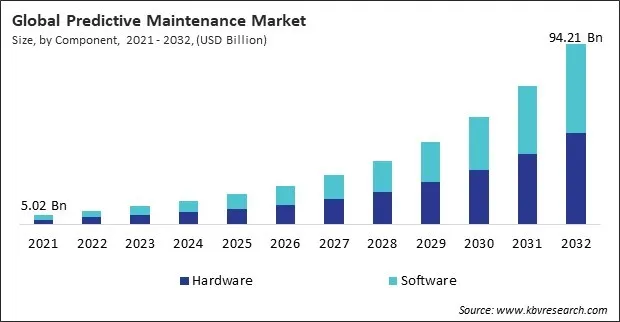
“Global Predictive Maintenance Market to reach a market value of USD 94.21 Billion by 2032 growing at a CAGR of 29%”
The Global Predictive Maintenance Market size is expected to reach $94.21 billion by 2032, rising at a market growth of 29.0% CAGR during the forecast period
The growing need for real-time asset monitoring, predictive analytics, and condition-based maintenance has fuelled the adoption of standalone predictive maintenance solutions across manufacturing, logistics, and energy industries. Many organizations, particularly small and medium-sized enterprises (SMEs), prefer standalone predictive maintenance software due to its flexibility, ease of deployment, and cost-effectiveness. These solutions are designed to operate independently without requiring extensive integration with existing enterprise systems, making them ideal for companies looking for specialized maintenance analytics and monitoring tools.
Organizations across industries, including manufacturing, energy, and transportation, face increasing pressure to optimize operational costs. Traditional reactive and preventive maintenance approaches often lead to excessive spending, inefficient resource utilization, and unexpected equipment failures. Predictive maintenance offers a cost-effective alternative by allowing companies to transition from a time-based to a condition-based maintenance strategy, reducing unnecessary service interventions and cutting down on maintenance expenses. Hence, rising demand for cost-effective maintenance solutions is driving the growth of the market.
Additionally, unplanned equipment failures can lead to severe production losses, missed deadlines, and financial repercussions. Many industries are shifting their focus toward predictive maintenance to minimize unplanned downtime and improve business continuity. By analyzing data from industrial equipment, predictive maintenance systems detect early signs of wear and tear, allowing maintenance teams to address issues before they escalate into major failures. In conclusion, growing emphasis on reducing downtime and enhancing equipment lifespan is propelling the growth of the market.
However, implementing predictive maintenance requires substantial initial investment, which can be a deterrent for many companies. Businesses must invest in IoT sensors, data storage infrastructure, advanced analytics software, and skilled personnel to effectively deploy and manage predictive maintenance solutions. These costs can be prohibitive, especially for small and medium-sized enterprises (SMEs) with limited budgets. In conclusion, high initial implementation costs and complexity hinder the market's growth.
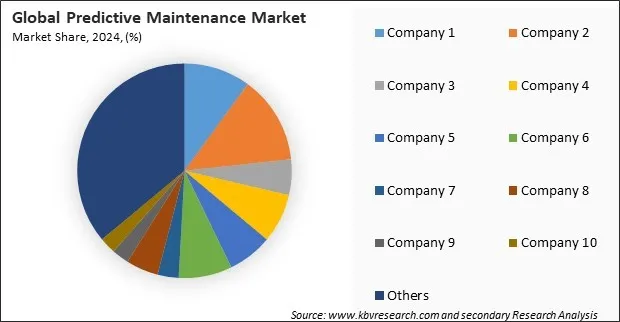
The leading players in the market are competing with diverse innovative offerings to remain competitive in the market. The above illustration shows the percentage of revenue shared by some of the leading companies in the market. The leading players of the market are adopting various strategies in order to cater demand coming from the different industries. The key developmental strategies in the market are Partnerships, Collaborations & Agreements.

Based on component, the market is characterized into hardware and software. The increasing adoption of AI-driven analytics, machine learning algorithms, and cloud-based solutions has significantly contributed to the growth of this segment. Predictive maintenance software enables organizations to monitor equipment health in real time, analyze historical data, and predict potential failures before they occur, reducing downtime and maintenance costs.
The software segment is further subdivided into integrated and standalone. Organizations across various industries increasingly adopt integrated predictive maintenance solutions that seamlessly connect with existing enterprise systems, such as Enterprise Resource Planning (ERP) and Computerized Maintenance Management Systems (CMMS).
On the basis of enterprise size, the market is divided into large enterprises and small & medium-sized enterprises (SMEs). SMEs are increasingly adopting predictive maintenance technologies, albeit at a slower pace compared to large enterprises. The growing availability of cost-effective, scalable solutions has made PDM more accessible to smaller businesses, allowing them to reap the benefits of reduced downtime and maintenance costs.
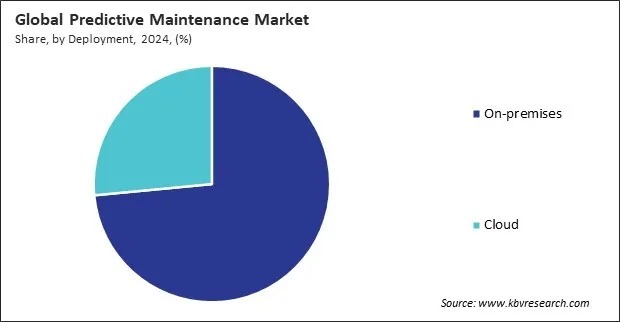
On the basis of deployment, the market is classified into on-premise and cloud. Many industries, especially those dealing with sensitive data such as manufacturing, energy, and defense, prefer on-premise deployment due to enhanced data security, greater control over IT infrastructure, and reduced dependence on external networks. On-premise predictive maintenance solutions enable organizations to process and analyze large volumes of equipment data locally, minimizing latency and ensuring real-time monitoring.
By application, the market is divided into condition monitoring, predictive analytics, remote monitoring, asset tracking, and maintenance scheduling. The rising need for efficient asset management, particularly in logistics, transportation, and healthcare, has driven the demand for asset-tracking solutions.
On the basis of technology, the market is categorized into IoT, artificial intelligence & machine learning, digital twin, advanced analytics, and others. Digital twin technology enables the creation of virtual replicas of physical assets, allowing businesses to simulate real-world scenarios and predict potential failures accurately. Digital twins enhance asset monitoring, maintenance planning, and performance optimization by integrating real-time data from IoT sensors and AI-driven analytics.
Based on end-use, the market is segmented into military & defense, energy & utilities, manufacturing, IT & telecom, logistics & transportation, and others. Fleet operators, airlines, and railway networks increasingly leverage predictive maintenance to enhance vehicle and equipment uptime, optimize fuel efficiency, and ensure safety. AI-driven predictive maintenance solutions help monitor engine health, detect wear and tear, and plan proactive maintenance schedules.
Free Valuable Insights: Global Predictive Maintenance Market size to reach USD 94.21 Billion by 2032
Region-wise, the market is analyzed across North America, Europe, Asia Pacific, and LAMEA. The region is experiencing rapid digital transformation, with industries increasingly investing in Industry 4.0, AI, and IoT-based solutions for predictive maintenance. European governments and enterprises are enhancing operational efficiency and reducing manufacturing, energy & utilities, and transportation downtime.
| Report Attribute | Details |
|---|---|
| Market size value in 2024 | USD 12.47 Billion |
| Market size forecast in 2032 | USD 94.21 Billion |
| Base Year | 2024 |
| Historical Period | 2021 to 2023 |
| Forecast Period | 2025 to 2032 |
| Revenue Growth Rate | CAGR of 29.0% from 2025 to 2032 |
| Number of Pages | 467 |
| Number of Tables | 740 |
| Report coverage | Market Trends, Revenue Estimation and Forecast, Segmentation Analysis, Regional and Country Breakdown, Market Share Analysis, Porter’s 5 Forces Analysis, Company Profiling, Companies Strategic Developments, SWOT Analysis, Winning Imperatives |
| Segments covered | Component, Deployment, Enterprise Size, Technology, End-use, Application, Region |
| Country scope |
|
| Companies Included | IBM Corporation, Microsoft Corporation, Honeywell International, Inc., Siemens AG, GE Vernova Group, SAP SE, PTC Inc., Schneider Electric SE, ABB Ltd. and Rockwell Automation, Inc. |
By Component
By Deployment
By Enterprise Size
By Technology
By End-use
By Application
By Geography
This Market size is expected to reach $94.21 billion by 2032.
Rising Demand for Cost-Effective Maintenance Solutions are driving the Market in coming years, however, High Initial Implementation Costs and Complexity restraints the growth of the Market.
IBM Corporation, Microsoft Corporation, Honeywell International, Inc., Siemens AG, GE Vernova Group, SAP SE, PTC Inc., Schneider Electric SE, ABB Ltd. and Rockwell Automation, Inc.
The expected CAGR of this Market is 29.0% from 2023 to 2032.
The Large Enterprises segment is generating the maximum revenue in the Market by Enterprise Size in 2024; thereby, achieving a market value of $64.75 billion by 2032.
The North America region dominated the Market by Region in 2024, and would continue to be a dominant market till 2032; thereby, achieving a market value of $31.5 billion by 2032.
Our team of dedicated experts can provide you with attractive expansion opportunities for your business.












 Unique Offerings