“Global Power System Analysis Software Market to reach a market value of USD 24.12 Billion by 2032 growing at a CAGR of 12%”
The Global Power System Analysis Software Market size is expected to reach $24.12 billion by 2032, rising at a market growth of 12.0% CAGR during the forecast period.
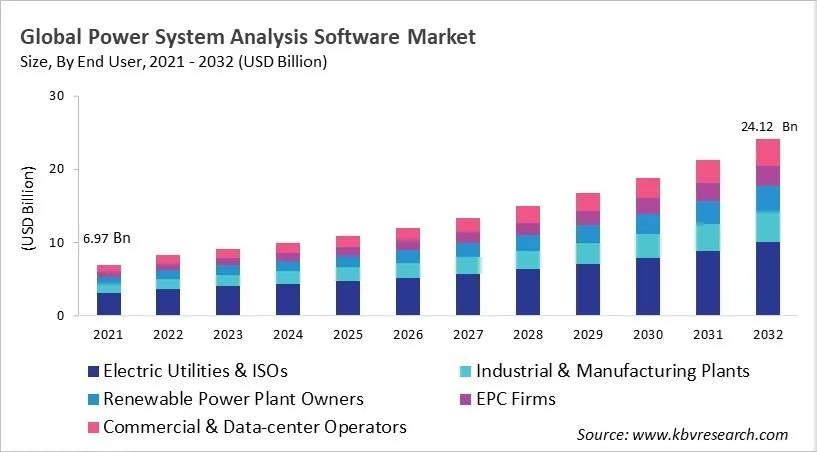
The global power system analysis software market has developed from simple load-flow and fault analysis tools to highly advanced, AI-driven digital twin and cloud-native platforms that simulate, model, and optimise entire power grids. The evolution has been shaped by the rising complexity of modern electricity networks, supported by distributed energy resources (DERs), smart grids, renewable energy integration, and regulatory mandates for grid resilience and reliability. The power system analysis software market’s growth reflects the broader transition of the global power industry towards flexible, decentralised, and decarbonised systems. Developed regions such as North America and Europe have surged in adoption due to grid modernization and ageing infrastructure, while Asia Pacific and emerging economies are expanding rapidly as energy demand and digitalisation accelerate.
The power system analysis software market is witnessing growth opportunities supported by trends such as the integration of DERs, platform-based ecosystems, and AI-enabled analytics that allow utilities to transition from static engineering studies to data-driven, real-time decision-making. Market players are differentiating through scalable, open, and modular architectures, offering subscription-based and hybrid cloud models to reach a larger consumer base. Strategic initiatives emphasize improving resilience, allowing automation grid management, and supporting flexible grid operations through automation and analytics. The power system analysis software market seems to be intensively competitive, shaped by industrial giants like ABB, Schneider Electric, Siemens, alongside innovative niche software firms focusing on renewable integration, advanced analytics, and micro-grids. Large OEMs leverage global networks and domain expertise; smaller players bring innovation and agility. The power system analysis software market is defined by rapid technological convergence, continuous innovation, and strong competition-positioning power system analysis software as a crucial enabler of global energy transition.
The major strategies followed by the market participants are Product Launches as the key developmental strategy to keep pace with the changing demands of end users. For instance, In May, 2025, ABB Ltd. unveiled a scalable BESSaaS solution to accelerate renewable energy adoption and grid stability. By combining data-driven control and predictive algorithms, the system aids in energy optimization and grid resilience—key factors supporting power system analysis and dynamic power flow simulations across utility and industrial sectors. Moreover, In September, 2025, Eaton Corporation plc unveiled a firmware update for its Power Xpert (PXQ) system to identify sub synchronous oscillations and sudden load spikes (“AI power bursts”) in data-centres and the grid. This edge-based analytics capability enables real-time power-quality and grid-stability analysis — a core function of power-system analysis software.
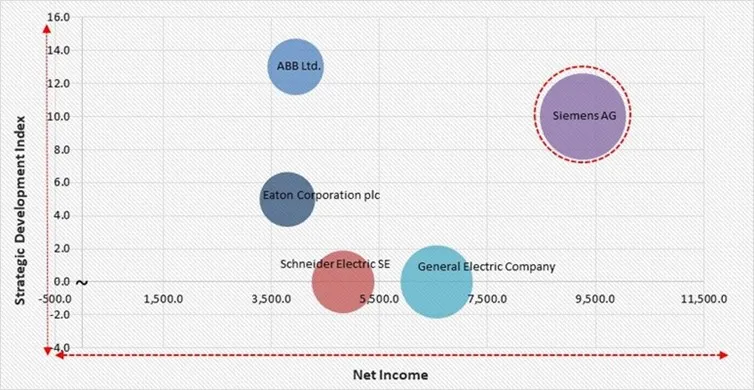
Based on the Analysis presented in the KBV Cardinal matrix; Siemens AG is the forerunner in the Power System Analysis Software Market. In June, 2025, Siemens AG unveiled Systems Modeler for SysML v2, a web-based model-based systems engineering tool integrating with Siemens’ Teamcenter PLM, enabling multidisciplinary collaboration (mechanical, electrical, software) via the SysML open standard. Companies such as General Electric Company, Schneider Electric SE, and ABB Ltd. are some of the key innovators in Power System Analysis Software Market.
The COVID-19 pandemic impacted the global power system analysis software market because lockdowns, supply chain problems, and limits on industrial operations slowed down infrastructure projects and made people less likely to buy software. Utilities and energy companies put more value on basic services than on adopting new technologies. Project delays and financial uncertainty also made it harder for the market to grow. Small and medium-sized businesses were having trouble with money, and research and development slowed down because there wasn't enough collaboration and funding. The crisis later made it clear how important it was to digitalize and make the grid more resilient, but at first, it caused projects to be put on hold, spending to go down, and demand for software to go down in all regions. Thus, the COVID-19 pandemic had a negative impact on the market.

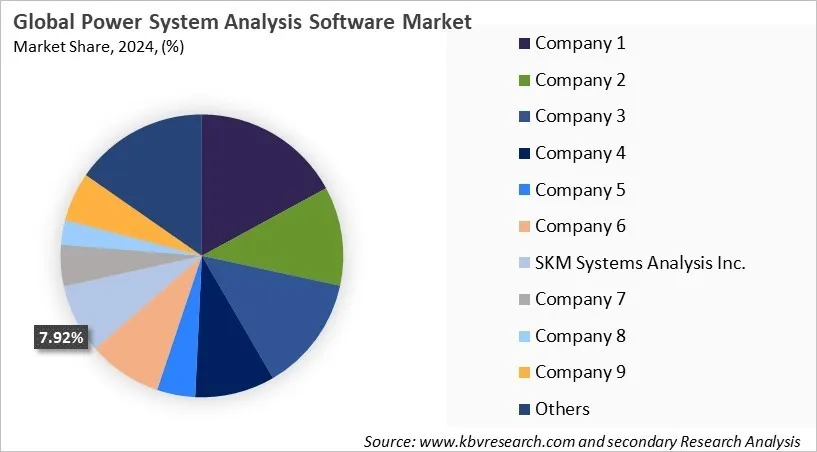
The leading players in the market are competing with diverse innovative offerings to remain competitive in the market. The above illustration shows the percentage of revenue shared by some of the leading companies in the market. The leading players of the market are adopting various strategies in order to cater demand coming from the different industries. The key developmental strategies in the market are Acquisitions, and Partnerships & Collaborations.
Free Valuable Insights: Power System Analysis Software Market size to reach USD 24.12 Billion by 2032
Based on End User, the market is segmented into Electric Utilities & ISOs, Industrial & Manufacturing Plants, Renewable Power Plant Owners, EPC Firms and Commercial & Data-center Operators. The industrial & manufacturing plants segment attained 17% revenue share in the Power System Analysis Software Market in 2024. Industrial and manufacturing facilities across the globe depend heavily on power system analysis software to ensure energy efficiency, maintain operational continuity, and safeguard equipment. These plants often run extensive electrical networks that require protection coordination, load balancing, and fault analysis to prevent downtime. Software solutions help in identifying power-quality issues such as harmonics or voltage dips that can impact sensitive machinery.
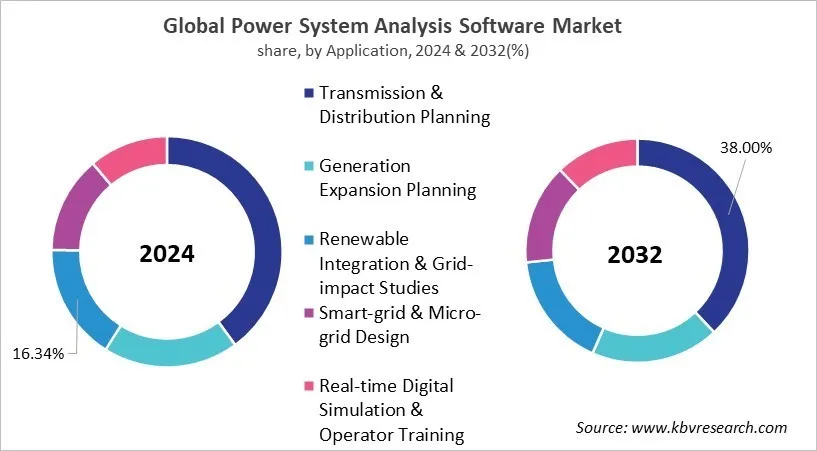
Based on Application, the market is segmented into Transmission & Distribution Planning, Generation Expansion Planning, Renewable Integration & Grid-impact Studies, Smart-grid & Micro-grid Design and Real-time Digital Simulation & Operator Training. The generation expansion planning segment recorded 20% revenue share in the Power System Analysis Software Market in 2024. Generation expansion planning software helps utilities and governments ensure that sufficient and sustainable power generation capacity is available to meet growing demand. Globally, these tools are used to simulate long-term resource adequacy, optimize generation portfolios, and assess the economic feasibility of new power plants.
Based on Module & Tool Type, the market is segmented into Load-flow & Power-flow Analysis, Short-circuit Analysis, Arc-flash & Protection Coordination, Harmonics & Flicker Analysis and Other Module & Tool Type. The short-circuit analysis segment garnered 20% revenue share in the Power System Analysis Software Market in 2024. Short-circuit analysis modules focus on fault-condition modelling: when a fault occurs (e.g., three-phase, line-to-ground, phase-to-phase) what are the fault currents, how does the system respond, what equipment ratings are required, and where must protection devices be placed? These tools are critical for selecting switchgear, ensuring protective devices can interrupt fault currents safely, planning ground-fault current paths, determining equipment stress under fault condition, and validating that the system is designed to clear faults reliably.
Based on Deployment Type, the market is segmented into On-premise and Cloud-based. The cloud-based segment attained 36% revenue share in the Power System Analysis Software Market in 2024. Conversely, the cloud-based deployment model is growing increasingly significant across global markets for power system analysis software. Cloud-based solutions offer scalability, remote access, rapid deployment, centralized updates and collaborative workflows—enabling utilities, EPC firms, data-centre operators and renewable-plant owners to leverage large-scale computing, multi-site analysis and real-time scenario modelling. As grids become more complex—incorporating distributed energy resources, hybrid generation, smart-grid controls and digital-twin systems—the flexibility and cost-efficiency of cloud platforms become attractive.
Region-wise, the Power System Analysis Software Market is analyzed across North America, Europe, Asia Pacific, and LAMEA. The Europe segment witnessed 35% revenue share in the Power System Analysis Software Market in 2024. The power system analysis software market is expected to experience significant expansion in North America and Europe. The market is driven by ageing grid infrastructure, strict regulatory frameworks, early digitalization initiatives focused in resilience, reliability and cybersecurity. Utilities in Canada, the US, and Western Europe are largely investing in grid modernisation programmes that integrate AI-driven analytics, digital twins, and renewable integration modelling. In North America, the rising penetration of electric vehicles and distributed energy resources (DERs) has raised the demand for advanced forecasting, simulation, and optimisation tools. Moreover, Europe region is developing significantly with its decarbonisation and energy transition goals, backed by the EU’s “Fit for 55” and smart grid initiatives. North America and Europe are experiencing surged adoption of cloud-based, hybrid, and subscription models, allowing utilities to improve operational flexibility and reduce costs along with ensuring compliance with changing energy and data governance standards.
In the Asia Pacific and LAMEA region, the power system analysis software market is predicted to experience prominent expansion. The market is driven by rapid urbanisation, electrification, and the growth of renewable energy capacity. Nations such as India, Japan, South Korea, and China are largely investing in AI-enabled analytics, smart grid technologies, and power system modernization to fulfil increasing electricity demand and renewable integration. Government programmers encouraging grid digitalisation, coupled with public-private collaborations, are surging adoption across emerging economies. Furthermore, the LAMEA power system analysis software market is expanding, supported by renewable energy development, grid expansion and multilateral funding for infrastructure reliability and resilience. Providers are largely tailoring cost-efficient, modular, and cloud-based solutions to these regions, thereby offering growth opportunities in the market.
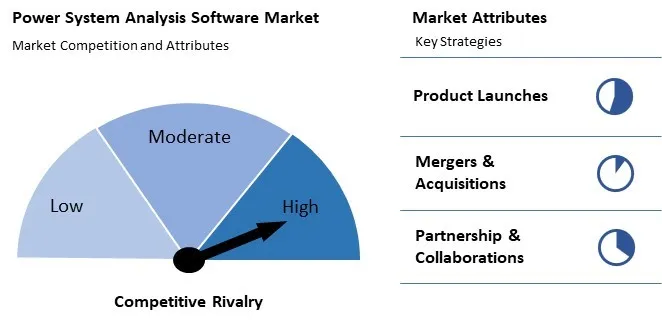
The Power System Analysis Software Market is very competitive because of constant innovation, advanced simulation capabilities, and the ability to work with renewable energy systems. Vendors compete with each other by offering software that is reliable, can analyze data in real time, and is easy to set up. Rivalry gets even stronger with strategic partnerships, new technologies, and a focus on modernizing the grid. Companies want to improve interoperability, cybersecurity, and automation, which makes it hard to tell them apart. The competitive nature of the market encourages quick changes and regular updates to meet the needs of different power networks.
| Report Attribute | Details |
|---|---|
| Market size value in 2025 | USD 10.92 Billion |
| Market size forecast in 2032 | USD 24.12 Billion |
| Base Year | 2024 |
| Historical Period | 2021 to 2023 |
| Forecast Period | 2025 to 2032 |
| Revenue Growth Rate | CAGR of 12.0% from 2025 to 2032 |
| Number of Pages | 622 |
| Number of Tables | 494 |
| Report coverage | Market Trends, Revenue Estimation and Forecast, Segmentation Analysis, Regional and Country Breakdown, Competitive Landscape, Market Share Analysis, Porter’s 5 Forces Analysis, Company Profiling, Companies Strategic Developments, SWOT Analysis, Winning Imperatives |
| Segments covered | End User, Application, Module & Tool Type, Deployment Type, Region |
| Country scope |
|
| Companies Included | Siemens AG, General Electric Company, ABB Ltd., Schneider Electric SE, Eaton Corporation plc, DIgSILENT GmbH, SKM Systems Analysis Inc., PowerWorld Corporation, GSE Performance Solutions, LLC (GSE Solutions), and PSI Neplan AG (PSI Software SE) |
By End User
By Application
By Module & Tool Type
By Deployment Type
By Geography
This Market size is expected to reach USD 24.12 billion by 2032.
The power system analysis software market is projected to grow at a CAGR of 12% between 2025 and 2032.
Rising complexity and scale of power grids, along with the growing integration of renewable energy sources and distributed energy resources, is intensifying modern grid management needs.
Siemens AG, General Electric Company, ABB Ltd., Schneider Electric SE, Eaton Corporation plc, DIgSILENT GmbH, SKM Systems Analysis Inc., PowerWorld Corporation, GSE Performance Solutions, LLC (GSE Solutions), and PSI Neplan AG (PSI Software SE)
The Load-flow & Power-flow Analysis segment led the maximum revenue in the Global Power System Analysis Software Market by Module & Tool Type in 2024, thereby, achieving a market value of $5.7 billion by 2032.
The Europe region dominated the Global Power System Analysis Software Market by Region in 2024, and would continue to be a dominant market till 2032; thereby, achieving a market value of $8.1 billion by 2032.
Our team of dedicated experts can provide you with attractive expansion opportunities for your business.












 Unique Offerings