“Global Post-Quantum Cryptography Market to reach a market value of USD 13.94 Billion by 2032 growing at a CAGR of 39.6%”
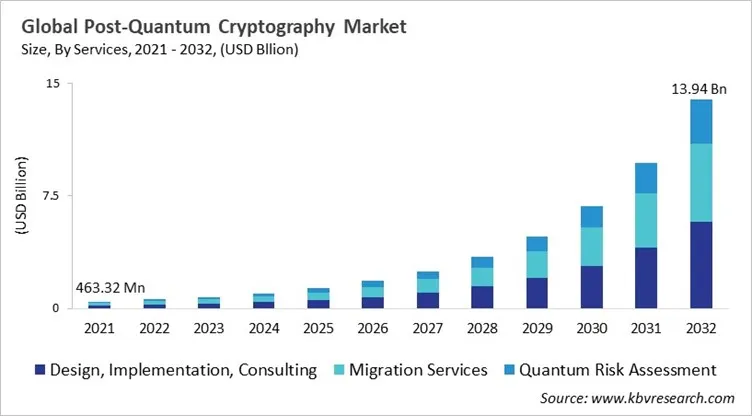
The Global Post-Quantum Cryptography Market size is expected to reach USD 13.94 billion by 2032, rising at a market growth of 39.6% CAGR during the forecast period.
Post-quantum cryptography has largely evolved from academic research into a global security priority as industries and governments prepare for quantum-driven cyber threats. Traditional encryption systems such as ECC and RSA are vulnerable to quantum attacks, enabling enterprises like the NSA, NIST, and ENISA to issue migration guidelines and accelerate the adoption of quantum-resistant algorithms. OEMs and major technology providers, including Google, Intel, IBM, Cisco, Microsoft, and AWS, are integrating PQC into communication protocols, routers, cloud services, hardware, and IoT devices. This transformation is s driven by increasing concerns over “harvest now, decrypt-later” threats, driving industries like defense, healthcare, telecom, and banking to proactively adopt cyrpto-agile infrastructure and hybrid cryptographic architectures.
The post-quantum cryptography market’s landscape is defined by intense collaboration and commercial integration among technology firms, governments, and technology firms. Key market trends include large-scale adoption of hybrid classical-PQC security models, crypto-agility frameworks, and hardware-level acceleration that allow smooth algorithm upgrades. Leading market players are gaining a competitive advantage through active participation in open-source PQC development, standardization efforts, and enterprise migration toolkits. Semiconductor firms, network equipment providers, and cloud hyperscalers are also integrating PQC capabilities into their ecosystems to secure future supply chains. With the shifting focus from research to large-scale implementation, competition largely centers on scalability, performance, interoperability, and readiness for post-quantum mandates.
The Covid-19 pandemic had a small positive effect on the Post-Quantum Cryptography (PQC) market by speeding up the shift to digital technology and making people more aware of the need for secure remote communication. More people working from home and using the cloud made people more aware of long-term cybersecurity risks, such as quantum threats that may come. Instead of using quantum-resistant algorithms in full scale, companies and governments started looking into them through pilot projects and early investments. The pandemic made cyber vulnerabilities worse, which led to the evaluation of next-generation security frameworks. Government agencies and important parts of the economy, like defense, banking, and telecom, looked again at how strong cryptography is. Overall, Covid-19 made PQC's strategic importance and market presence stronger. The pandemic helped set the stage for stronger post-pandemic adoption, even though growth stayed steady. Thus, the COVID-19 pandemic had a mild positive impact on the market.

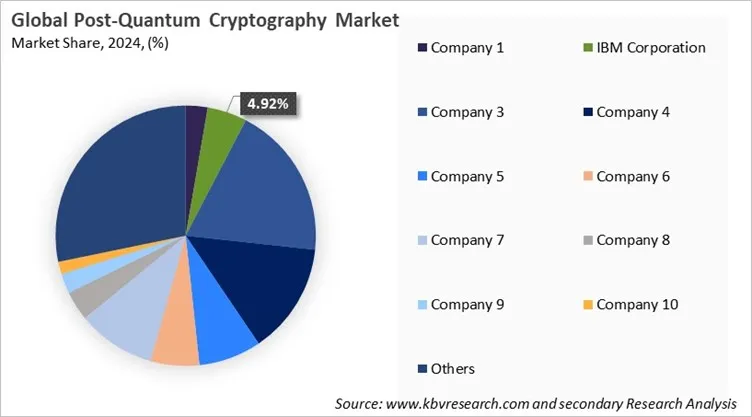
The leading players in the market are competing with diverse innovative offerings to remain competitive in the market. The above illustration shows the percentage of revenue shared by some of the leading companies in the market. The leading players of the market are adopting various strategies in order to cater to demand coming from the different industries. The key developmental strategies in the market are Acquisitions, and Partnerships & Collaborations.
Based on services, the post-quantum cryptography market is characterized into design, implementation, consulting, migration services, and quantum risk assessment. The migration services segment attained 37% revenue share in the post-quantum cryptography Market in 2024. The migration services segment plays a critical role in assisting organizations as they shift from traditional cryptographic methods to quantum-secure alternatives. This includes evaluating existing infrastructure, identifying vulnerable components, and executing a systematic transition to post-quantum algorithms.
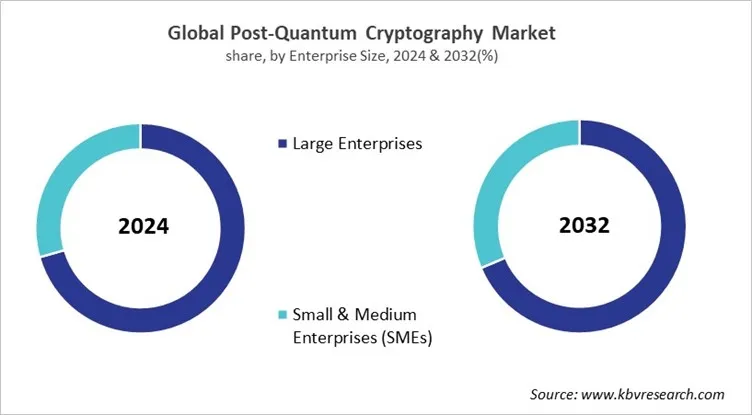
By enterprise size, the post-quantum cryptography market is divided into large enterprises and small & medium enterprises (SMEs). The small & medium enterprises (SMEs) segment recorded 29% revenue share in the post-quantum cryptography market in 2024. The small & medium enterprises segment reflects a growing inclination toward quantum-safe security as awareness of emerging threats increases. SMEs are increasingly adopting advanced cryptographic tools to secure their systems, customer data, and digital transactions as they expand their digital footprints.
Free Valuable Insights: Post-Quantum Cryptography Market size to reach USD 13.94 Billion by 2032
Region-wise, the post-quantum cryptography market is analyzed across North America, Europe, Asia Pacific, and LAMEA. The North America segment recorded 38% revenue share in the post-quantum cryptography market in 2024. In North America and LAMEA, the post-quantum cryptography market is anticipated to expand at a substantial rate in the upcoming years. The adoption is driven by strong regulatory leadership and early industrial participation. In the US, agencies such as the NSA and NISR have created a structured migration path with PQC standardization efforts and the CNSA 2.0 directives, prompting rapid integration across critical infrastructure and government. Moreover, Europe post-quantum cryptography market is growing with support from ENISA and national cybersecurity agencies, encouraging sectors like telecom, banking, and healthcare to adopt hybrid cryptographic, and crypto-agility models, Major technology companies based in these regions such as Google, IBM, Cisco, Nokia, Intel, and Microsoft are embedding PQC into communication protocols, cloud platforms, enterprise systems, and chipsets, making the region global leader for testing, algorithm development, and early commercial implementations.
The post-quantum cryptography market is predicted to grow at a prominent rate in the Asia Pacific and LAMEA region. This is because of surging adoption as governments and industries are preparing for quantum-era threats, though the pace varies by national readiness. Nations like South Korea, China, Japan, and Australia are largely investing in quantum research and issuing early migration frameworks to align with NIST standards, while telecom and cloud providers in the region are testing PQC integration into IoT devices, 5G infrastructure, and networks. Furthermore, the LAMEA market is accelerating, driven by rising adoption due to critical infrastructure modernization, increasing cyber risks, and pressure from global supply chains to implement quantum-safe security. LAMEA and APAC enterprises largely rely on cloud hyperscalers, OEMs, and cybersecurity providers to deploy PQC-allowing solutions.
| Report Attribute | Details |
|---|---|
| Market size value in 2025 | USD 1.35 Billion |
| Market size forecast in 2032 | USD 13.94 Billion |
| Base Year | 2024 |
| Historical Period | 2021 to 2023 |
| Forecast Period | 2025 to 2032 |
| Revenue Growth Rate | CAGR of 39.6% from 2025 to 2032 |
| Number of Pages | 701 |
| Number of Tables | 601 |
| Report coverage | Market Trends, Revenue Estimation and Forecast, Segmentation Analysis, Regional and Country Breakdown, Market Share Analysis, Porter’s 5 Forces Analysis, Company Profiling, Companies Strategic Developments, SWOT Analysis, Winning Imperatives |
| Segments covered | Services, Type, Enterprise Size, Vertical, Solution, Region |
| Country scope |
|
| Companies Included | ISARA Corporation, IBM Corporation, NXP Semiconductors N.V., Thales Group S.A., IDEMIA SAS, Palo Alto Networks, Inc., Amazon.com, Inc., Microsoft Corporation, Google LLC (Alphabet Inc.) and DigiCert, Inc. (Clearlake Capital Group, L.P.) |
By Services
By Type
By Enterprise Size
By Vertical
By Solution
By Geography
This Market size is expected to reach USD 13.94 billion by 2032.
The post-quantum cryptography market is projected to grow at a CAGR of 39.6% between 2025 and 2032.
Emerging quantum computing threats to traditional encryption, intensifying “harvest now, decrypt later” risks and long-term data protection needs.
ISARA Corporation, IBM Corporation, NXP Semiconductors N.V., Thales Group S.A., IDEMIA SAS, Palo Alto Networks, Inc., Amazon.com, Inc., Microsoft Corporation, Google LLC (Alphabet Inc.) and DigiCert, Inc. (Clearlake Capital Group, L.P.)
The Quantum-Resistant Algorithms segment dominated the Global Post-Quantum Cryptography Market by Solution in 2024, growing at a CAGR of 37.1 % during the forecast period.
The North America region dominated the Global Post-Quantum Cryptography Market by Region in 2024, and would continue to be a dominant market till 2032; thereby, achieving a market value of $5.08 billion by 2032.
Our team of dedicated experts can provide you with attractive expansion opportunities for your business.








 Unique Offerings