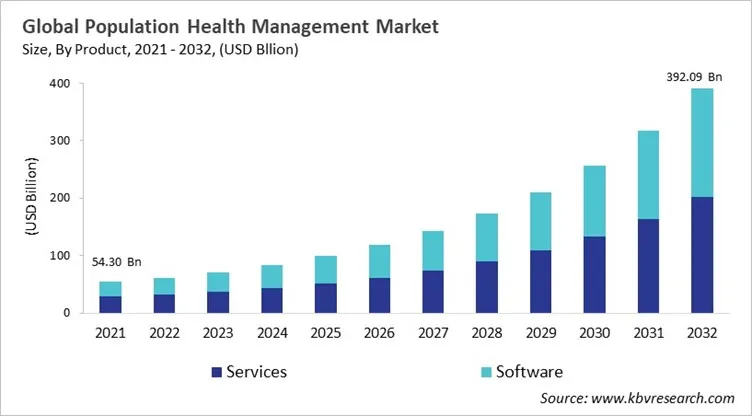
“Global Population Health Management Market to reach a market value of USD 392.09 Billion by 2032 growing at a CAGR of 21.6%”
The Global Population Health Management Market size is expected to reach USD 392.09 billion by 2032, rising at a market growth of 21.6% CAGR during the forecast period.
Population health management has evolved as a data-driven discipline that integrates community-level information with clinical insights. PHM has transformed care delivery to proactive risk management from reactive treatment with the capabilities of claims integration, interoperable systems, and electronic health records. Health organizations as well as governments are both deploying PHM into healthcare as an operational model using analytics to identify care gaps, coordinate interventions, and stratify risk. Key players in the market are introducing platforms that offer population registries, automated workflows, and closed-loop referrals to support providers in reducing disparities, enhancing preventive outcomes, and streamlining outreach.
These days, population health management has become a concept combining public health goals with healthcare delivery mechanics, strengthened by the growing concern of chronic diseases, aging population, and value-based contracting. Players in the market now combine remote monitoring, workflow automation, and patient engagement to make sure that insights driven through PHM can be translated to measurable results. Market competition is increasing with demand for PHM enabling operational functionality, demonstrated outcomes, and interoperability. With increasing focus of governments towards cross-industry data sharing and standardized measures, population health management is combining with integrated platforms that consolidate digital tools, clinical care, and social services, thereby transforming the concept of episodic treatment to continued health management.
The major strategies followed by the market participants are Partnerships as the key developmental strategy to keep pace with the changing demands of end users. In March, 2025, Athenahealth, Inc. partnered with GRAIL to integrate Galleri® cancer screening into its EHR platform, enabling streamlined early cancer detection for high-risk populations. This collaboration supports preventive care and broad adoption of population health strategies. Additionally, In July, 2024, eClinicalWorks LLC and Aledade partnered to integrate Sunoh.ai, an AI-powered ambient listening tool, improving clinical documentation and physician efficiency. This collaboration enhances value-based care, streamlines workflows, and supports population health management across over 400 jointly supported primary care practices.
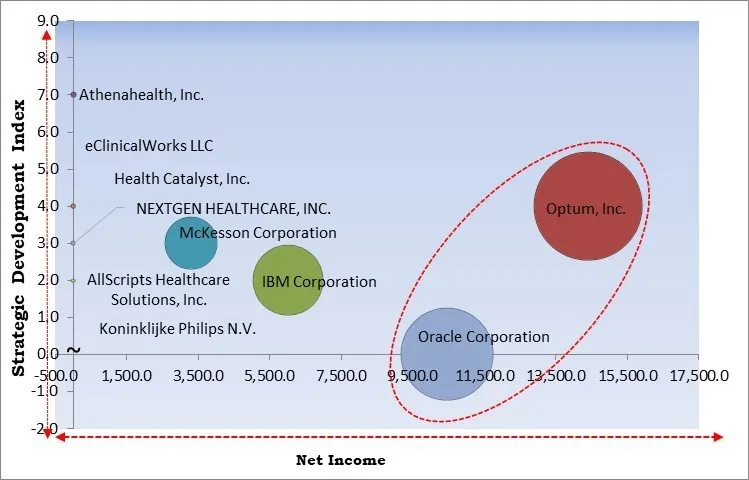
Based on the Analysis presented in the KBV Cardinal matrix; Optum, Inc. and Oracle Corporation and are the forerunners in the Population Health Management Market. Companies such as IBM Corporation and McKesson Corporation are some of the key innovators in the Population Health Management Market. In April, 2022, IBM Corporation partnered with the Healthcare Transformation Consortium to deliver AI-powered population health analytics. The initiative enables hospitals to use predictive models and social determinants data to improve health outcomes at the community level.
By emphasizing the importance of population health management (PHM) in proactive, data-driven care, the COVID-19 pandemic hastened its adoption. PHM tools were used by health systems to monitor susceptible groups, control testing, immunization, and treatment, and combine information from various sources to make prompt decisions. To implement focused interventions that increased equity and decreased disparities, the crisis placed a strong emphasis on addressing social determinants of health. Telehealth, remote monitoring, and dashboards tailored to COVID-19 were brought about by rapid digital transformation, which improved crisis response and care delivery. These innovations demonstrated PHM's contribution to operational effectiveness and readiness, promoting long-term investment and adoption throughout international healthcare ecosystems. Thus, the COVID-19 had a positive impact on the market.

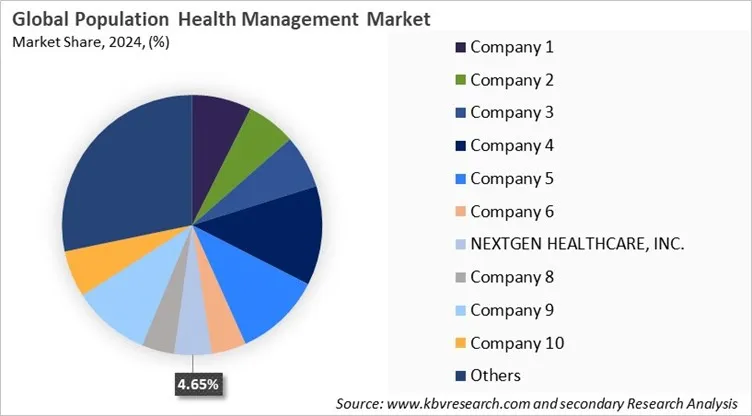
The leading players in the market are competing with diverse innovative offerings to remain competitive in the market. The above illustration shows the percentage of revenue shared by some of the leading companies in the market. The leading players of the market are adopting various strategies in order to cater demand coming from the different industries. The key developmental strategies in the market are Partnerships, Collaborations & Agreement.
Free Valuable Insights: Global Population Health Management Market size to reach USD 392.09 Billion by 2032
Based on Product, the Population Health Management Market is segmented into Services, and Software. The Software segment acquired 47% revenue share in the market in 2024. These platforms enable healthcare stakeholders to collect, integrate, and analyze clinical, claims, and social determinants data, translating insights into actionable care plans. PHM software often includes modules for patient registries, gaps-in-care alerts, care coordination dashboards, and reporting tools for quality measures. Many software solutions are designed to integrate with electronic health records and other health IT systems, offering a centralized environment for managing population health strategies.
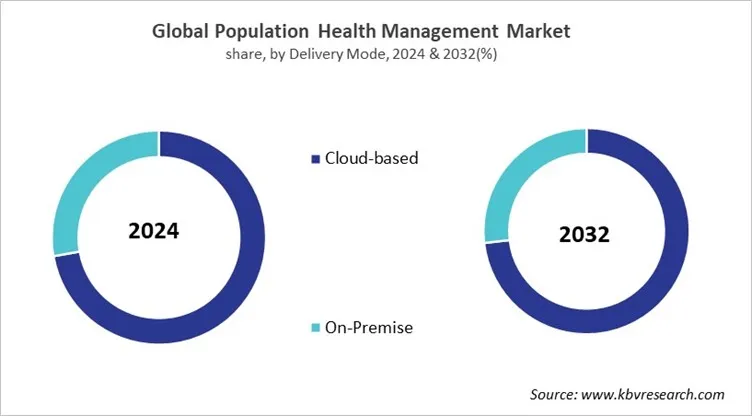
Based on Delivery Mode, the Population Health Management Market is segmented into Cloud-based, and On-Premise. The On-Premise segment acquired 27% revenue share in the market in 2024. The on-premise delivery mode in this market continued to serve healthcare organizations that prioritized direct control over their infrastructure, data security, and system customization. This approach enabled institutions to maintain sensitive health information within their own data centers, aligning with strict compliance requirements and internal governance policies. On-premise solutions offered greater opportunities for tailored configurations, allowing organizations to adapt the system to their specific workflows and integration needs.
Region-wise, the Population Health Management Market is analyzed across North America, Europe, Asia Pacific, and LAMEA. The North America segment recorded 44% revenue share in the market in 2024. In the North America region, the population health management market is experiencing significant growth. This is owing to the enhanced healthcare structure and larger acceptance of electronic health records. The market growth is prominent in nations such as the US due to their increased focus on lessening healthcare costs while enhancing patient outcomes. Also, the growing adoption of digital health platforms is resulting in expansion. Additionally, Europe region is projected to witness market opportunities in the forecast period. The growth in the European region is driven by government initiatives supporting healthcare digitalization, rising focus on preventive care, and deployment of PHM solutions to manage aging populations and chronic diseases.
The population health management market is expected to grow at a steady pace in the Asia Pacific region. This is because of the increasing concern of chronic diseases, rising healthcare expenditure, and prevalence of digital healthcare initiatives in nations such as Japan, India, and China. Rising investment in healthcare IT and government-led initiatives for healthcare are increasing acceptance. Moreover, the LAMEA market is predicted to have promising growth. This is because of the modernization in healthcare systems and increasing collaborations with global providers. Further, increasing demand for cost-effective and efficient care models is predicted to support the growth.
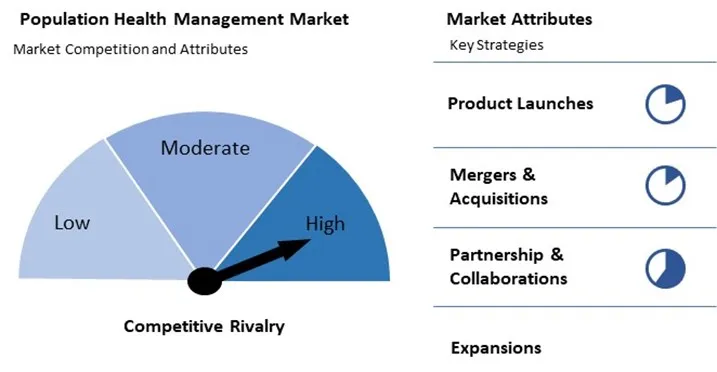
The market competition is intense, driven by rapid technological advancements, continuous innovation, and evolving customer expectations. Numerous global and regional players compete to differentiate themselves through pricing strategies, advanced features, and customer-centric solutions. The rise of digital transformation, automation, and data-driven decision-making further fuels rivalry, as businesses strive to offer scalable, flexible, and integrated platforms. High entry barriers, coupled with constant product upgrades and aggressive marketing, make the environment highly dynamic, pushing companies to innovate to maintain competitiveness.
| Report Attribute | Details |
|---|---|
| Market size value in 2024 | USD 83.87 Billion |
| Market size forecast in 2032 | USD 392.09 Billion |
| Base Year | 2024 |
| Historical Period | 2021 to 2023 |
| Forecast Period | 2025 to 2032 |
| Revenue Growth Rate | CAGR of 21.6% from 2025 to 2032 |
| Number of Pages | 445 |
| Number of Tables | 334 |
| Report coverage | Market Trends, Revenue Estimation and Forecast, Segmentation Analysis, Regional and Country Breakdown, Competitive Landscape, Market Share Analysis, Porter’s 5 Forces Analysis, Company Profiling, Companies Strategic Developments, SWOT Analysis, Winning Imperatives |
| Segments covered | Product, Delivery Mode, End-use, Region |
| Country scope |
|
| Companies Included | AllScripts Healthcare Solutions, Inc., Cerner Corporation, McKesson Corporation, Tenet Healthcare Corporation (Conifer Health Solutions, LLC), eClinicalWorks LLC, UnitedHealth Group, Inc. (Optum, Inc.), Koninklijke Philips N.V., Athenahealth, Inc. (Veritas Capital), IBM Corporation and Epic Systems Corporation |
By Product
By Delivery Mode
By End-use
By Geography
The market size is projected to reach USD 392.09 billion by 2032.
The Population Health Management market is projected to grow at a CAGR of 21.6% between 2025 and 2032.
Technological advancements in analytics and interoperability, along with aging populations and the rising chronic disease burden, are driving market growth.
AllScripts Healthcare Solutions, Inc., Cerner Corporation, McKesson Corporation, Tenet Healthcare Corporation (Conifer Health Solutions, LLC), eClinicalWorks LLC, UnitedHealth Group, Inc. (Optum, Inc.), Koninklijke Philips N.V., Athenahealth, Inc. (Veritas Capital), IBM Corporation and Epic Systems Corporation
The Cloud-based segment is generating the maximum revenue share in the Global Population Health Management Market by Delivery Mode in 2024; thereby, achieving a market value of USD 286.88 billion by 2032.
The North America region dominated the Global Population Health Management Market by Region in 2024, and would continue to be a dominant market till 2032; thereby, achieving a market value of $168.25 billion by 2032.
Our team of dedicated experts can provide you with attractive expansion opportunities for your business.











 Unique Offerings