“Global Polyacrylic Acid Market to reach a market value of USD 4.15 Billion by 2032 growing at a CAGR of 6.2%”
The Global Polyacrylic Acid Market size is expected to reach $4.15 billion by 2032, rising at a market growth of 6.2% CAGR during the forecast period. In the year 2024, the market attained a volume of 16,719.00 hundred tonnes experiencing a growth of 20.5% (2021-2024).
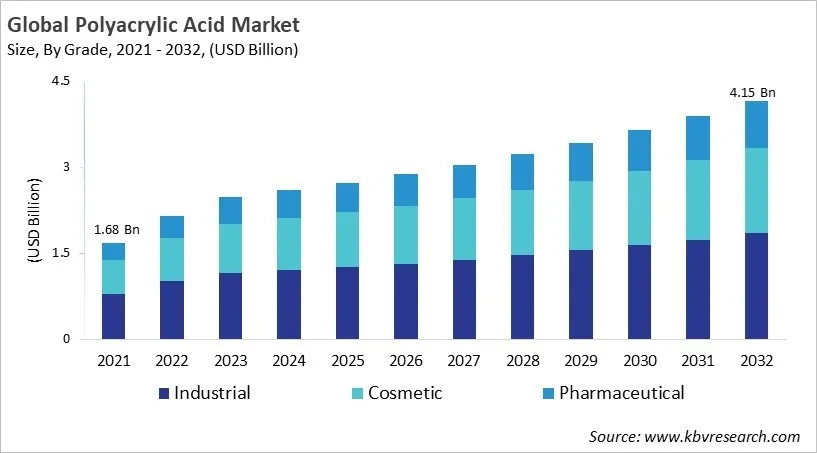
Polyacrylic acid is a multifunctional polymer popular for water retention and dispersing capabilities, primarily derived from acrylic acid polymerization. In the mid-20th century, the uses of Polyacrylic acid expanded, mainly to hygiene products such as detergents, water treatment, diapers, personal care, and coatings. Advancements in the polymerization techniques gave pinpoint control over molecular weight, solubility, and charge density, creating new opportunities in emulsifiers, gels, and rheology modifiers. Currently, sustainability and rising environmental concerns are propelling the change, with research emphasising the eco-friendly acrylic acid from renewable sources like lactic acid and biomass sugars to decrease the burden on fossil fuels and reduce carbon emissions. Furthermore, ongoing research on PAA’s biodegradability and environmental safety is providing opportunities for eco-friendly formulations.
The market is also moving toward high-purity and specialty PAA grades for medical, energy storage, and other niche uses, which means that the polymer structure needs to be more tightly controlled. More and more strict rules about safety and the environment are affecting how products are designed, made, and disposed of. Innovation is the main thing that makes companies compete with each other, and strategic priorities are now focused on developing renewable feedstocks, customizing performance, and following the rules. Regions with strong manufacturing infrastructure and supportive policy frameworks are making the most progress. Companies are trying to find a balance between technological progress and environmental stewardship while also meeting the needs of both traditional and new markets.

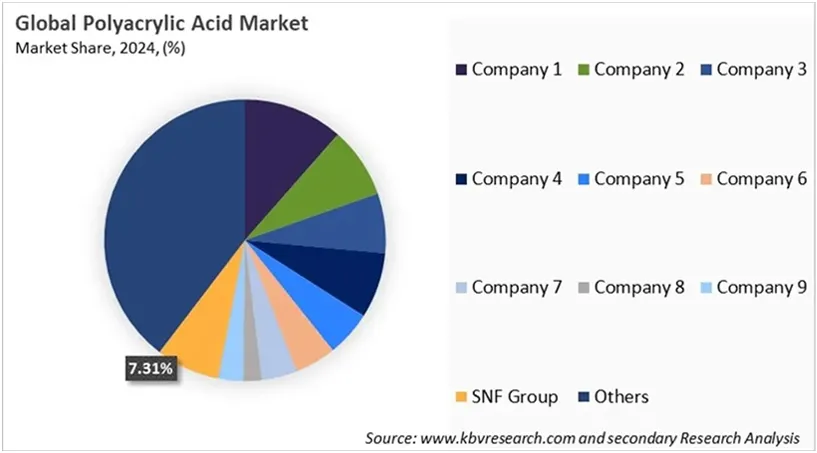
The leading players in the market are competing with diverse innovative offerings to remain competitive in the market. The above illustration shows the percentage of revenue shared by some of the leading companies in the market. The leading players of the market are adopting various strategies in order to cater demand coming from the different industries. The key developmental strategies in the market are Acquisitions, and Partnerships & Collaborations.
The COVID-19 pandemic had a substantial impact on the global polyacrylic acid market, disrupting supply chains, halting production, and reducing demand across multiple end-use industries. Lockdowns and movement restrictions led to temporary shutdowns of manufacturing plants and logistical hurdles, causing supply shortages and delays. Industrial demand declined sharply, especially in sectors like personal care, textiles, and water treatment. In conclusion, while the pandemic posed significant short-term challenges, it also laid the foundation for a more resilient and adaptable polyacrylic acid industry moving forward.
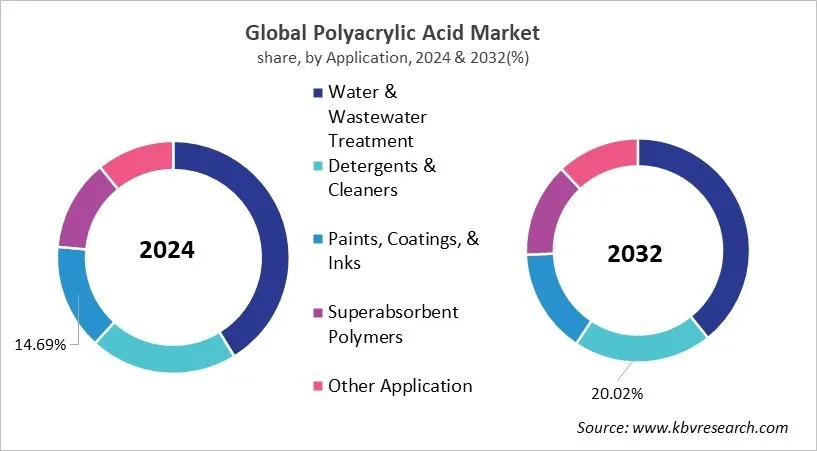
Based on Application, the market is segmented into Water & Wastewater Treatment, Detergents & Cleaners, Paints, Coatings, & Inks, Superabsorbent Polymers, and Other Application. The detergents & cleaners segment garnered 20.5% revenue share in the market in 2024. In terms of volume, 5,255.28 hundred tonnes of detergents & cleaners are expected to be utilized by the year 2032. Polyacrylic acid is widely utilized in detergent formulations due to its superior dispersing and anti-redeposition properties, which enhance cleaning efficiency. Its role in preventing dirt and mineral deposits from re-attaching to surfaces makes it an essential ingredient in laundry and dishwashing detergents.
Free Valuable Insights: Global Polyacrylic Acid Market size to reach USD 4.15 Billion by 2032
Pacific segment witnessed 45.2% revenue share in the market in 2024. By the year 2032, In terms of volume, 4,874.18 hundred tonnes of polyacrylic acid is expected to be utilized in Europe region. The polyacrylic acid market in North America is mature because there is a strong demand from the hygiene, water treatment, and detergent industries, and a well-established industrial base. The area has advanced manufacturing capabilities, strict environmental rules, and large research and development (R&D) investments, especially in making acrylic acid in an environmentally friendly manner and using bio-based materials. Government policies that support green chemistry and low-carbon technologies are speeding up the use of renewable feedstocks. In Europe, there are similar factors at work, but the rules set by REACH and the EU Green Deal are even stricter. This pushes manufacturers to make products that are better for the environment, have less residual monomer content, and break down more easily. Specialty-grade PAA is also in higher demand in both areas for medical uses, advanced coatings, and battery technologies.
Asia Pacific is the fastest-growing market because of quick industrialization, urbanization, and high demand for personal care, water treatment, and hygiene products. China, Japan, and South Korea are the leaders in large-scale production. There is a growing focus on high-performance and specialty-grade PAA for electronics, energy storage, and biomedical uses. The area also benefits from low-cost manufacturing and rising domestic demand, but environmental compliance is becoming a more important factor in competition. In LAMEA, the market is growing steadily thanks to more water treatment facilities, agricultural uses, and detergent demand. Some countries, on the other hand, have limited local production capacity, so they have to rely on imports. Middle Eastern producers, on the other hand, are looking into how to integrate PAA into petrochemical value chains and renewable feedstock initiatives.
| Report Attribute | Details |
|---|---|
| Market size value in 2024 | USD 2.59 Billion |
| Market size forecast in 2032 | USD 4.15 Billion |
| Base Year | 2024 |
| Historical Period | 2021 to 2023 |
| Forecast Period | 2025 to 2032 |
| Revenue Growth Rate | CAGR of 6.2% from 2025 to 2032 |
| Quantitative Data | Volume in Hundred Tonnes, Revenue in USD Billion, and CAGR from 2025 to 2032 |
| Number of Pages | 437 |
| Number of Tables | 551 |
| Report coverage | Market Trends, Revenue Estimation and Forecast, Segmentation Analysis, Regional and Country Breakdown, Porter’s 5 Forces Analysis, Company Profiling, Companies Strategic Developments, SWOT Analysis, Winning Imperatives |
| Segments covered | Grade, Application, Region |
| Country scope |
|
| Companies Included | BASF SE, The Dow Chemical Company, The Lubrizol Corporation (Berkshire Hathaway Inc.), Evonik Industries AG (RAG-Stiftung), Ashland Inc., Nippon Express Co., Ltd., Sumitomo Seika Chemicals Co. Ltd., Kao Corporation, Merck KGaA, and SNF Group |
By Grade (Volume, Hundred Tonnes, USD Billion, 2021-2032)
By Application (Volume, Hundred Tonnes, USD Billion, 2021-2032)
By Geography (Volume, Hundred Tonnes, USD Billion, 2021-2032)
This Market size is expected to reach $4.15 billion by 2032.
Surging Demand in Water Treatment Applications are driving the Market in coming years, however, Volatility in Raw Material Prices and Petrochemical Dependency restraints the growth of the Market.
BASF SE, The Dow Chemical Company, The Lubrizol Corporation (Berkshire Hathaway Inc.), Evonik Industries AG (RAG-Stiftung), Ashland Inc., Nippon Express Co., Ltd., Sumitomo Seika Chemicals Co. Ltd., Kao Corporation, Merck KGaA, and SNF Group
The expected CAGR of this Market is 6.2% from 2023 to 2032.
The Industrial segment led the maximum revenue in the Market by Grade in 2024, thereby, achieving a market value of $1.84 billion by 2032.
The Asia Pacific market dominated the Market by Region in 2024, thereby, achieving a market value of $1.89 billion by 2032.
Our team of dedicated experts can provide you with attractive expansion opportunities for your business.







 Unique Offerings