“Global Personal Identity Management Market to reach a market value of USD 52.94 Billion by 2032 growing at a CAGR of 12.1%”
The Global Personal Identity Management Market size is expected to reach $52.94 billion by 2032, rising at a market growth of 12.1% CAGR during the forecast period.
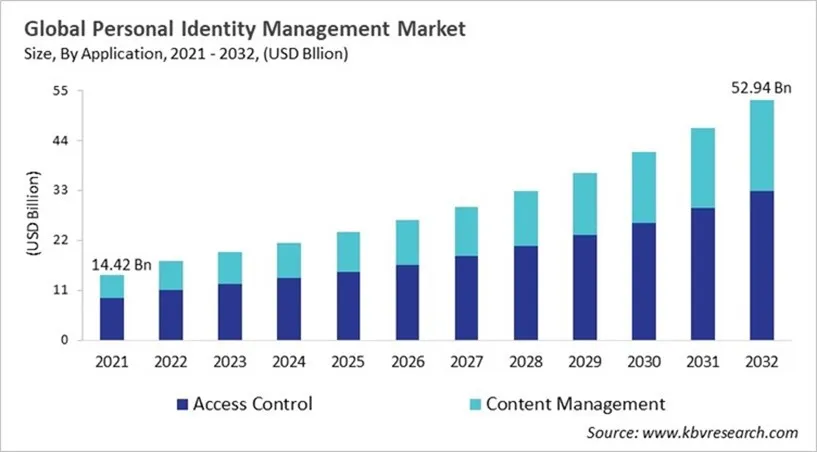
Personal identity management comprises the systems and frameworks used to authenticate, identify, and authorize individuals and entities across digital and physical environments, ensuring secure and appropriate access to resources. Identity management developed as enterprises are adopting cloud-based, networked, and mobile environments. This transition expanded IAM into a comprehensive discipline covering identity lifecycle management, privileged access, governance, federation, and adaptive authentication. Large enterprises and governments are early adopters, integrating IAM into digital services like benefit platforms, tax systems, and online portals to protect sensitive data, meet compliance needs, and maintain public trust. The growth of cloud computing, remote work, and mobile access further surged the shift toward identity-centric security models, where identity effectively became the primary security perimeter.
Personal identity management underpins continuous authentication, Zero Trust architectures, and context-aware access decisions based on behaviour, risk signals, and device posture. Cloud-native IAM platforms, adaptive multi-factor authentication, and AI-based analytics are now central to balancing strong security with seamless user experience. Further, identity systems support regulatory compliance, privacy protection, and large-scale digital governance initiatives. The competitive market is driven by major technology providers like Microsoft, Oracle, and IBM, along with specialized IAM providers focused on areas like privileged access, customer identity, and biometrics. Through standards-based interoperability, cloud-centric delivery, and innovation in password-less and adaptive access, these market players continue to drive the development of personal identity management as an essential component of digital trust infrastructure.
The COVID-19 pandemic had a small negative effect on the Personal Identity Management market, especially in the beginning. Even though the basic need for digital security solutions stayed the same, new deployments were slowed down by IT project delays and problems with business operations. Many businesses, especially small and medium-sized ones, put off upgrading their identity management systems because of economic uncertainty and tight budgets. Their priorities shifted to keeping the business running. Also, problems in the supply chain, a limited workforce, and limited access to the site made the implementation process take longer. But the quick rise in remote work and digital transactions brought attention back to secure identity verification, which helped the market slowly recover. Thus, the COVID-19 pandemic had a MILD negative impact on the market.

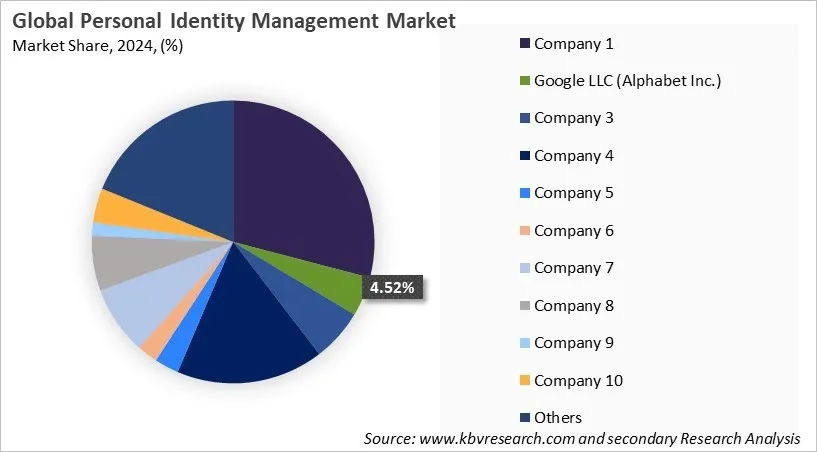
The leading players in the market are competing with diverse innovative offerings to remain competitive in the market. The above illustration shows the percentage of revenue shared by some of the leading companies in the market. The leading players of the market are adopting various strategies in order to cater demand coming from the different industries. The key developmental strategies in the market are Acquisitions, and Partnerships & Collaborations.
Based on Application, the market is segmented into Access Control, and Content Management. The Content Management segment acquired 37% revenue share in the market in 2024. The Content Management segment in the Personal Identity Management Market is centered on the organization, storage, and secure handling of digital content and user information. This segment provides tools and platforms that allow organizations to manage large volumes of content while ensuring compliance with data protection regulations and maintaining data integrity. Content management solutions encompass document management systems, digital asset management, records management, and collaboration platforms that help streamline workflows and maintain centralized repositories of information.
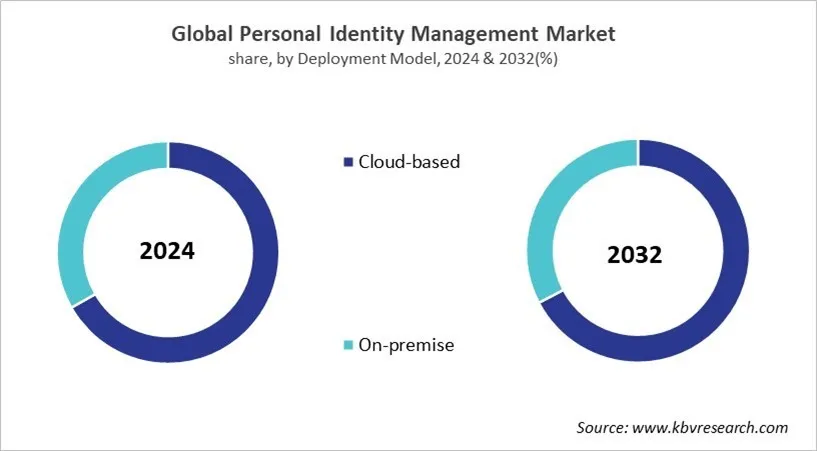
Based on Deployment Model, the market is segmented into Cloud-based, and On-premise. The On-premise segment acquired 33% revenue share in the market in 2024. The On-premise segment of the Personal Identity Management Market involves deploying identity management systems within the organization’s own IT infrastructure, giving businesses complete control over their data, processes, and security protocols. On-premise solutions are designed to meet the specific requirements of organizations that prioritize data privacy, regulatory compliance, and customization capabilities, allowing full control over system configuration and integration with existing enterprise applications.
Based on Service Type, the market is segmented into Managed Services, and Professional Services. The Professional Services segment attained 44% revenue share in the market in 2024. The Professional Services segment in the Personal Identity Management Market provides specialized expertise to assist organizations in implementing, optimizing, and maintaining identity management solutions. This segment includes three key categories: Support and Maintenance Services, Consulting Services, and Training and Education Services. Support and Maintenance Services focus on providing ongoing technical assistance, troubleshooting, system updates, and performance optimization to ensure that identity management solutions remain fully operational and secure.
Free Valuable Insights: Personal Identity Management Market size to reach USD 52.94 Billion by 2032
Region-wise, the Personal Identity Management Market is analyzed across North America, Europe, Asia Pacific, and LAMEA. The North America segment recorded 40% revenue share in the market in 2024. The personal identity management market is anticipated to grow at a substantial rate in North America and Europe. This is because of the presence of major technology vendors, strong digital infrastructure, strict regulatory requirements, and increased cybersecurity concerns that compel organization to adopt advanced IAM systems for risk mitigation and compliance. Adoption is particularly high among healthcare, BFSI, government, and large enterprises, with a large focus on cloud-based and Zero-Trust identity frameworks to protect against sophisticated threats. Furthermore, Europe personal identity management market is expanding significantly, driven by robust data protection regulations like GDPR, which mandate comprehensive identity governance and access controls, especially in industries like public administration and financial services. European enterprises largely implement biometric authentication, federated identity, and governance solutions to comply with regulatory standards and improve cross-border interoperability.
In the Asia Pacific and LAMEA regions, the personal identity management market is estimated to experience rapid expansion. The market is propelled by cloud adoption, rapid digitalization, and expanding internet penetration across Japan, China, Australia, India, and Southeast Asia. Regional governments are advancing digital identity initiatives, while businesses across industries like IT, telecom, fintech, and e-commerce largely invest in identity services and IAM to support mobile workforces, fraud prevention, and digital payments. Additionally, the LAMEA personal identity management market is witnessing growth. In Latin America, the expansion of digital services and regulatory focus on privacy are driving steady IAM adoption, especially in Mexico and Brazil. In the Middle East and Africa, demand is rising as governments and enterprises deploy identity security systems to support smart city and e-governance initiatives and protect critical infrastructure.
| Report Attribute | Details |
|---|---|
| Market size value in 2025 | USD 23.80 Billion |
| Market size forecast in 2032 | USD 52.94 Billion |
| Base Year | 2024 |
| Historical Period | 2021 to 2023 |
| Forecast Period | 2025 to 2032 |
| Revenue Growth Rate | CAGR of 12.1% from 2025 to 2032 |
| Number of Pages | 621 |
| Number of Tables | 544 |
| Report coverage | Market Trends, Revenue Estimation and Forecast, Segmentation Analysis, Regional and Country Breakdown, Market Share Analysis, Porter’s 5 Forces Analysis, Company Profiling, Companies Strategic Developments, SWOT Analysis, Winning Imperatives |
| Segments covered | Application, Deployment Model, Service Type, Vertical, Region |
| Country scope |
|
| Companies Included | Microsoft Corporation, Google LLC (Alphabet Inc.), Thales Group S.A., IBM Corporation, Hewlett Packard Enterprise Company, Dell Technologies, Inc., Oracle Corporation, Broadcom, Inc., OneLogin, Inc., and Ping Identity Holding Corp. |
By Application
By Deployment Model
By Service Type
By Vertical
By Geography
The market size is projected to reach USD 52.94 Billion by 2032.
The personal identity management market is projected to grow at a CAGR of 12.1% between 2025 and 2032.
Escalating sophistication and frequency of cyber threats, combined with rapid growth in digital transactions and online services, are driving market growth.
Microsoft Corporation, Google LLC (Alphabet Inc.), Thales Group S.A., IBM Corporation, Hewlett Packard Enterprise Company, Dell Technologies, Inc., Oracle Corporation, Broadcom, Inc., OneLogin, Inc., and Ping Identity Holding Corp.
The Access Control segment captured the maximum revenue in the Global Personal Identity Management Market by Application in 2024, thereby, achieving a market value of $32.8 billion by 2032.
The North America region dominated the Global Personal Identity Management Market by Region in 2024, and would continue to be a dominant market till 2032; thereby, achieving a market value of $20.2 billion by 2032.
Our team of dedicated experts can provide you with attractive expansion opportunities for your business.








 Unique Offerings