“Global Perimeter Intrusion Detection Systems Market to reach a market value of USD 47.21 Billion by 2032 growing at a CAGR of 14.2%”
The Global Perimeter Intrusion Detection Systems Market size is estimated at $18.64 billion in 2025 and is expected to reach $47.21 billion by 2032, rising at a market growth of 14.2% CAGR during the forecast period (2025-2032). The growth of this Market is driven by rising security threats, increasing infrastructure protection needs, and wider adoption across critical facilities. Advancements in AI-enabled surveillance, smart sensors, and growing investments in border security and industrial safety strongly justify the projected CAGR and market valuation.
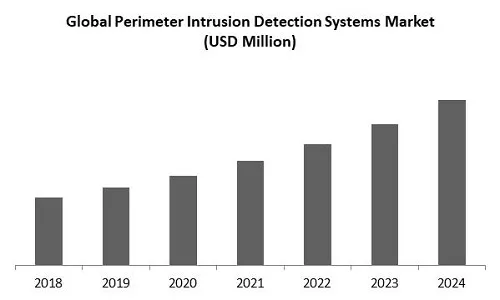
Perimeter Intrusion Detection Systems (PIDS) are smart tangible security technologies manufactured to locate prohibited access across secured landscapes like government facilities, critical infrastructure, and industrial sites. Transitioning from elementary obstacles such as fences and patrols, PIDS now comprises alarms, electronic sensors, and digital signal processing to address increasingly complex threats including vandalism, theft, terrorism, and sabotage. Modern perimeter security systems now bring together multiple sensing technologies—such as passive infrared, radar, microwave, and fiber-optic sensing—to deliver more accurate detection while significantly reducing false alarms. Advances introduced by OEMs like Honeywell, Future Fibre Technologies, and NEC have made it possible to monitor long distances with greater precision, adapt to challenging environmental conditions, and maintain real-time awareness of potential threats. As a result, PIDS solutions have become a vital part of national security and critical infrastructure protection strategies around the world, supporting more reliable and proactive security operations.
The market is steadily moving toward smarter, more integrated, and highly scalable perimeter security solutions. Today’s PIDS increasingly use AI and machine learning to identify threats in real time, helping security teams clearly separate genuine intrusions from routine environmental disturbances. At the same time, organizations and government agencies are shifting to holistic security approaches that bring together intrusion detection, video analytics, access control, and centralized command systems, enabling faster and more coordinated responses. Ongoing regulatory requirements and the need to protect critical infrastructure are further pushing demand for rugged, interoperable, and standards-compliant solutions. In this evolving landscape, leading OEMs such as Honeywell, Senstar, Bosch, Axis Communications, and NEC stand out by focusing on technological innovation, seamless system integration, scalability, and close collaboration with government and defense agencies to meet increasingly complex security needs.
The COVID-19 pandemic impacted the Perimeter Intrusion Detection Systems (PIDS) market because it caused major problems in global supply chains, such as factories closing, shortages of raw materials, and delays in delivering parts, which slowed down production and project completion. Demand fell because important end-user sectors like transportation, commercial infrastructure, and industrial facilities put off or canceled security investments to deal with financial uncertainty. Movement restrictions and social distancing made it even harder to install, calibrate, and maintain equipment on-site, which made it harder for service providers to do their jobs. Also, limited budgets at both government and private organizations meant that money had to be moved to healthcare and emergency response programs. As a result, these factors together temporarily slowed market growth and made it harder for people to use advanced perimeter intrusion detection technologies during the pandemic. Thus, the COVID-19 pandemic had a negative impact on the market.

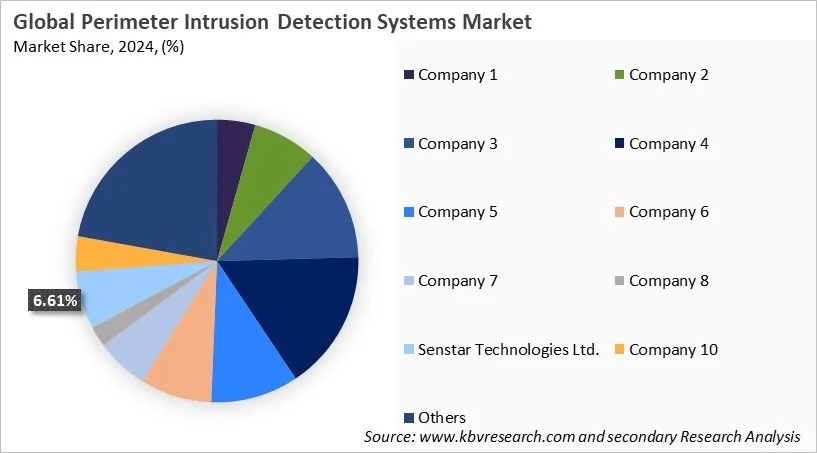
The leading players in the market are competing with diverse innovative offerings to remain competitive in the market. The above illustration shows the percentage of revenue shared by some of the leading companies in the market. The leading players of the market are adopting various strategies in order to cater demand coming from the different industries. The key developmental strategies in the market are Acquisitions, and Partnerships & Collaborations.
Based on Offering, the market is segmented into Hardware, Software and Services. The Software segment attained 22% revenue share in the market in 2024. The software segment plays a central role in enhancing the intelligence and responsiveness of perimeter intrusion detection systems by enabling data analysis, event correlation, visualization, and system control. Software platforms support functions such as video analytics, pattern recognition, artificial intelligence–driven threat classification, and centralized monitoring dashboards.
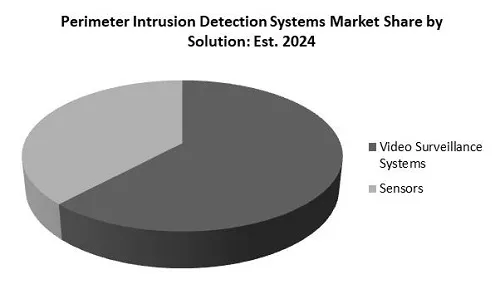
Based on Deployment Type, the market is segmented into Fence-Mounted, Open Area and Buried. The Open Area segment attained 34% revenue share in the market in 2024. The open area segment addresses security needs in locations where physical fencing is impractical or insufficient, such as wide perimeters, open fields, runways, borders, and critical infrastructure zones. This deployment relies on advanced technologies including radar, lidar, infrared, microwave, and video analytics to monitor large, unobstructed spaces.
Free Valuable Insights: Perimeter Intrusion Detection Systems Market size to reach USD 47.21 Billion by 2032
Region-wise, the Perimeter Intrusion Detection Systems Market is analyzed across North America, Europe, Asia Pacific, and LAMEA. The North America segment recorded 36% revenue share in the market in 2024. North America and Europe have matured perimeter intrusion detection markets, shaped by strict security regulations, strong government involvement, and widespread adoption across critical infrastructure, defense, and transportation sectors. In these regions, organizations prioritize advanced and tightly integrated PIDS platforms that combine fiber-optic sensing, radar, passive infrared, and AI-driven analytics to achieve high detection accuracy while keeping false alarms to a minimum. OEMs place strong emphasis on interoperability, ensuring these systems work seamlessly with video surveillance, access control, and command-and-control platforms to enable centralized monitoring and rapid response in complex, high-risk environments.
In contrast, Asia Pacific and LAMEA are seeing steady growth in PIDS adoption as infrastructure expands, cities develop, and attention to border and industrial security increases. Governments and operators across these regions are increasingly deploying multi-technology and AI-enabled perimeter detection systems to protect airports, energy facilities, ports, and national borders. The market here tends to favor scalable and flexible solutions that can cover large areas, support remote monitoring, and be upgraded gradually over time, often through partnerships between global OEMs and local system integrators to meet evolving security needs.
| Report Attribute | Details |
|---|---|
| Market size value in 2025 | USD 18.64 Billion |
| Market size forecast in 2032 | USD 47.21 Billion |
| Base Year | 2024 |
| Historical Period | 2021 to 2023 |
| Forecast Period | 2025 to 2032 |
| Revenue Growth Rate | CAGR of 14.2% from 2025 to 2032 |
| Number of Pages | 535 |
| Number of Tables | 395 |
| Report coverage | Market Trends, Revenue Estimation and Forecast, Segmentation Analysis, Regional and Country Breakdown, Market Share Analysis, Porter’s 5 Forces Analysis, Company Profiling, Companies Strategic Developments, SWOT Analysis, Winning Imperatives |
| Segments covered | Offering, Deployment Type, End-User Verticals, Region |
| Country scope |
|
| Companies Included | Advanced Perimeter Systems Limited, Schneider Electric SE, Johnson Controls International PLC, Honeywell International, Inc., Teledyne FLIR LLC (Teledyne Technologies Incorporated), Axis Communications AB (Canon, Inc.), Optex Co. Ltd. (Optex Group Co., Ltd.), PureTech Systems, Inc., Senstar Technologies Ltd., and Cias Elettronica Srl |
By Offering
By Deployment Type
By End-User Verticals
By Geography
The market size is projected to reach USD 47.21 Billion by 2032.
The perimeter intrusion detection systems market is projected to grow at a CAGR of 14.2% between 2025 and 2032.
Rising security threats and criminal activity, combined with advances in detection and analytics technologies, are accelerating market adoption.
Advanced Perimeter Systems Limited, Schneider Electric SE, Johnson Controls International PLC, Honeywell International, Inc., Teledyne FLIR LLC (Teledyne Technologies Incorporated), Axis Communications AB (Canon, Inc.), Optex Co. Ltd. (Optex Group Co., Ltd.), PureTech Systems, Inc., Senstar Technologies Ltd., and Cias Elettronica Srl
The Fence-Mounted segment led the maximum revenue in the Global Perimeter Intrusion Detection Systems Market by Deployment Type in 2024, thereby, achieving a market value of $18.2 billion by 2032.
The North America region dominated the Global Perimeter Intrusion Detection Systems Market by Region in 2024, and would continue to be a dominant market till 2032; thereby, achieving a market value of $15.9 billion by 2032.
Our team of dedicated experts can provide you with attractive expansion opportunities for your business.







 Unique Offerings