“Global Passive Optical Component Market to reach a market value of USD 140.37 Billion by 2032 growing at a CAGR of 13.3%”
The Global Passive Optical Component Market size is expected to reach $140.37 billion by 2032, rising at a market growth of 13.3% CAGR during the forecast period.
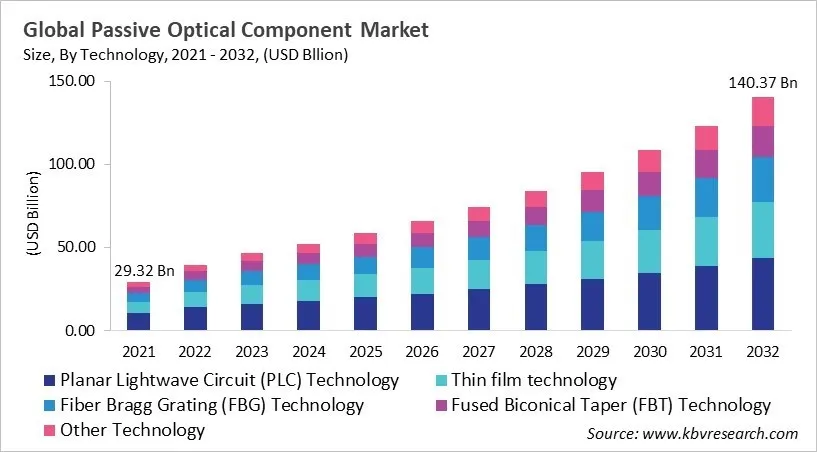
Recently, the passive optical component market has evolved from its origin in government supported optical research to a cornerstone of data-center infrastructure and modern telecom. Early integration in Europe, Japan, and the US resulted in popularity of high-capacity optical communication, which afterwards surged by nationwide broadband programs such as China, India, South Korea, Singapore, the US, and Europe. Passive components like WDM filters, connectors, PLCs and splitters developed into critical enablers of energy-efficient, and high-speed networks, with the expanding usage of internet and necessity of fiber networks for cloud computing, FTTH, 4G/5G and smart city deployments. In addition, the initiatives in silicon photonics, high density fiber management and micro-optics have strengthened the role of passive optical components across enterprise, IoT ecosystems, and telecom.
The expansion of market is supported by hyperscale data-center expansion, rapid technological advancements, and strong policy support. Key players such as Huawei, TE Connectivity, Corning, and Sumitomo Electric seek to position themselves with advanced materials engineering, global manufacturing, R&D investment, and collaborations with cloud providers, and telecom operators. The market seems to be intensively competitive across innovation-led high-performance segments and cost-driven commoditized components like silicon-photonics modules, and DWDM filters. The passive optical component market continues to grow at a steady rate driven by next-generation network requirements, and digital modernization combined with rising performance demands and increasing fiber deployment globally.
The COVID-19 pandemic had a big impact on the global passive optical component market by changing the way that supply and demand worked. Raw material shortages, shipment delays, and factory shutdowns, especially in important production centers like China, put a lot of stress on supply chains. This led to longer lead times and slower production. At the same time, demand patterns changed as more people worked from home and spent more time online, making the need for high-speed connectivity greater. However, telecom companies and businesses put off investing in infrastructure to save money, which delayed the deployment of large-scale fiber networks. Fieldwork restrictions and a lack of workers made it even harder to install and maintain FTTH and data center projects, which slowed down the rate at which projects were completed. These factors all together caused suppliers to have operational problems, delayed contracts, and falling revenues, which slowed down market growth for a short time. Thus, the COVID-19 pandemic had a negative impact on the market.

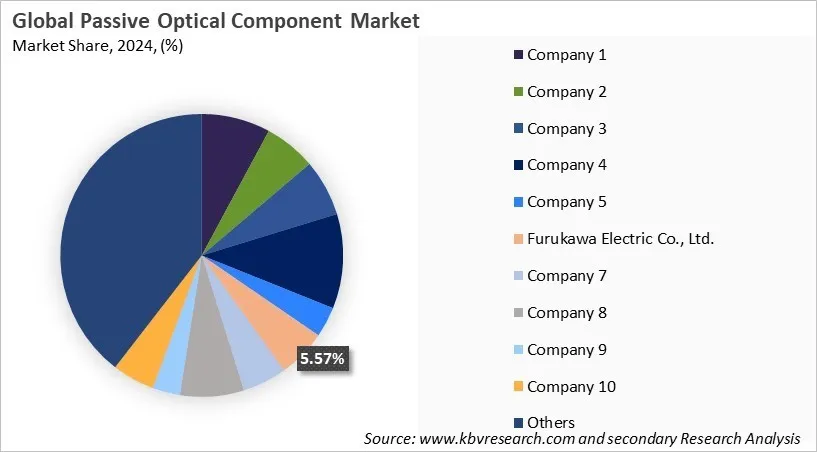
The leading players in the market are competing with diverse innovative offerings to remain competitive in the market. The above illustration shows the percentage of revenue shared by some of the leading companies in the market. The leading players of the market are adopting various strategies in order to cater demand coming from the different industries. The key developmental strategies in the market are Acquisitions, and Partnerships & Collaborations.
Based on Technology, the market is segmented into Planar Lightwave Circuit (PLC) Technology, Thin film technology, Fiber Bragg Grating (FBG) Technology, Fused Biconical Taper (FBT) Technology and Other Technology. The thin film technology segment attained 24% revenue share in the passive optical component market in 2024. Thin Film technology plays a prominent role across the global passive optical landscape due to its importance in wavelength management, optical filtering, and spectral precision. As global data traffic surges and optical communication networks become more complex, thin-film-based components support critical functions such as wavelength division multiplexing, signal conditioning, and high-accuracy filtering.
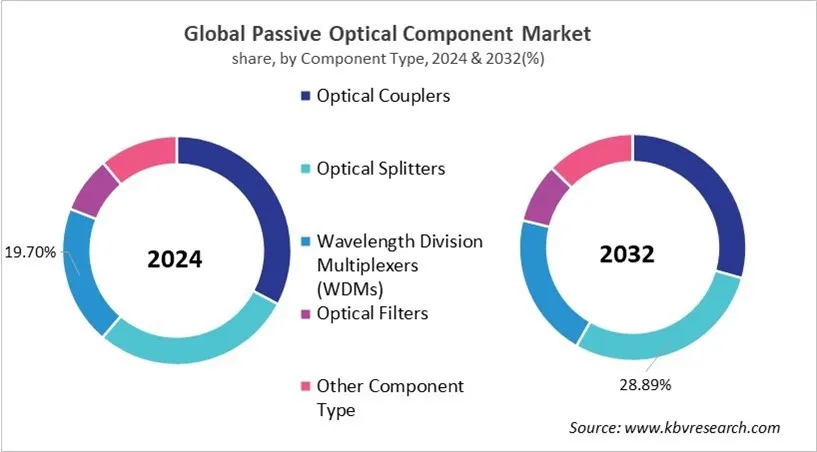
Based on Component Type, the market is segmented into Optical Couplers, Optical Splitters, Wavelength Division Multiplexers (WDMs), Optical Filters and Other Component Type. The optical splitters segment recorded 28% revenue share in the passive optical component market in 2024. The Optical Splitters segment holds a significant share of the worldwide passive optical component market due to its essential role in distributing optical signals across multiple output channels. As global demand for high-speed internet access, fiber-to-the-home (FTTH) deployment, and passive optical network (PON) infrastructure continues to rise, the need for optical splitters remains substantial.
Free Valuable Insights: Passive Optical Component Market size to reach USD 140.37 Billion by 2032
Region-wise, the passive optical component market is analyzed across North America, Europe, Asia Pacific, and LAMEA. The North America segment recorded 39% revenue share in the passive optical component market in 2024. In North America and Europe region, the passive optical component market is anticipated to grow at a significant rate. This is because of the support from well-established telecom infrastructure, continuous investment in 5G, substantial FTTH/FTTP rollouts and expansion of data center. In North America, US federal programs like Canada’s Universal Broadband Fund and BEAD support large-scale fiber deployments in remote areas, thereby accelerating demand for WDM modules, splitters, and high-density connectivity components. Moreover, Europe region is experiencing expansion driven by national digital initiatives in the UK, France, and Germany, and EU Gigabit Society targets. The region’s strong focus on low-energy network designs and sustainability surges adoption of micro-optics, advanced PLC technologies and energy-efficient passive distribution systems.
The passive optical component market is predicted to capture prominent market share in Asia Pacific and LAMEA regions. The growth in regions is supported by large-scale greenfield fiber deployment. The APAC region leads fiber adoption backed by China’s nationwide FTTH expansion, rapid broadband modernization in Japan, Southeast Asia and South Korea, and India’s BharatNet projects. Such initiatives result in high demand for cost-effective passive components along with accelerating innovations in compact optical devices for dense urban networks, and 5G small cells. Furthermore, LAMEA region is also representing positive opportunities as regional governments prioritize smart-city projects, telecom modernization, and digital inclusion. Nations like Brazil, Saudi Arabia, and the UAE are largely investing in data-center buildouts, and fiber backbones, thereby offering new opportunities for passive optical component market.
| Report Attribute | Details |
|---|---|
| Market size value in 2025 | USD 58.64 Billion |
| Market size forecast in 2032 | USD 140.37 Billion |
| Base Year | 2024 |
| Historical Period | 2021 to 2023 |
| Forecast Period | 2025 to 2032 |
| Revenue Growth Rate | CAGR of 13.3% from 2025 to 2032 |
| Number of Pages | 583 |
| Number of Tables | 431 |
| Report coverage | Market Trends, Revenue Estimation and Forecast, Segmentation Analysis, Regional and Country Breakdown, Market Share Analysis, Porter’s 5 Forces Analysis, Company Profiling, Companies Strategic Developments, SWOT Analysis, Winning Imperatives |
| Segments covered | Technology, Component Type, Application, Region |
| Country scope |
|
| Companies Included | Broadcom, Inc., Coherent Corp., Fujitsu Limited, Corning Incorporated, Molex, LLC (Koch Industries, Inc.), Furukawa Electric Co., Ltd., Sumitomo Electric Industries, Ltd., Huawei Technologies Co., Ltd. (Huawei Investment & Holding Co., Ltd.), ZTE Corporation, and TE Connectivity Ltd. |
By Technology
By Component Type
By Application
By Geography
The market size is projected to reach USD 140.37 Billion by 2032.
The passive optical component market is projected to grow at a CAGR of 13.3% between 2025 and 2032.
The rollout of 5G, mobile backhaul, and fixed–mobile network convergence, together with growth in data centers, cloud services, edge computing, and enterprise network upgrades, is accelerating market growth.
Broadcom, Inc., Coherent Corp., Fujitsu Limited, Corning Incorporated, Molex, LLC (Koch Industries, Inc.), Furukawa Electric Co., Ltd., Sumitomo Electric Industries, Ltd., Huawei Technologies Co., Ltd. (Huawei Investment & Holding Co., Ltd.), ZTE Corporation, and TE Connectivity Ltd.
The Optical Couplers segment led the maximum revenue in the Global Passive Optical Component Market by Component Type in 2024, thereby, achieving a market value of $41.2 billion by 2032.
The North America region dominated the Global Passive Optical Component Market by Region in 2024, and would continue to be a dominant market till 2032; thereby, achieving a market value of $52.6 billion by 2032.
Our team of dedicated experts can provide you with attractive expansion opportunities for your business.












 Unique Offerings