“Global On-Device AI Market to reach a market value of USD 54.79 Billion by 2032 growing at a CAGR of 27.1%”
The Global On-device AI Market size is estimated at $10.24 billion in 2025 and is expected to reach $54.79 billion by 2032, rising at a market growth of 27.1% CAGR during the forecast period (2025-2032). The rapid expansion of the on-device AI market is driven by growing demand for real-time processing, enhanced data privacy, and reduced cloud dependency across smartphones, wearables, and IoT devices. Advancements in edge AI chips, 5G connectivity, and optimized machine learning models further accelerate adoption and support strong revenue growth.
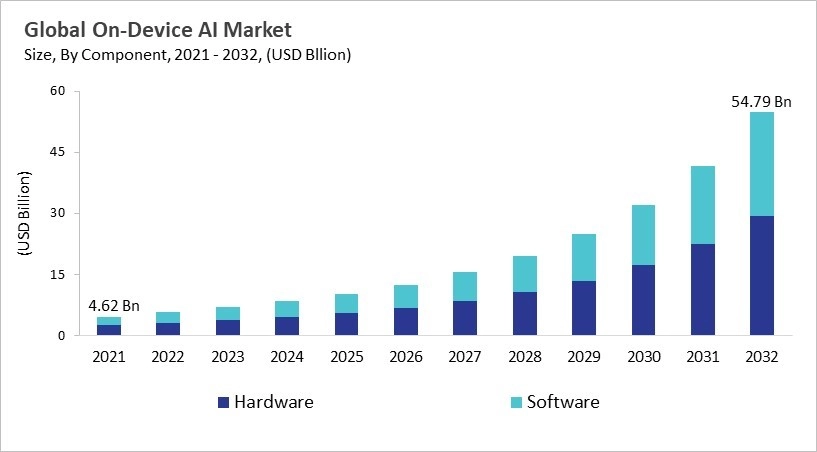
On-device artificial intelligence (AI) involves running AI models directly on hardware like wearables, laptops, smartphones, and embedded systems, rather than relying on cloud servers. This approach developed as devices became more powerful and chipmakers unveiled dedicated neural processing units having the capability to handle complex task like speech processing, image recognition, and predictive text. Key OEMs like Qualcomm and Apple further supported the shift by deeply integrating AI accelerators and optimized software frameworks into their platforms, thus allowing low-latency, fast, and offline AI experiences. Recently, on-device AI has evolved into a core product strategy, with initiatives like Neural Engine, Apple’s, Core ML, and Apple Intelligence enabling rising sophisticated models, such as large language models, to run privately on user devices.
The on-device AI market’s growth is propelled by rising emphasis on regulatory pressure, privacy, and the need for responsive, always-available principles while allowing features like health monitoring, real-time translation, visual search, and contextual assistance. Hybrid architectures are developing where regional inference is combined with selective cloud support for large-scale workloads. On-device artificial intelligence is rapidly expanding into AR/VR, IoT, wearables, and automotive systems, driven by enhanced developer frameworks that simplify optimization and deployment. These trends point toward a distributed AI future that balances efficiency, performance, and privacy while delivering a more resilient user experience.
The major strategies followed by the market participants are Partnership as the key developmental strategy to keep pace with the changing demands of end users. For instance, In June, 2025, IBM partnered with Inclusive Brains to enhance brain-machine interfaces using AI and quantum technologies, aiming to classify brain activity patterns for accessibility. The collaboration enables real-time, adaptive, multimodal AI systems that empower users with disabilities through non-invasive, on-device interaction. Additionally, In June, 2025, Apple expanded its partnership with OpenAI and introduced new on-device AI features at WWDC 2025, including live translation, visual intelligence, and Siri upgrades. These enhancements emphasize privacy-focused, device-based AI processing, contrasting with competitors' cloud-based AI strategies.
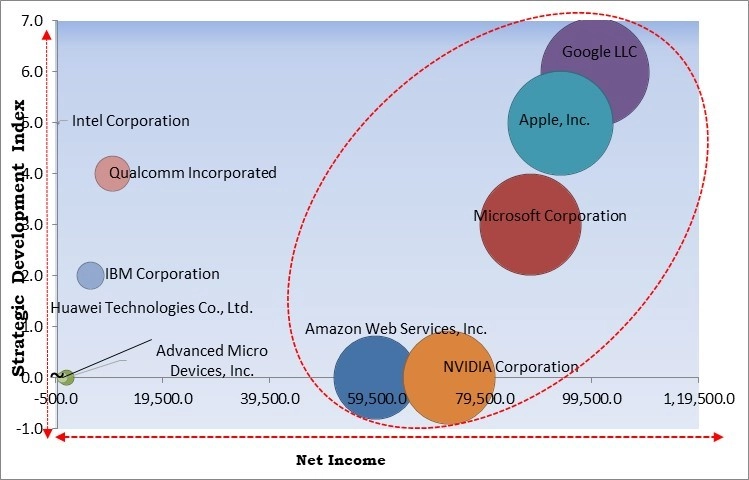
Based on the Analysis presented in the KBV Cardinal matrix; Google LLC, Apple, Inc., Amazon Web Services, Inc. Companies such as Qualcomm Incorporated and IBM Corporation are some of the key innovators in On-device AI Market. Microsoft Corporation and NVIDIA Corporation are the forerunners in the On-device AI Market. In June, 2025, Google LLC and OpenAI partnered to expand its computing capacity, despite being AI rivals. This move reduces OpenAI’s reliance on Microsoft Azure and supports its growing AI demands, indirectly benefiting the broader AI ecosystem, including the on-device AI market.
The COVID-19 pandemic hurt the on-device AI market by breaking up global supply chains and making processors, sensors, and edge AI chips hard to find. This pushed back product launches and raised production costs. Consumer demand fell because people were unsure about the economy and had less money to spend, which meant they put off buying non-essential AI-enabled devices. Enterprise adoption also slowed down because of budget issues and a shift in focus to infrastructure for remote work. Also, R&D was slowed down by problems with the workforce and limited access to facilities, which delayed new ideas and made them available for sale. All these things together slowed down short-term market growth and technological progress during the pandemic. Thus, the COVID-19 pandemic had a negative impact on the market.

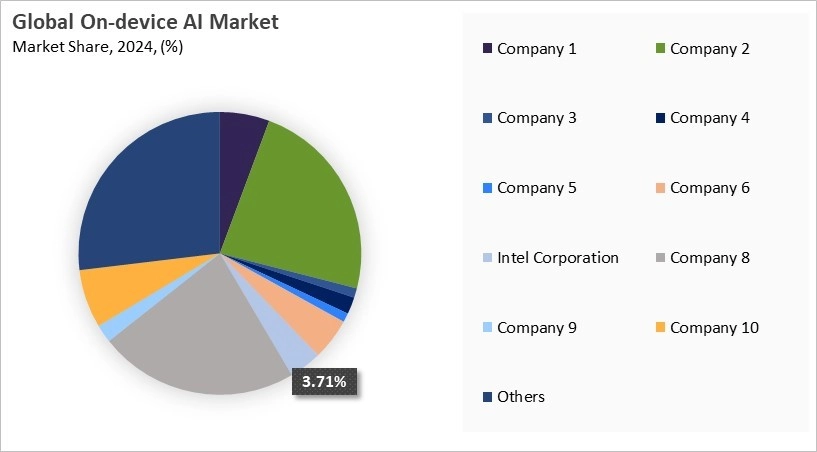
The leading players in the market are competing with diverse innovative offerings to remain competitive in the market. The above illustration shows the percentage of revenue shared by some of the leading companies in the market. The leading players of the market are adopting various strategies in order to cater demand coming from the different industries. The key developmental strategies in the market are Acquisitions, and Partnerships & Collaborations.
Based on technology, the on-device AI market is segmented into machine learning, computer vision, natural language processing, and speech recognition. The computer vision segment attained 27% revenue share in the market in 2024. The computer vision segment focuses on enabling devices to interpret and analyze visual data such as images and video streams directly at the device level. This technology is widely used in applications including facial recognition, object detection, gesture control, augmented reality, surveillance systems, and autonomous navigation.
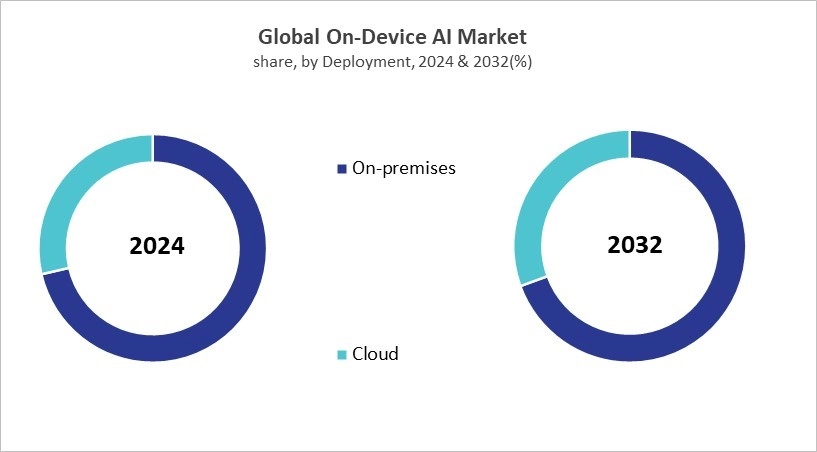
Based on deployment, the on-device AI market is segmented into on-premises and cloud. The cloud segment acquired 29% revenue share in the market in 2024. The cloud segment within the on-device AI market involves leveraging cloud-based infrastructure to support certain aspects of AI model management, updates, and extended analytics while maintaining device-level intelligence. This deployment approach allows developers and organizations to centrally manage models, deploy updates, and scale AI capabilities across large device networks.
Free Valuable Insights: On-device AI Market Size to reach $54.79 by 2032
Region-wise, the on-device AI market is analyzed across North America, Europe, Asia Pacific, and LAMEA. The North America segment recorded 36% revenue share in the market in 2024. The on-device artificial intelligence (AI) market is anticipated to grow at a significant rate in North America and Europe. The market is supported by early adoption of advanced AI software and hardware, strong presence of major tech and semiconductor companies. The market drives demand through rapid consumer electronics adoption, noticeable R&D investment, and enterprise integration across healthcare, automotive, and IoT, favoring regional processing for privacy and performance benefits. Moreover, the European on-device artificial intelligence market is estimated to expand during the forecast period. This is because of investments in AI innovation and strict data privacy frameworks like GDPR that encourage on-device processing to reduce dependency on the cloud. European growth is also driven by industrial automation and rising smart city deployments that support regional AI interference to improve responsiveness and compliance.
In the Asia Pacific and LAMEA regions, the on-device AI market is projected to capture a noticeable share during the forecast period. The market is driven by widespread smartphone penetration, proactive government initiatives, and strong consumer electronics manufacturing hubs. This growth is further supported by a large volume of AI-driven devices shipped and surging adoption across industries from smart manufacturing to connected mobility. Furthermore, the LAMEA on-device artificial intelligence market is witnessing expansion at a steady pace. Some of the elements supporting expansion include smart city projects, digital transformation efforts, and increasing IoT adoption in the region, creating opportunities for on-device AI solutions that emphasize real-time responsiveness and regional data handling.
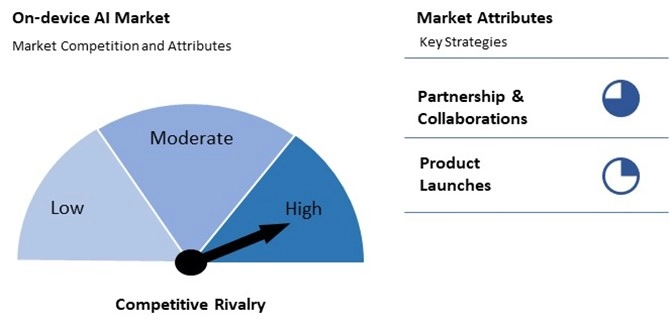
The on-device AI market is highly competitive, with key players like Apple, Google, Qualcomm, and NVIDIA innovating to enhance performance, efficiency, and privacy. Competition focuses on low-power architectures, specialized AI chips, and optimized algorithms for smartphones, wearables, and IoT devices. Market attributes include reduced latency, enhanced data security, and offline capabilities. Continuous R&D, strategic partnerships, and product differentiation through hardware-software integration are driving rapid adoption and competitive positioning.
| Report Attribute | Details |
|---|---|
| Market size value in 2025 | USD 10.24 Billion |
| Market size forecast in 2032 | USD 54.79 Billion |
| Base Year | 2024 |
| Historical period | 2021 to 2023 |
| Forecast Period | 2025 to 2032 |
| Revenue Growth Rate | CAGR of 27.1% from 2025 to 2032 |
| Number of Pages | 674 |
| Tables | 587 |
| Report Coverage | Market Trends, Revenue Estimation and Forecast, Segmentation Analysis, Regional and Country Breakdown, Competitive Landscape, Market Share Analysis, Porter’s 5 Forces Analysis, Company Profiling, Companies Strategic Developments, SWOT Analysis, Winning Imperatives |
| Segments Covered | Component, Technology, Deployment, Device, Vertical, Region |
| Country Scope |
|
| Companies Included | Google LLC, Apple, Inc., Amazon Web Services, Inc. (Amazon.com, Inc.), Microsoft Corporation, IBM Corporation, NVIDIA Corporation, Intel Corporation, Qualcomm Incorporated (Qualcomm Technologies, Inc.), Advanced Micro Devices, Inc. and Huawei Technologies Co., Ltd. (Huawei Investment & Holding Co., Ltd.) |
By Component
By Technology
By Deployment
By Device
By Vertical
By Geography
Our team of dedicated experts can provide you with attractive expansion opportunities for your business.











 Unique Offerings