The North America Virtualized Evolved Packet Core (vEPC) Market would witness market growth of 24.9% CAGR during the forecast period (2025-2032).
The US market dominated the North America Virtualized Evolved Packet Core (vEPC) Market by Country in 2024, and would continue to be a dominant market till 2032; thereby, achieving a market value of $8,883.9 million by 2032. The Canada market is experiencing a CAGR of 27.1% during (2025 - 2032). Additionally, The Mexico market would exhibit a CAGR of 26.3% during (2025 - 2032). The US and Canada led the North America Virtualized Evolved Packet Core (vEPC) Market by Country with a market share of 71.9% and 14% in 2024.
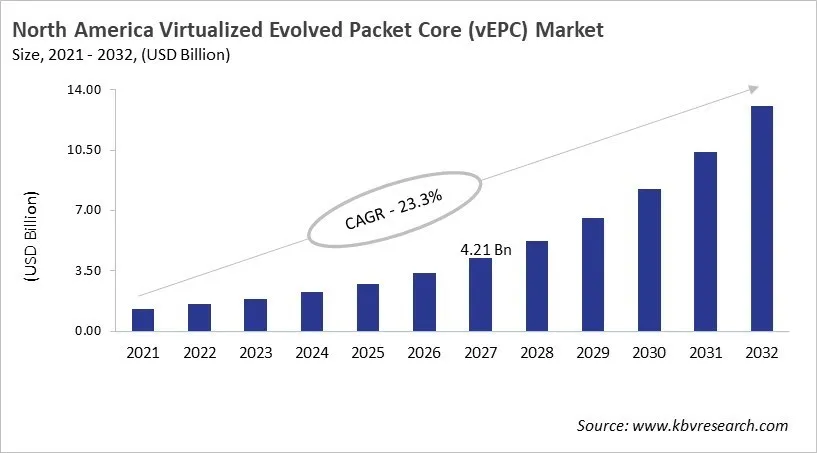
The North American vEPC market has become a crucial part of the region's move toward software-defined, cloud-native mobile networks. This is due to the early adoption of LTE, rapid growth in mobile data traffic, and pressure on old hardware-based cores. Strong government support for digital modernization and early investments by major operators in network virtualization sped up the shift toward flexible, scalable vEPC architectures. Telecom companies and OEMs worked together to replace proprietary infrastructure with virtualized core functions running on COTS servers. This improved system flexibility, cost-effectiveness, and capability for advanced services such as private LTE, IoT, and mission-critical communications. As a result, vEPC has become a strategic tool for making wireless solutions in North America more efficient, mobile, and business-focused.
Important trends are shaping the market. These include distributed and edge-enabled core deployments, growth of private LTE/5G networks using CBRS spectrum, and movement toward cloud-native, containerized vEPC that matches 5G Core evolution. Top companies are solidifying their positions by investing in automation and open, interoperable ecosystems. They are also forming partnerships with hyperscale cloud providers to support low-latency, enterprise, and edge use cases. Competition remains fierce. Telecom OEMs, operators, cloud providers, and specialized vendors all strive to offer solutions that are flexible, scalable, and meet industry standards. The North American vEPC market is a mature but fast-changing ecosystem. It links legacy LTE networks with the future of cloud-native 5G networks.
Based on End User, the market is segmented into Telecom Operators, Enterprises & Industrial Applications, MVNE / MVNOs, Government & Public Safety, and Cloud Service Providers. The Telecom Operators market segment dominated the US Virtualized Evolved Packet Core (vEPC) Market by End User is expected to grow at a CAGR of 23.1 % during the forecast period thereby continuing its dominance until 2032. Also, The Cloud Service Providers market is anticipated to grow as a CAGR of 27.9 % during the forecast period during (2025 - 2032).
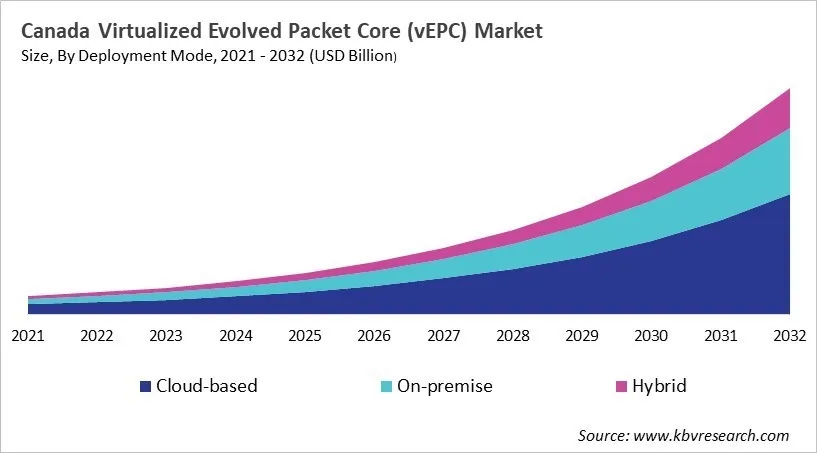
Based on Deployment Mode, the market is segmented into Cloud-based, On-premise, and Hybrid. Among various Canada Virtualized Evolved Packet Core (vEPC) Market by Deployment Mode; The Cloud-based market achieved a market size of USD $173.9 Million in 2024 and is expected to grow at a CAGR of 26.5 % during the forecast period. The Hybrid market is predicted to experience a CAGR of 28.2% throughout the forecast period from (2025 - 2032).
Free Valuable Insights: The Virtualized Evolved Packet Core (vEPC) Market is Predicted to reach USD 45.29 Billion by 2032, at a CAGR of 25.7%
The US is a very advanced and important VPC market, thanks to fast 5G rollouts, strong digital transformation in businesses, and big investments by telecom companies. The move from old EPC systems to new, cloud-native, and 5G-ready core architectures is speeding up because of the rise in mobile data traffic from video streaming, gaming, and IoT apps. Key growth drivers include the nationwide rollout of 5G, federal support for upgrading telecom infrastructure, and the increasing use of private 4G and 5G networks in industries like manufacturing, healthcare, and logistics. Market trends show that cloud-native cores, containerized network functions, mobile edge computing, and AI-driven automation are becoming more popular. Competition is still fierce, with global network vendors, cloud hyperscalers, and new software companies driving innovation. At the same time, operators are still focusing on scalability, agility, and cost-effectiveness through virtualization.

By End User
By Deployment Mode
By Application
By Country
Our team of dedicated experts can provide you with attractive expansion opportunities for your business.



 Unique Offerings