The North America Video as a Sensor Market would witness market growth of 7.5% CAGR during the forecast period (2025-2032).
The US market dominated the North America Video As A Sensor Market by Country in 2024, and would continue to be a dominant market till 2032; thereby, achieving a market value of $31,052.6 million by 2032. The Canada market is experiencing a CAGR of 9.7% during (2025 - 2032). Additionally, The Mexico market would exhibit a CAGR of 8.8% during (2025 - 2032).
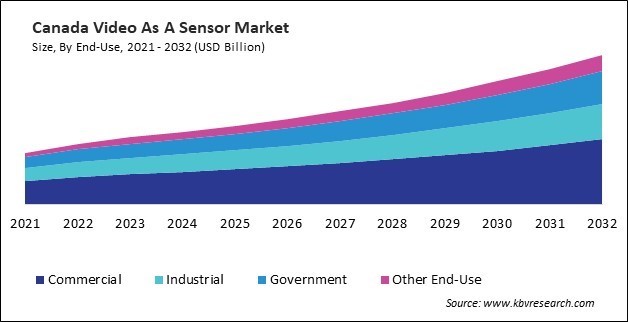
The Video as a Sensor (VaaS) industry in North America has grown from simple CCTV systems to smart platforms that use analytics. The U.S. Department of Homeland Security and other government agencies originally paid for and recorded this change. Their CCTV Technology Handbook described early IP, DVR, and network storage designs. This change set the stage for video sensors that can provide data in real time.
Free Valuable Insights: The Video As A Sensor Market is Predict to reach USD 131.73 Billion by 2032, at a CAGR of 8.1%
North America is witnessing rapid growth in AI-enhanced video analytics for public safety and critical infrastructure protection. These solutions go beyond traditional video monitoring, providing functionalities such as facial recognition, behavior detection, and real-time threat alerts.
In July 2023, the New York City Police Department (NYPD) expanded its use of AI-based video analytics as part of its subway surveillance system. The city upgraded its network with edge-based computing nodes and object recognition AI to detect unattended bags, abnormal movement, and identify known individuals through facial recognition.
Chicago’s Office of Emergency Management and Communications continues to expand its Strategic Decision Support Centers (SDSCs), integrating AI-enabled cameras to proactively monitor high-crime areas since its initial deployment in 2017, with major upgrades introduced in 2022.
Smart city projects across the U.S. and Canada increasingly rely on intelligent video sensors for optimizing traffic, monitoring environmental conditions, and ensuring public safety. These sensors form the core of next-generation urban infrastructure.
In February 2023, the City of Las Vegas announced the next phase of its smart city initiative in partnership with NTT Group and Dell Technologies. The project involves AI-powered video sensors to monitor real-time vehicle and pedestrian flow, with results used to reduce road accidents and congestion in the downtown corridor.
North America represents one of the most dynamic and competitive regional markets for Video as a Sensor technology, driven by smart city rollouts, high public safety spending, industrial automation, and military-grade surveillance demands. The competitive environment is characterized by a strong base of domestic OEMs, influential cloud infrastructure providers, and aggressive adoption of AI-enabled surveillance technologies.
Key Players: Cisco Systems, Motorola Solutions (Avigilon), FLIR Systems (Teledyne), Honeywell Security, Axis Communications (North American operations), Pelco
U.S.-based OEMs dominate the enterprise and government segments. For example:
Key Players: Rhombus Systems, Verkada, Eagle Eye Networks, Openpath (acquired by Motorola)
These firms focus on scalable, secure cloud-based video management platforms that appeal to enterprise IT departments:
Based on Offering, the market is segmented into Hardware, Software, and Services.
In early 2025, Kyocera introduced its DuraForce PRO 3 rugged smartphone featuring an AI-capable depth sensor over private 5G—supporting outdoor and industrial VaaS use cases. Texas Instruments also released ultra-low-power vision processors (AM62A / AM68A / AM69A) supporting multi-camera inferencing at sub-1 W power for smart security and industrial embedded sensors.
North American hardware market features established OEMs like Axis, Hanwha, and Bosch in surveillance; Kyocera and TI in rugged and embedded sensors; and compute module leaders NVIDIA, Intel, and TI providing edge-AI foundations.
In August 2024, Airship AI secured a multi-year DoD contract for its Acropolis enterprise video/data management platform—a sign of the U.S. government’s trust in VaaS software ecosystems.
Software leadership in North America includes Airship AI, BriefCam, Genetec, and Avigilon, with compute integration from Sony, NVIDIA, and TI, and 5G delivery via Ericsson and carriers.
Based on Product, the market is segmented into Video Surveillance, Machine Vision & Monitoring, Thermal Imaging, and Hyperspectral Imaging.
Trend: Accelerating deployment of AI-enhanced surveillance in public safety and urban infrastructure
For instance: Loudoun County, VA, is implementing AI-driven surveillance cameras (by VOLT AI) to detect fights, bullying, and medical emergencies in school environments. This system flags events in real-time, verified by staff before alerts are sent — illustrating growing reliance on intelligent video systems in community settings.
A recent report from Axis Communications emphasizes North America’s rapid shift from passive CCTV to AI-enabled systems supporting facial recognition, behavior analysis, and operational insights.
Trend: Expanding use of hyperspectral sensors in defense, healthcare, and environmental applications
For instance, North America dominates global hyperspectral imaging usage with a 35% regional share, driven by heavy investments in defense and healthcare sectors.
Though specialized, hyperspectral imaging is gaining in public sector use (e.g., agriculture and food safety). Notably, government-funded remote sensing projects are increasingly leveraging these systems.
Based on End-Use, the market is segmented into Commercial, Industrial, Government, and Other End-Use.
Trend: Federal and municipal agencies are deploying edge-enabled video sensors integrated with AI for enhanced border security, law enforcement, and public safety.
Trend: Commercial entities—especially retailers—are embracing AI gesture-recognition platforms to reduce theft and improve staff response, while respecting customer privacy.
Based on Application, the market is segmented into Security & Surveillance, Traffic Management, Retail Analytics, Healthcare, Manufacturing, Mapping, and Other Application.
Trend: AI-powered gesture and behavior detection is being deployed at scale in public and retail environments, enhancing situational awareness and loss prevention.
For instance:
Trend: Automated video sensors and smart infrastructure are optimizing traffic flow, enforcing safety, and prioritizing emergency vehicles.
Based on Offering, the market is segmented into Hardware, Software, and Services. Based on Product, the market is segmented into Video Surveillance, Machine Vision & Monitoring, Thermal Imaging, and Hyperspectral Imaging. Based on End-Use, the market is segmented into Commercial, Industrial, Government, and Other End-Use. Based on Application, the market is segmented into Security & Surveillance, Traffic Management, Retail Analytics, Healthcare, Manufacturing, Mapping, and Other Application. Based on countries, the market is segmented into U.S., Mexico, Canada, and Rest of North America.

By Offering
By Product
By End-Use
By Application
By Country
Our team of dedicated experts can provide you with attractive expansion opportunities for your business.



 Unique Offerings