The North America Soft Facility Management Market would witness market growth of 4.4% CAGR during the forecast period (2025-2032).
The US market dominated the North America Soft Facility Management Market by Country in 2024, and would continue to be a dominant market till 2032; thereby, achieving a market value of $240,322.1 million by 2032. The Canada market is experiencing a CAGR of 6.1% during (2025 - 2032). Additionally, The Mexico market would exhibit a CAGR of 5.4% during (2025 - 2032). The US and Canada led the North America Soft Facility Management Market by Country with a market share of 70.2% and 15% in 2024.
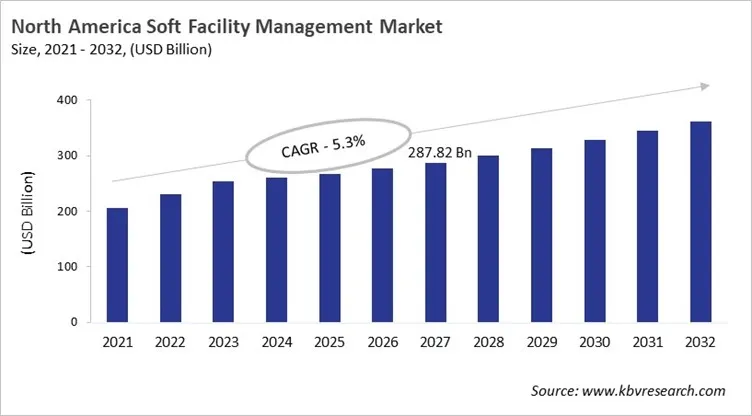
Soft facility management in North America has grown from simple cleaning and maintenance tasks to a strategic role that is important to how buildings work. It now offers a wide range of services, such as cleaning, landscaping, trash collection, utility maintenance, and energy management, all of which are in line with safety, comfort, productivity, and following the rules. Federal practices, especially those of the U.S. GSA, show this change through wide-ranging facility-related service frameworks and regulations like 41 CFR Part 102-74, which require buildings to be run well. The industry has been moving away from reactive, single-service contracts and toward integrated, preventive, and performance-driven models. This is part of a bigger change in which people no longer see facility management as just a cost, but as something that helps with sustainability, energy efficiency, and risk reduction.
As real estate portfolios grew, the market started to use bundled services and strategic sourcing models like the GSA's BMO program, which groups together contracts for cleaning, landscaping, HVAC, pest control, and other important services. Smart-building and IoT technologies now make things even more efficient, helping to save energy and improve management of operations. The competitive landscape has also grown up. Now, providers are judged on how well they do in terms of sustainability, occupant health, following the rules, and managing lifecycle costs. In general, soft facility management has become a technology-enabled, outcome-focused field where providers work as strategic partners. This is due to trends in outsourcing, regulatory expectations, environmental goals, and the growing importance of occupant experience.
Based on End Use, the market is segmented into Business & Corporate, Healthcare, Retail, Education, Travel & Hospitality, Construction & Real Estate, Government & Public Sector, Manufacturing, and Other End Use. Among various US Soft Facility Management Market by End Use; The Business & Corporate market achieved a market size of USD $67346.4 Million in 2024 and is expected to grow at a CAGR of 2.4 % during the forecast period. The Government & Public Sector market is predicted to experience a CAGR of 4.5% throughout the forecast period from (2025 - 2032).
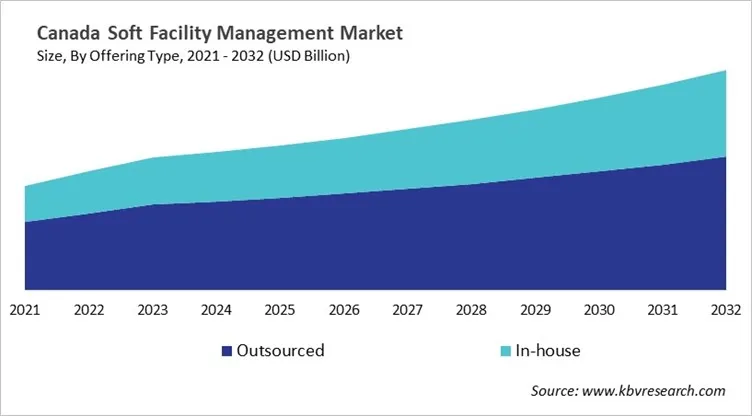
Based on Offering Type, the market is segmented into Outsourced, and In-house. The Outsourced market segment dominated the Canada Soft Facility Management Market by Offering Type is expected to grow at a CAGR of 5.4 % during the forecast period thereby continuing its dominance until 2032. Also, The In-house market is anticipated to grow as a CAGR of 7.4 % during the forecast period during (2025 - 2032).
Free Valuable Insights: The Soft Facility Management Market is Predicted to reach USD 1107.03 Billion by 2032, at a CAGR of 5.0%
The U.S. soft facility-management market is big because it has a lot of commercial, institutional, and public infrastructure. This makes services like cleaning, security, landscaping, catering, and reception very popular. Rising concerns about health, safety, hygiene, and sustainability in the workplace—especially after the pandemic—are changing what people expect and speeding up the outsourcing of non-core tasks. The market is moving away from contracts for one service at a time and toward integrated, bundled solutions that use data analytics, IoT technologies, and adaptive scheduling for hybrid workplaces. There is a lot of competition, with global FM companies and specialized domestic firms fighting over things like adopting new technologies, reaching customers all over the country, getting environmental certifications, and showing measurable performance results. Providers with strong innovation skills and eco-friendly practices are best suited to lead the U.S. soft-FM sector as sustainability, operational efficiency, and occupant well-being become more important.

By Offering Type
By Organization Size
By Services Type
By End Use
By Country
Our team of dedicated experts can provide you with attractive expansion opportunities for your business.



 Unique Offerings