The North America Situation Awareness Systems Market would witness market growth of 6.1% CAGR during the forecast period (2025-2032).
The US market dominated the North America Situation Awareness Systems Market by Country in 2024, and would continue to be a dominant market till 2032; thereby, achieving a market value of $11,111.8 million by 2032. Canada market is experiencing a CAGR of 8.2% during (2025 - 2032). Additionally, The Mexico market would exhibit a CAGR of 7.5% during (2025 - 2032). The US and Canada led the North America Situation Awareness Systems Market by Country with a market share of 76% and 13.1% in 2024.
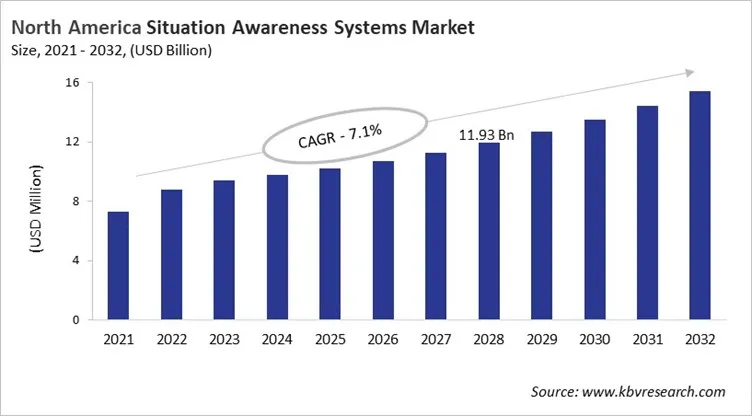
In North America, situational awareness has gone from separate radar-based warning systems to highly integrated, multi-domain architectures that cover air, land, sea, cyber, and space. These capabilities started as air and missile defense programs from the Cold War and grew over time into networked command, control, communications, and intelligence systems that combined radar, satellite, and intelligence data. In the modern era, programs like the Joint All-Domain Command and Control (JADC2) from the U.S. Department of Defense show a move toward unified operational pictures that link different sensors and platforms. This change is happening because threats are getting more complicated, technology is moving quickly, and the government is spending more money on defense and homeland security.
Situational awareness in North America now includes more than just military operations. It also includes homeland security, border protection, emergency response, and monitoring of space domains. Advanced unmanned platforms, radar systems, and data-sharing services help keep an eye on the border and the sea. Space situational awareness programs like GSSAP keep an eye on orbital environments to protect important assets. Artificial intelligence, machine learning, sensor fusion, and satellite communications make it easier to understand things in real time and make the operator's job easier. Government agencies, defense contractors, and technology providers work together to make sure that systems can work together, analyze data, and change as needed. These trends together make up a competitive and future-focused situational awareness landscape.
Based on Platform, the market is segmented into Land, Air, Sea, and Space. The Land market segment dominated the US Situation Awareness Systems Market by Platform is expected to grow at a CAGR of 4.7 % during the forecast period thereby continuing its dominance until 2032. Also, The Sea market is anticipated to grow as a CAGR of 5.9 % during the forecast period during (2025 - 2032).
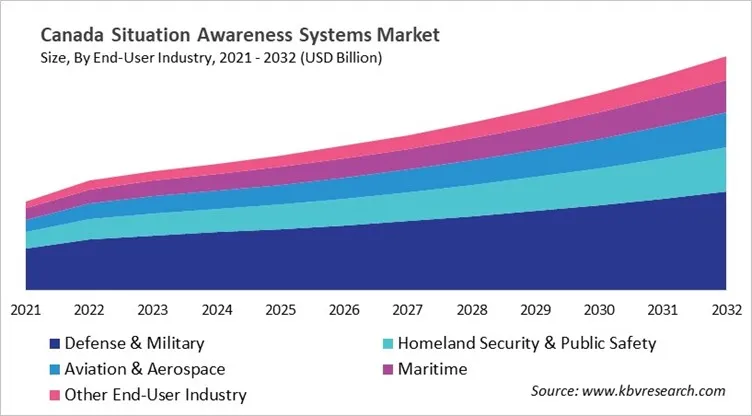
Based on End-User Industry, the market is segmented into Defense & Military, Homeland Security & Public Safety, Aviation & Aerospace, Maritime, and Other End-User Industry. With a compound annual growth rate (CAGR) of 7.1% over the projection period, the Defense & Military Market, dominate the Canada Situation Awareness Systems Market by End-User Industry in 2024 and would be a prominent market until 2032. The Maritime market is expected to witness a CAGR of 9.1% during (2025 - 2032).
Based on Type, the market is segmented into Command & Control Systems, RADAR, Optronics / EO/IR, Vehicle SAS / ADAS, and SONAR. Among various Mexico Situation Awareness Systems Market by Type; The Command & Control Systems market achieved a market size of USD $186.6 Million in 2024 and is expected to grow at a CAGR of 6.6 % during the forecast period. The SONAR market is predicted to experience a CAGR of 7.8% throughout the forecast period from (2025 - 2032).
Free Valuable Insights: The Situation Awareness Systems Market is Predicted to reach USD 44.44 Billion by 2032, at a CAGR of 6.8%
The US has the most advanced situational awareness market in all North America. This is because the government spends a lot of money on defense, and keeping the country safe is very important. The U.S. has gone from using old radar systems to using integrated, networked architectures that let people know what's going on in real time in the air, on land, at sea, in cyberspace, and in space. The Joint All-Domain Command and Control (JADC2) program and other Department of Defense (DoD) programs are making it more important to have platforms that can work with each other and grow that make it easy to make quick decisions in many areas. The market gets even bigger because of uses in homeland security, like watching the border and helping in disasters. It's easier to find threats and see what's going on with new technologies like AI, machine learning, advanced analytics, and secure satellite communications.

By Type
By Component
By Platform
By End-User Industry
By Application
By Country
Our team of dedicated experts can provide you with attractive expansion opportunities for your business.



 Unique Offerings