The North America Sensing Cable Market would witness market growth of 6.0% CAGR during the forecast period (2025-2032).
The US market dominated the North America Sensing Cable Market by Country in 2024, and would continue to be a dominant market till 2032; thereby, achieving a market value of $367.5 million by 2032. The Canada market is experiencing a CAGR of 7.8% during (2025 - 2032). Additionally, The Mexico market would exhibit a CAGR of 7.1% during (2025 - 2032). The US and Canada led the North America Sensing Cable Market by Country with a market share of 71% and 15.8% in 2024.
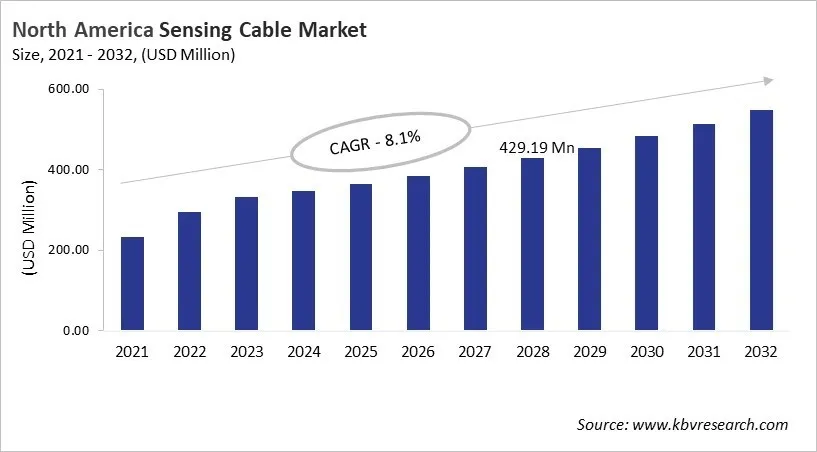
The North American sensing cable market has evolved from small, specialized applications to a mature and integral part of modern infrastructure monitoring. Because traditional point-based sensors have limitations, distributed fiber-optic sensing (DFOS) technologies have enabled the continuous and real-time monitoring of long-distance assets, such as pipelines, power transmission systems, tunnels, and civil infrastructure. New fiber-optic techniques, such as distributed temperature, strain, and acoustic sensing, have made them more reliable, better at capturing small details, and capable of monitoring multiple parameters simultaneously. As infrastructure owners prioritize safety, adherence to rules, predictive maintenance, and reduced downtime, sensing cables are becoming increasingly important to "smart infrastructure" plans in the U.S. and Canada across the energy, utilities, transportation, and civil engineering sectors.
The region's competition indicates a shift away from separate components and toward integrated, end-to-end sensing solutions. Advanced sensing technologies, turnkey packages that include cables, interrogators, analytics, and long-term support, as well as strong partnerships with infrastructure operators and engineering firms, set leading OEMs and system integrators apart. There are both specialized DFOS providers and traditional fiber manufacturers that are moving into sensing applications. This makes the market more competitive and enables more people to utilize it. As sensing cables become more standardized and important to missions, having a reliable system, expert knowledge of applications, advanced data analytics, and good service become more important than price alone.
Based on End-Use Industry, the market is segmented into Oil and Gas, Power and Utilities, Civil Infrastructure and Construction, Industrial Manufacturing and Process, Defense and Security and Data Centers and Commercial Buildings. Among various US Sensing Cable Market by End-Use Industry; The Oil and Gas market achieved a market size of USD $106.4 Million in 2024 and is expected to grow at a CAGR of 4.6 % during the forecast period. The Industrial Manufacturing and Process market is predicted to experience a CAGR of 6.5% throughout the forecast period from (2025 - 2032).
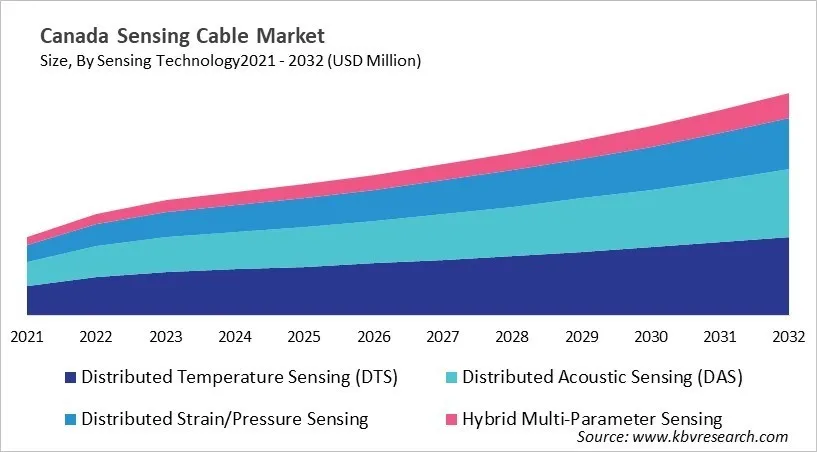
Based on Sensing Technology, the market is segmented into Distributed Temperature Sensing (DTS), Distributed Acoustic Sensing (DAS), Distributed Strain/Pressure Sensing and Hybrid Multi-Parameter Sensing. With a compound annual growth rate (CAGR) of 7% over the projection period, the Distributed Temperature Sensing (DTS) Market, dominate the Canada Sensing Cable Market by Sensing Technology in 2024 and would be a prominent market until 2032. The Distributed Acoustic Sensing (DAS) market is expected to witness a CAGR of 7.9% during (2025 - 2032).
Free Valuable Insights: The Sensing Cable Market is Predicted to reach USD 1.68 Billion by 2032, at a CAGR of 6.6%
The United States has a technologically advanced sensing cable market. This advantage stems from its large energy infrastructure, strict safety rules, and major smart-grid modernization projects. Furthermore, federal rules from agencies like PHMSA and DOE have accelerated the use of advanced solutions like DFOS, DTS, and DAS. These solutions enable real-time leak detection, integrity management, and risk reduction in one of the world's largest oil and gas pipeline networks. In addition, the need for continuous monitoring systems has intensified with ongoing grid modernization, renewable energy integration, methane-reduction goals, and climate-resilience projects. Moreover, market trends reveal that sensing cables are increasingly integrated with cloud platforms, AI-based analytics, and SCADA for predictive maintenance. At the same time, adoption is rising in offshore wind, HVDC transmission, and robust protection of critical infrastructure. Despite these developments, competition remains strong, as global OEMs, specialized sensing companies, and system integrators collaborate to deliver end-to-end monitoring solutions.

By Application
By End-Use Industry
By Sensing Technology
By Cable Type
By Country
Our team of dedicated experts can provide you with attractive expansion opportunities for your business.




 Unique Offerings