The North America Power System Analysis Software Market would witness market growth of 11.8% CAGR during the forecast period (2025-2032).
The US market dominated the North America Power System Analysis Software Market by Country in 2024, and would continue to be a dominant market till 2032; thereby, achieving a market value of $5,321.8 million by 2032. The Canada market is experiencing a CAGR of 14.2% during (2025 - 2032). Additionally, The Mexico market would exhibit a CAGR of 13.6% during (2025 - 2032). The US and Canada led the North America Power System Analysis Software Market by Country with a market share of 78.2% and 12.1% in 2024.
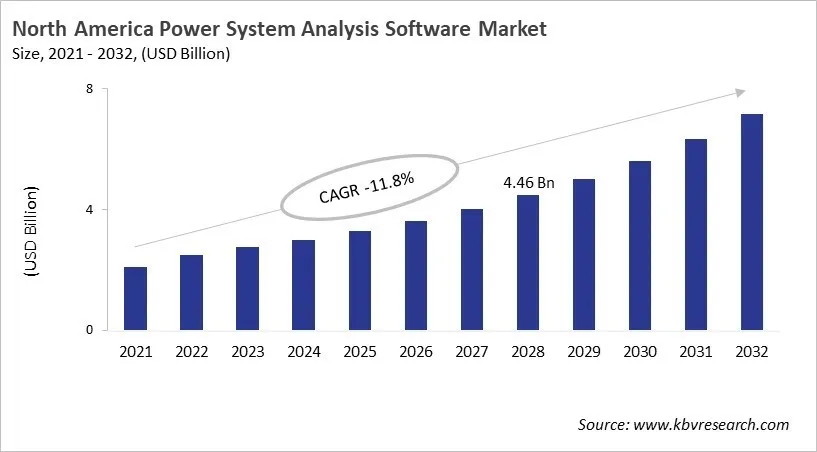
The North American power system analysis software market has changed as electricity networks in the U.S. and Canada have become more complicated. It has gone from simple steady-state and fault-analysis tools to full-featured, data-rich platforms. Modern utilities have to deal with a lot of problems, like integrating renewable energy sources, managing distributed energy resources (DERs), dealing with the growth of electric vehicle loads, aging infrastructure, and decarbonization mandates. This has led to a need for software that can model DERs, handle bidirectional flows, do cloud-based analytics, make decisions in real time, and plan for resilience. Top companies like Siemens, Schneider Electric, and GE have added digital-twin capabilities, advanced scenario analysis, and asset management features to their standalone engineering tools. This lets utilities modernize and protect their grids for the future.
Some important trends in the market are the use of DERs and behind-the-meter assets in modeling, the rise of cloud-based, analytics-driven digital-twin platforms, and efforts to modernize and strengthen the grid that are required by law. Vendors use strategic methods like platform consolidation, modular software suites, service-led growth, and DER-focused solutions. They often work with utilities and technology companies to make these strategies work. The competitive landscape includes big global OEMs that use their size, domain knowledge, and full range of services, as well as small, flexible companies that focus on micro-grids, storage, and distribution analytics. In this market, success depends on the software's capabilities, how easy it is to deploy, how well it supports the entire lifecycle, and how well it can work with both new and old utility workflows and systems.
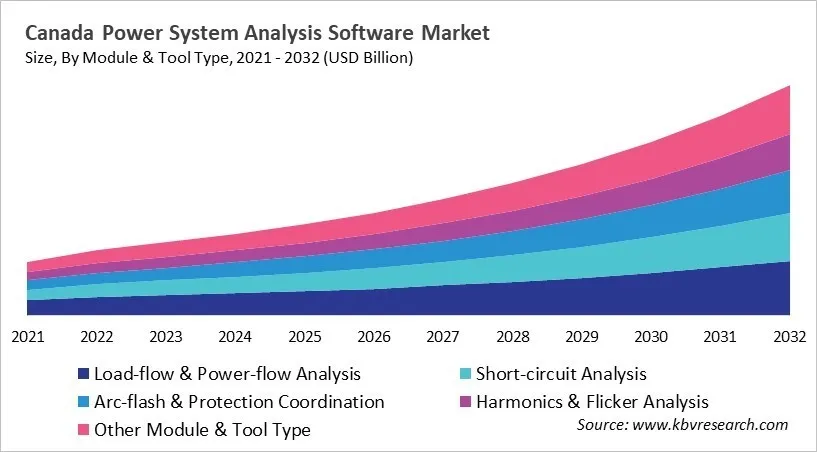
Based on Module & Tool Type, the market is segmented into Load-flow & Power-flow Analysis, Short-circuit Analysis, Arc-flash & Protection Coordination, Harmonics & Flicker Analysis and Other Module & Tool Type. With a compound annual growth rate (CAGR) of 12.2% over the projection period, the Load-flow & Power-flow Analysis Market, dominate the Canada Power System Analysis Software Market by Module & Tool Type in 2024 and would be a prominent market until 2032. The Harmonics & Flicker Analysis market is expected to witness a CAGR of 14.7% during (2025 - 2032).
Based on Deployment Type, the market is segmented into On-premise and Cloud-based. The On-premise market segment dominated the US Power System Analysis Software Market by Deployment Type is expected to grow at a CAGR of 10.6 % during the forecast period thereby continuing its dominance until 2032. Also, The Cloud-based market is anticipated to grow as a CAGR of 11.8 % during the forecast period during (2025 - 2032).
Free Valuable Insights: The Power System Analysis Software Market is Predicted to reach USD 24.12 Billion by 2032, at a CAGR of 12.0%
The U.S. power system is going through a big change because more renewable and inverter-based resources (IBR) are being used, transportation and heating are becoming more electric, the infrastructure is getting older, the weather is getting worse, and everything is becoming more digital. This change is making more people want advanced power-system analysis (PSA) software that can do dynamic, multi-domain, and high-fidelity modeling, such as load flow, fault analysis, DER integration, transmission-distribution co-modeling, and digital-twin frameworks. Key market drivers are renewables and IBRs, smart-grid deployment, resilience requirements, and grid complexity. Challenges include legacy systems, data integration, and regulatory differences. Trends show that real-time simulation, cloud-based platforms, integrated T&D modeling, scenario analysis, and the merging of planning and operational tools are all becoming more popular. There are both global and domestic PSA software vendors, OEMs, and utility in-house teams in the competitive landscape. Market adoption favors solutions that are scalable, flexible, and able to do analytics that fit with U.S. regulatory and operational contexts. The U.S. PSA software market is mature but still changing. Vendors that can handle scale, complexity, and integration across multiple domains have a lot of chances to succeed.

By End User
By Application
By Module & Tool Type
By Deployment Type
By Country
Our team of dedicated experts can provide you with attractive expansion opportunities for your business.



 Unique Offerings