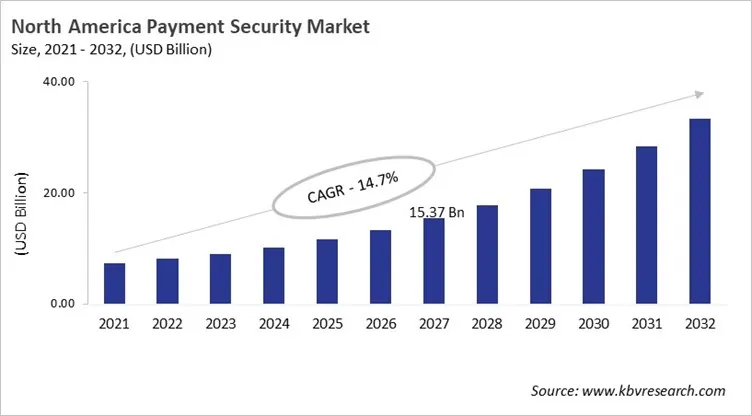
The North America Payment Security Market would witness market growth of 16.3% CAGR during the forecast period (2025-2032).
The US market dominated the North America Payment Security Market by Country in 2024, and would continue to be a dominant market till 2032; thereby, achieving a market value of $25,118.1 million by 2032. The Canada market is exhibiting a CAGR of 18.8% during (2025 - 2032). Additionally, The Mexico market is expected to witness a CAGR of 18.4% during (2025 - 2032). The US and Canada led the North America Payment Security Market by Country with a market share of 79.1% and 11.9% in 2024.
The North American payment security market has grown along with the region's early use of electronic and digital payments. Early systems used closed, bank-centered networks, and security was handled by institutional controls and regulated clearing houses. As card-based payments became more popular, the risk of fraud increased, which led to better authentication, data protection, and cooperation between banks, networks, and authorities. Cryptographic verification made it much harder to commit fraud by using fake EMV chip technology. As e-commerce grew, so did the risk of cybercrime. This led to the use of encryption, secure protocols, and network-level monitoring. Standardized cryptographic frameworks from government agencies like NIST influenced security practices. Mobile payments and digital wallets made device-level security, biometrics, and secure elements even more connected, all while regulatory oversight was changing.
In North America, payment security requirements have changed because of real-time payments and open banking. Faster settlement speeds mean that fraud detection, risk assessment, and behavioral analytics must all happen right away. Tokenization and advanced encryption are now essential tools for keeping sensitive payment information safe. Biometric authentication is being used more to make things safer and easier for users. Market leaders concentrate on regulatory compliance, proactive security-by-design, and robust infrastructure. Working with public institutions and standards bodies makes defenses across the ecosystem stronger by sharing information. Overall, competition is still fierce and driven by new ideas. Security capability, compliance expertise, and real-time protection are all important ways to stand out.
Based on End-User Industry, the market is segmented into Retail & E-commerce, BFSI (Banking & Financial Services), Healthcare, IT & Telecom, Travel & Hospitality, Government, and Other End-User Industry. Among various US Payment Security Market by End-User Industry; The Retail & E-commerce market achieved a market size of USD $2819.8 Million in 2024 and is expected to grow at a CAGR of 14.1 % during the forecast period. The Government market is predicted to experience a CAGR of 18.1% throughout the forecast period from (2025 - 2032).
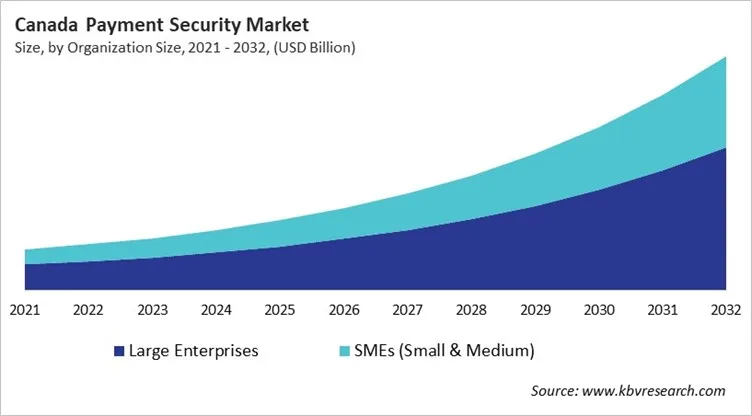
Based on Organization Size, the market is segmented into Large Enterprises, and SMEs (Small & Medium). The Large Enterprises market segment dominated the Canada Payment Security Market by Organization Size is expected to grow at a CAGR of 18.4 % during the forecast period thereby continuing its dominance until 2032. Also, The SMEs (Small & Medium) market is anticipated to grow as a CAGR of 19.6 % during the forecast period during (2025 - 2032).
Free Valuable Insights: The Payment Security Market is Predicted to reach USD 96.90 Billion by 2032, at a CAGR of 16.9%
The U.S. payment system is very advanced and connected. It supports safe money transfers through a wide range of platforms, from ACH to real-time services like FedNow. Payment security keeps trust and reliability by using both technical and regulatory and operational frameworks. The Federal Reserve plays a big role by making rules, encouraging education, and putting tools in place to stop fraud. The rise in transaction volumes and the move toward digital and instant payments have made security problems worse. Many people use advanced technologies like encryption, tokenization, fraud monitoring, and risk analytics. Because there are only a few chances to reverse a payment, real-time payments need better fraud management. Overall, the market stresses the need for continuous innovation and collaboration to strike a balance between strong security and smooth payment experiences for consumers.

By Organization Size
By Platform
By Solution Type
By End-User Industry
By Country
Our team of dedicated experts can provide you with attractive expansion opportunities for your business.



 Unique Offerings