The North America Passive Optical Component Market would witness market growth of 12.7% CAGR during the forecast period (2025-2032).
The US market dominated the North America Passive Optical Component Market by Country in 2024, and would continue to be a dominant market till 2032; thereby, achieving a market value of $37,992.9 million by 2032. The Canada market is experiencing a CAGR of 15.2% during (2025 - 2032). Additionally, The Mexico market would exhibit a CAGR of 14.2% during (2025 - 2032). The US and Canada led the North America Passive Optical Component Market by Country with a market share of 76.2% and 12% in 2024.
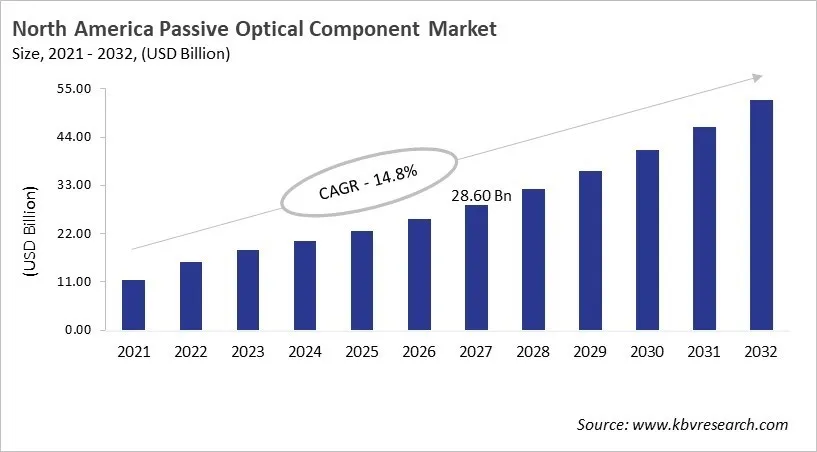
Over the years, the North American Passive Optical Component Market has changed because of new technologies, government-funded research, and a big shift to digital. Bell Labs, DARPA, and the NSF all worked on projects in the past that helped make low-loss optical fibers, waveguides, and important connectors. These projects helped the switch from copper to fiber networks in the 1980s. The internet became available to businesses in the 1990s, and programs to expand broadband access made passive components more popular. In the 2000s and 2010s, hyperscale data centers, cloud computing, and fiber-to-the-home deployments made them even more important. Today, the region's optical ecosystem is defined by strong fiber penetration, a lot of money going into research and development, and a growing demand from telecom operators, cloud providers, smart-city initiatives, and industrial automation.
Some of the most important trends in the market are the growth of fiber broadband across the country through programs like the U.S. BEAD, RDOF, and Canada's Universal Broadband Fund; the huge growth of hyperscale data centers; and the development of new technologies for small, high-performance components using planar lightwave circuits and silicon photonics. Top OEMs like Corning, TE Connectivity, AFL, Sumitomo Electric, Cisco, and Nokia focus on advanced materials, high-density fiber management, and designs that are tough on the environment. They also make strategic partnerships and improve domestic supply chains. Technological performance, product reliability, and scale are what drive competition. Sustainability and energy efficiency are becoming more important in determining who leads the market. Government investment, cloud-scale growth, and new optical technologies have all made passive optical components essential for North America's fast, reliable digital infrastructure.
Based on Technology, the market is segmented into Planar Lightwave Circuit (PLC) Technology, Thin film technology, Fiber Bragg Grating (FBG) Technology, Fused Biconical Taper (FBT) Technology and Other Technology. With a compound annual growth rate (CAGR) of 10.5% over the projection period, the Planar Lightwave Circuit (PLC) Technology Market, dominate the US Passive Optical Component Market by Technology in 2024 and would be a prominent market until 2032. The Fused Biconical Taper (FBT) Technology market is expected to witness a CAGR of 12.6% during (2025 - 2032).
Based on Component Type, the market is segmented into Optical Couplers, Optical Splitters, Wavelength Division Multiplexers (WDMs), Optical Filters and Other Component Type. Among various Canada Passive Optical Component Market by Component Type; The Optical Couplers market achieved a market size of USD $801.4 Million in 2024 and is expected to grow at a CAGR of 13.6 % during the forecast period. The Wavelength Division Multiplexers (WDMs) market is predicted to experience a CAGR of 15.9% throughout the forecast period from (2025 - 2032).

Free Valuable Insights: The Passive Optical Component Market is Predicted to reach USD 140.37 Billion by 2032, at a CAGR of 13.3%
The market for passive optical components in the United States has grown quickly because of efforts across the country to expand high-speed broadband and update digital infrastructure. Federal programs like the BEAD program have helped with this. The need for advanced passive components like splitters, connectors, WDMs, and optical distribution systems has grown because of more data use, cloud adoption, 5G deployment, and businesses needing networks that are reliable and have low latency. Major carriers are quickly rolling out FTTH networks, and hyperscale data centers are growing, which means that high-density, durable optical solutions are needed. Global OEMs like Corning, CommScope, and TE Connectivity are the main players in the market. Regional suppliers help with deployment, making it a competitive market based on innovation, reliability, and following federal standards. The U.S. market is a technologically advanced and high-investment place for passive optical components.

By Technology
By Component Type
By Application
By Country
Our team of dedicated experts can provide you with attractive expansion opportunities for your business.








 Unique Offerings