The North America Parcel Sortation Systems Market would witness market growth of 5.4% CAGR during the forecast period (2025-2032).
The US market dominated the North America Parcel Sortation Systems Market by Country in 2024, and would continue to be a dominant market till 2032; thereby, achieving a market value of $828.5 million by 2032. The Canada market is experiencing a CAGR of 7.9% during (2025 - 2032). Additionally, The Mexico market would exhibit a CAGR of 6.6% during (2025 - 2032). The US and Canada led the North America Parcel Sortation Systems Market by Country with a market share of 76% and 10.8% in 2024.
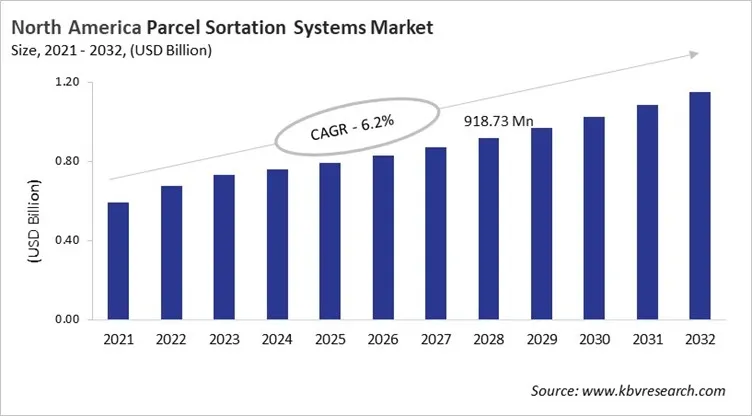
Parcel sortation systems are very important to North America's postal and CEP logistics networks because of the growing demand for e-commerce, direct-to-consumer shipping, and last-mile delivery. The region started using automation when the government modernized the postal system, especially when the USPS made early investments to speed up parcel delivery and cut down on manual handling. Over time, systems changed from conveyor belts that needed a lot of people to run them to high-speed automated sorters with optical scanning and smart controls. The rise of online shopping sped up the building of advanced sorting centers near big cities. COVID-19 showed how important automation is by showing how limited labor and capacity are. North American systems today focus on speed, accuracy, scalability, and resilience.
The current trends in the North American parcel sortation market are automation, modularity, and software integration. Increasingly, logistics companies prefer scalable, modular systems that can be expanded in small steps to handle changes in volume due to seasons and demand. With advanced software platforms, you can see what's going on in real time, plan maintenance ahead of time, and make sure that packages move smoothly between facilities. Established global OEMs and integrators that focus on reliable technology, complete solutions, and strong service support are at the top of the competition. Strategic partnerships with postal services, lifecycle services, and designs that focus on sustainability improve market positioning. In general, competition is about more than just price. It's also about performance, adaptability, and long-term operational value.
Based on Application, the market is segmented into E-commerce Fulfilment Centres, CEP Hubs, 3PL & Contract Logistics, Grocery & Food Distribution, Airports & Air-Cargo Terminals, and Other Application. Among various US Parcel Sortation Systems Market by Application; The E-commerce Fulfilment Centres market achieved a market size of USD $266.2 Million in 2024 and is expected to grow at a CAGR of 4.2 % during the forecast period. The Grocery & Food Distribution market is predicted to experience a CAGR of 5.9% throughout the forecast period from (2025 - 2032).
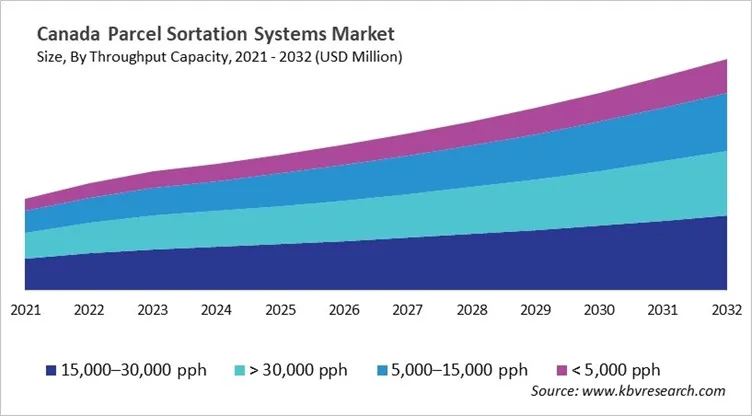
Based on Throughput Capacity, the market is segmented into 15,000–30,000 pph, > 30,000 pph, 5,000–15,000 pph, and < 5,000 pph. With a compound annual growth rate (CAGR) of 7.2% over the projection period, the 15,000–30,000 pph Market, dominate the Canada Parcel Sortation Systems Market by Throughput Capacity in 2024 and would be a prominent market until 2032. The > 30,000 pph market is expected to witness a CAGR of 7.7% during (2025 - 2032).
Free Valuable Insights: The Parcel Sortation Systems Market is Predicted to reach USD 4.31 Billion by 2032, at a CAGR of 5.9%
The United States is the most advanced parcel sortation systems market in North America, supported by a highly developed logistics network and massive e-commerce activity. Large-scale parcel flows and complex distribution operations make automation a strategic necessity rather than an optional upgrade. Rapid e-commerce growth, rising expectations for same-day and next-day delivery, and ongoing labor constraints continue to drive investment in high-speed automated sortation systems. Market trends emphasize modular and scalable solutions integrated with advanced warehouse control and execution software. These systems support omnichannel fulfillment, real-time monitoring, and predictive maintenance. Competition is led by global and domestic OEMs that focus on reliability, throughput, software capability, and strong local service support, positioning the U.S. as a key innovation hub.

By Type
By Application
By Throughput Capacity
By Offering
By Country
Our team of dedicated experts can provide you with attractive expansion opportunities for your business.




 Unique Offerings