The North America Parametric Insurance Market is expected to reach $7.56 billion by 2027 and would witness market growth of 9.4% CAGR during the forecast period (2025-2032).
The US market dominated the North America Parametric Insurance Market by Country in 2024, and would continue to be a dominant market till 2032; thereby, achieving a market value of $9,125.7 million by 2032. The Canada market is experiencing a CAGR of 12.2% during (2025 - 2032). Additionally, The Mexico market would exhibit a CAGR of 11% during (2025 - 2032). The US and Canada led the North America Parametric Insurance Market by Country with a market share of 80.1% and 9.2% in 2024.
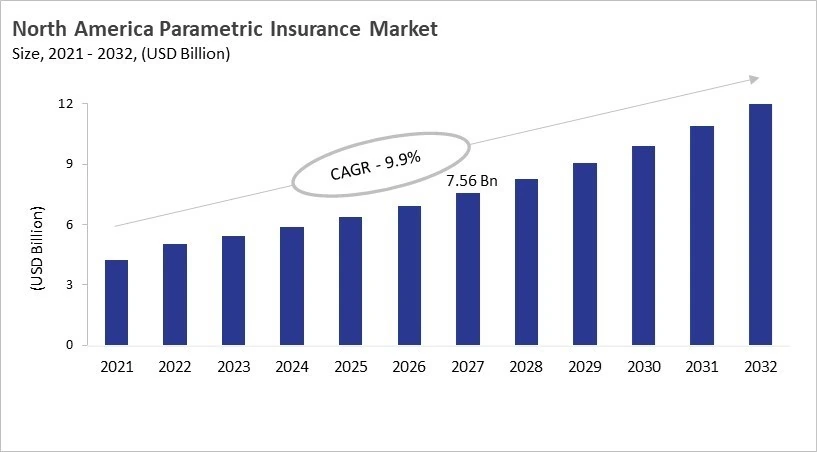
The global parametric insurance market exhibits significant regional disparities, influenced by the level of technological advancement, the most pressing regulatory requirements, and the extent of climate risk. North America is the leader in the market, which is because of advanced data analytics, AI-enabled modeling, satellite monitoring, and strong infrastructure for dealing with catastrophe risk. Next is Europe, which places a strong emphasis on following rules, meeting sustainability goals, and integrating deep climate modeling to support green and hybrid parametric solutions that fit with business risk management plans. Asia Pacific is known for quickly adopting digital technology, using mobile-based platforms, and starting microinsurance programs that make it easier for people in a wide range of economies, even those that are prone to disasters. At the same time, LAMEA is steadily growing by using scalable, cost-effective technologies and partnerships to reach more people in areas that don't have enough insurance and are at high risk.
Rising climate-related events, a growing need for quick and clear payouts, and stronger government support for disaster resilience frameworks are all things that are driving growth in all regions. Technological integration, like remote sensing, IoT-enabled monitoring, predictive analytics, and automated settlement platforms, keeps lowering basis risk and making operations run more smoothly. In competitive dynamics, global insurers, reinsurers, technology providers, and public institutions work together to make custom, multi-trigger, and hybrid products. Partnerships between the public and private sectors and initiatives led by development organizations speed up adoption even more, especially in the energy, agriculture, and infrastructure sectors. All of these things make parametric insurance a scalable, data-driven way to transfer risk that makes people better able to handle disasters and makes the world more financially stable.
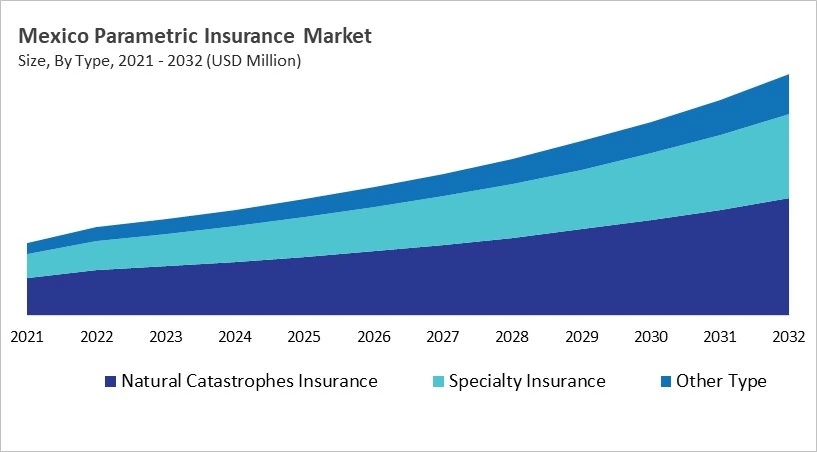
Based on Type, the market is segmented into Natural Catastrophes Insurance, Specialty Insurance, and Other Type. With a compound annual growth rate (CAGR) of 10.5% over the projection period, the Natural Catastrophes Insurance Market, dominate the Mexico Parametric Insurance Market by Type in 2024 and would be a prominent market until 2032. The Specialty Insurance market is expected to witness a CAGR of 11.3% during (2025 - 2032).
Based on Vertical, the market is segmented into Agriculture, Energy & Utilities, Construction, Manufacturing, Mining, Aerospace & Defense, and Other Vertical. The Agriculture market segment dominated the US Parametric Insurance Market by Vertical is expected to grow at a CAGR of 7.9 % during the forecast period thereby continuing its dominance until 2032. Also, The Mining market is anticipated to grow as a CAGR of 10.1 % during the forecast period during (2025 - 2032).
Free Valuable Insights: The Global Parametric Insurance Market will hit USD 32.57 billion by 2032, at a CAGR of 9.9%
The U.S. parametric insurance market has become a specialized and quickly growing part of the larger insurance industry. This is because climate-related risks are rising, and there is a need for faster, more transparent ways to settle claims. Parametric insurance is different from traditional indemnity models because it pays out based on set event triggers. This makes it easy for sectors like agriculture, energy, tourism, and infrastructure to get cash quickly. Technological advances like AI, geospatial analytics, satellite monitoring, and the Internet of Things (IoT) have made underwriting more accurate and automated claims validation. At the same time, product diversification has made coverage available for new risks like pandemics and supply chain disruptions. To stay ahead of the competition and build trust, market leaders focus on strategic partnerships, new ideas, teaching customers, and digital underwriting platforms. The competitive landscape includes established insurers, reinsurers, and insurtech companies. These companies are different from each other in terms of technology, focus on specific niches, and a common goal of being open, following the rules, and finding efficient ways to transfer risk.

By Type
By Vertical
By Country
Our team of dedicated experts can provide you with attractive expansion opportunities for your business.








 Unique Offerings