The North America On-device AI Market is expected to reach $6.93 billion by 2028 and would witness market growth of 26.4% CAGR during the forecast period (2025-2032).
The US market dominated the North America On-Device AI Market by Country in 2024, and would continue to be a dominant market till 2032; thereby, achieving a market value of $13,919.3 million by 2032. The Canada market is experiencing a CAGR of 29.7% during (2025 - 2032). Additionally, The Mexico market would exhibit a CAGR of 27.9% during (2025 - 2032). The US and Canada led the North America On-Device AI Market by Country with a market share of 77.2% and 9% in 2024.
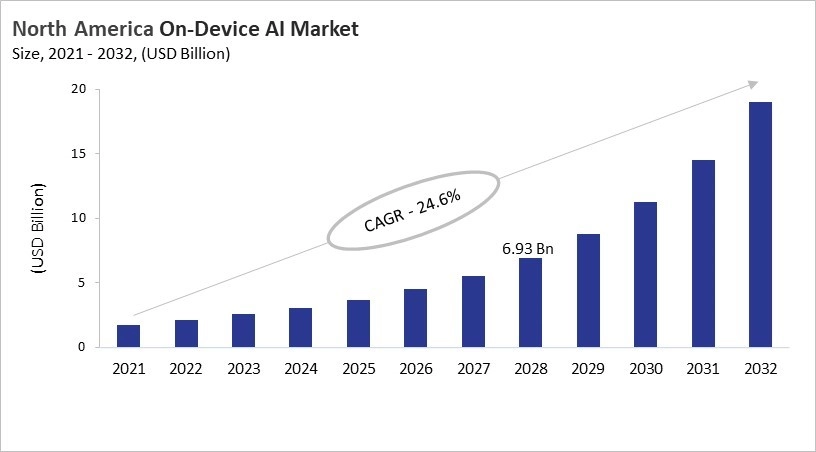
The North America on-device AI market is all about putting AI directly into local hardware like smartphones, laptops, wearables, and edge devices so that processing can happen quickly and with privacy in mind. This change is being pushed by big companies like Apple and Qualcomm, which make custom silicon, Neural Processing Units, and AI software stacks that work better. Apple's Apple Intelligence platform shows off hybrid on-device and server-based models that protect user data while adding features like live translation and contextual help. Qualcomm's AI Engine Direct and developer tools make it possible for Snapdragon devices to run neural networks quickly and easily. The government's recognition of AI and edge computing helps the ecosystem grow even more. Semiconductor innovation, policy interest, and a mature digital infrastructure are all speeding up adoption.
Some important trends in the market are the growth of AI that focuses on privacy, the growth of developer SDKs, and the use of hybrid AI architectures that combine local and cloud processing. Companies say that on-device intelligence has many benefits, such as less data transfer, better security, and faster response times. Apple's strategy of tightly integrating hardware and software is different from Qualcomm's approach, which supports many OEMs and frameworks like TensorFlow Lite and ONNX Runtime. Strategic partnerships between hardware, software, and cloud providers make it easier to deploy across consumer electronics, cars, and the Internet of Things (IoT). Performance efficiency, developer support, and ecosystem integration all play a role in how competitive things are. These factors make on-device AI a key differentiator in the smart device market in North America.
Based on Component, the market is segmented into Hardware, and Software. Among various US On-Device AI Market by Component; The Hardware market achieved a market size of USD $1290.3 Million in 2024 and is expected to grow at a CAGR of 25.1 % during the forecast period. The Software market is predicted to experience a CAGR of 26.1% throughout the forecast period from (2025 - 2032).
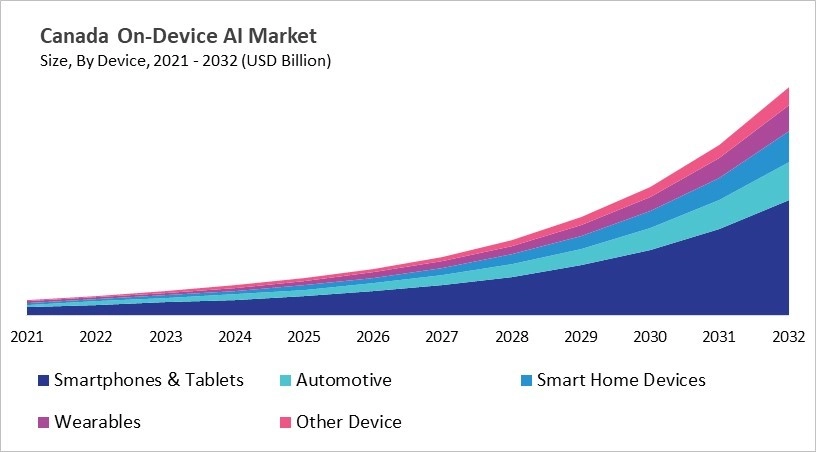
Based on Device, the market is segmented into Smartphones & Tablets, Automotive, Smart Home Devices, Wearables, and Other Device. The Smartphones & Tablets market segment dominated the Canada On-Device AI Market by Device is expected to grow at a CAGR of 29.1 % during the forecast period thereby continuing its dominance until 2032. Also, The Wearables market is anticipated to grow as a CAGR of 31 % during the forecast period during (2025 - 2032).
Free Valuable Insights: The Global On-device AI Market will hit USD 54.79 billion by 2032, at a CAGR of 27.1%
The U.S. market for AI on devices is growing quickly. More AI models are being run directly on smartphones, wearables, cars, and IoT devices to allow for real-time processing, lower latency, and better data privacy. A strong ecosystem of semiconductor innovation and early adoption of edge technologies is helping this growth. Apple and Qualcomm, for example, are putting specialized AI accelerators into chips so that they can do things like recognize images and process natural language on their own. Adoption is growing beyond consumer electronics to include automotive, healthcare, and industrial IoT for tasks like self-driving navigation and predictive maintenance. 5G supports hybrid edge-cloud architectures, which make performance and flexibility even better. Both big tech companies and new chip startups that are focused on efficiency and generative AI inference are driving competition. Overall, AI on devices is becoming an important part of how the U.S. develops technology.

By Component
By Technology
By Deployment
By Device
By Vertical
By Country
Our team of dedicated experts can provide you with attractive expansion opportunities for your business.



 Unique Offerings