The North America Native Advertising Market would witness market growth of 12.4% CAGR during the forecast period (2025-2032).
The US market dominated the North America Native Advertising Market by Country in 2024, and would continue to be a dominant market till 2032; thereby, achieving a market value of $68,110 million by 2032. The Canada market is experiencing a CAGR of 14.7% during (2025 - 2032). Additionally, The Mexico market would exhibit a CAGR of 14.1% during (2025 - 2032). The US and Canada led the North America Native Advertising Market by Country with a market share of 78.2% and 12% in 2024.
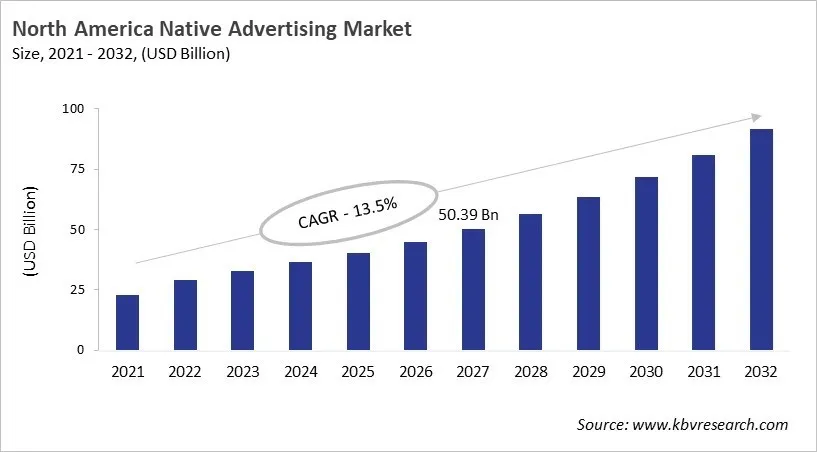
In North America, native advertising has changed from simple advertorials and sponsored content to a more advanced digital strategy that combines promotional messaging with the look, feel, and user experience of the host platform. The Federal Trade Commission and the Interactive Advertising Bureau set the rules for early adoption. They stressed the importance of clear disclosure and standard formats like in-feed units, recommendation widgets, and promoted listings. Innovations in platforms, programmatic capabilities, and tools for making money on mobile devices have all helped native advertising grow even more. This has allowed advertisers to improve their campaigns across publishers while still keeping measurement strict, A/B testing workflows, and safe placements for their brands. This change has made native a common part of media plans, balancing user experience, transparency, and performance.
Three main trends are shaping the market today: standardized, component-based native units that make it easier for different publishers to work together; a creative shift toward campaigns that tell stories and provide value to audiences; and design practices that prioritize disclosure to keep up with regulations and build consumer trust. To get the most engagement and brand lift, leaders in the space combine productized native units, high-quality content creation, systematic measurement, and multi-channel distribution. Major platforms with their own formats, independent native networks that offer scale and targeting flexibility, and premium publishers that sell custom partnerships all shape competition. Differentiation is becoming more about the quality of the creative work, the strictness of the compliance, and the sophistication of the measurement. These factors together show that native advertising works in a mature ecosystem where it is creative, scalable, and accountable at the same time.
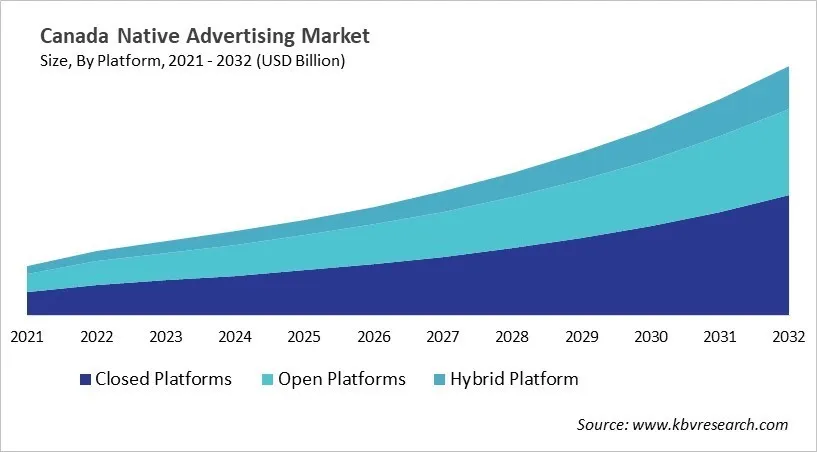
Based on Platform, the market is segmented into Closed Platforms, Open Platforms and Hybrid Platform. With a compound annual growth rate (CAGR) of 15% over the projection period, the Closed Platforms Market, dominate the Canada Native Advertising Market by Platform in 2024 and would be a prominent market until 2032. The Hybrid Platform market is expected to witness a CAGR of 15.5% during (2025 - 2032).
Based on End Use, the market is segmented into Retail & eCommerce, Media & Entertainment, BFSI, Travel & Hospitality, Healthcare, Telecom & IT, Automotive, Education and Other End Uses. Among various US Native Advertising Market by End Use; The Retail & eCommerce market achieved a market size of USD $7397.4 Million in 2024 and is expected to grow at a CAGR of 9.7 % during the forecast period. The Automotive market is predicted to experience a CAGR of 12.8% throughout the forecast period from (2025 - 2032).
Free Valuable Insights: The Native Advertising Market is Predicted to reach USD 263.84 Billion by 2032, at a CAGR of 13.0%
The United States is the leader in native advertising in North America. This is because there are a lot of people using the internet, the programmatic infrastructure is advanced, and people consume a lot of digital media. Native ads fit in perfectly with social media, high-end publishers, and content recommendation networks. They can be placed in feeds, articles, videos, or recommendations. Rich first-party data, advanced analytics, and a focus on content-aligned advertising that keeps the user experience are some of the main factors. On the other hand, regulatory scrutiny, data privacy, and user trust shape how companies disclose information and target ads. Market trends show that programmatic native, interactive storytelling, shoppable content, and more advanced measurement metrics like viewability and engagement are becoming more popular. There is a lot of competition between content-discovery networks, DSPs, and publishers. To be successful, they need to reach a lot of people, have high-quality inventory, be able to be creative, and be able to optimize in real time. In general, technology, media fragmentation, and the focus on contextual relevance are what keep the U.S. native advertising ecosystem moving forward.

By Platform
By Content Format
By End Use
By Country
Our team of dedicated experts can provide you with attractive expansion opportunities for your business.



 Unique Offerings