The North America Mobile Business Process Management Market is expected to reach $2.49 billion by 2027 and would witness market growth of 12.5% CAGR during the forecast period (2025-2032).
The US market dominated the North America Mobile Business Process Management Market by Country in 2024, and would continue to be a dominant market till 2032; thereby, achieving a market value of $3,159.1 million by 2032. The Canada market is experiencing a CAGR of 14.8% during (2025 - 2032). Additionally, The Mexico market would exhibit a CAGR of 13.7% during (2025 - 2032). The US and Canada led the North America Mobile Business Process Management Market by Country with a market share of 73.2% and 11.9% in 2024.
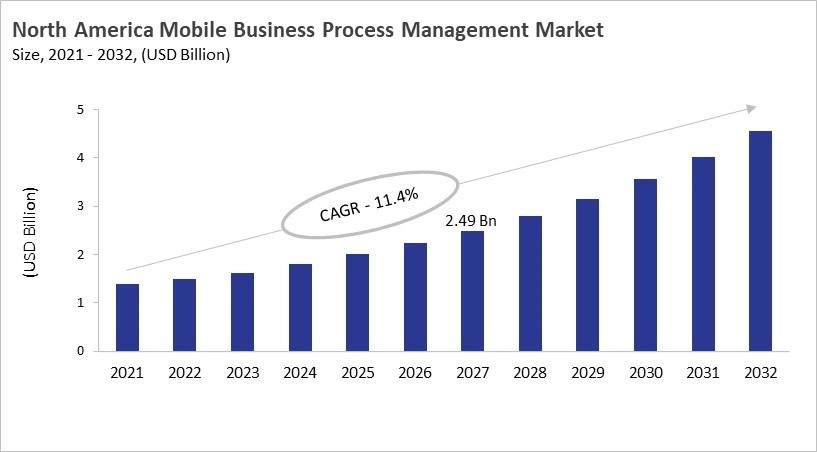
As businesses moved to digital transformation, cloud computing, and mobile workforces, mobile BPM in North America grew out of traditional BPM. The early growth of BPM was fueled by a strong IT infrastructure and widespread use of enterprise software. Later, it grew even more with the rise of smartphones and mobile broadband. Cloud platforms made it possible for businesses in many fields to run processes that could grow, be safe, and be done from anywhere. The COVID-19 pandemic made things even faster by making remote and hybrid workflows even more necessary. Today's mobile BPM has cloud-native design, mobile-first workflows, and tight connections to business systems. Some of the most important trends are mobile-first operations, the merging of low-code and automation, and the growing use of hybrid and cloud-based deployment models. These changes make mobile BPM a key part of agile and real-time business operations.
To get more people to use their products, market leaders like IBM, Microsoft, Oracle, SAP, and Appian focus on platform integration, cloud-first strategies, and low-code enablement. Security, compliance, and governance are still very important, especially in industries like finance and healthcare that are heavily regulated. The market is somewhat consolidated, and competition is based on how many platforms it supports, how easy it is to use on mobile devices, how well it can grow, and how strong its integration is. Vendors set themselves apart by forming partnerships with other companies in the same industry, offering solutions that are specific to that industry, and having advanced automation features. This makes mobile BPM a key part of North America's digital infrastructure for businesses.
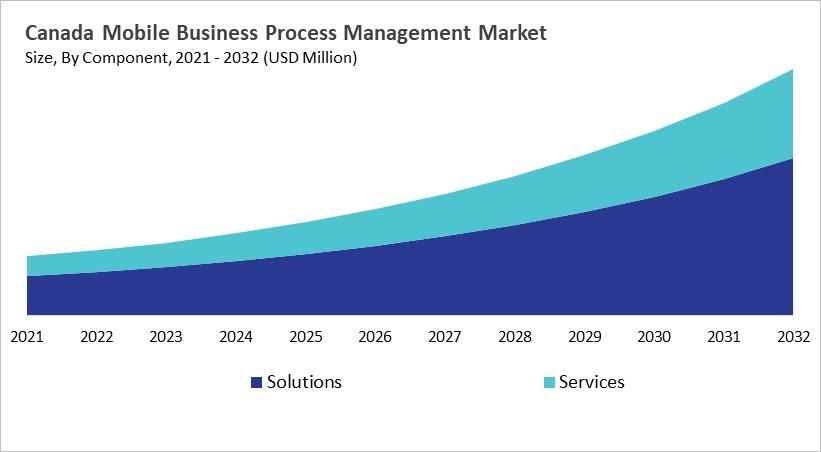
Based on Component, the market is segmented into Solutions and Services. The Solutions market segment dominated the Canada Mobile Business Process Management Market by Component is expected to grow at a CAGR of 14.4 % during the forecast period thereby continuing its dominance until 2032. Also, The Services market is anticipated to grow as a CAGR of 15.6 % during the forecast period during (2025 - 2032).
Based on Enterprise Size, the market is segmented into Large Enterprises and Small & Medium Enterprises. With a compound annual growth rate (CAGR) of 13.5% over the projection period, the Large Enterprises Market, dominate the Mexico Mobile Business Process Management Market by Enterprise Size in 2024 and would be a prominent market until 2032. The Small & Medium Enterprises market is expected to witness a CAGR of 14.3% during (2025 - 2032).
Free Valuable Insights: The Global Mobile Business Process Management Market will hit USD 13.35 billion by 2032, at a CAGR of 13.1%
National digital transformation projects that focus on making services available on mobile devices, making workflows more flexible, and delivering services through the cloud are driving the U.S. mobile BPM market in both the public and private sectors. Government policies encourage mobile-first processes to make things run more smoothly, cut down on manual work, and get people more involved. Integration with AI, cloud computing, and low-code platforms makes adoption easier by allowing decisions to be made in real time and workflows to be automated. Trends in the market show that BPM frameworks are moving toward being mobile-friendly, which means that employees and field workers can use smartphones and tablets to manage tasks and approvals. IBM, Oracle, and Microsoft are some of the biggest companies that compete in this space. There are also smaller companies that focus on workflow and offer mobile-first and low-code solutions. Increasingly, public sector procurement prefers cloud-based deployments that are secure and can work with other systems. In the US, mobile BPM is becoming a key part of business operations that are ready for the future and can grow. This is because more people are using mobile devices and digital services are growing.

By Component
By Deployment Mode
By Enterprise Size
By End-User Industry
By Country
Our team of dedicated experts can provide you with attractive expansion opportunities for your business.



 Unique Offerings