The North America Medical Imaging Informatics Market would witness market growth of 5.2% CAGR during the forecast period (2025-2032).
The US market dominated the North America Medical Imaging Informatics Market by Country in 2024, and would continue to be a dominant market till 2032; thereby, achieving a market value of $1,357.8 million by 2032. The Canada market is experiencing a CAGR of 7.4% during (2025 - 2032). Additionally, The Mexico market would showcase a CAGR of 6.8% during (2025 - 2032). The US and Canada led the North America Medical Imaging Informatics Market by Country with a market share of 78.2% and 12% in 2024.
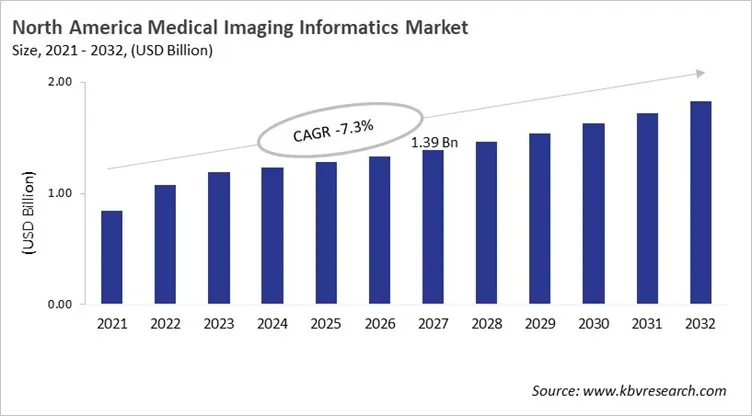
Medical imaging informatics combines healthcare IT and medical imaging to organize, store, analyze, and share imaging data so that doctors can make better decisions and work more quickly. In North America, the market changed when film-based imaging systems were replaced by digital ones like PACS and RIS. This was followed by a lot of EHR use in the early 2000s. Standards and frameworks for interoperability made it possible for systems to easily share data. Research, digitization, and connectivity were all supported by government and industry programs. Over time, solutions evolved from simple image storage to enterprise imaging platforms. These platforms now let people from different fields and all parts of the system use them. The result has been quicker diagnoses, better efficiency, and better care for patients.
AI integration, cloud-based platforms, and the growth of teleradiology and enterprise imaging have all had an impact on the market in the past few years. AI-driven analytics can now help with automated detection, improving workflows, and making clinical decisions. Cloud adoption makes it possible to store data on a large scale, access it from anywhere, and work together across facilities. The rise in demand for remote diagnostics has sped up the use of teleradiology in many areas. Competition is fierce because of new developments in AI, interoperability, security, and the ability to deploy in different ways. Vendors pay attention to unique features, partnerships with other companies in the ecosystem, and following data privacy rules. The market is still changing quickly and is driven by new ideas.
Based on Component, the market is segmented into Software, Services, and Hardware. The Software market segment dominated the US Medical Imaging Informatics Market by Component is expected to grow at a CAGR of 4.1 % during the forecast period thereby continuing its dominance until 2032. Also, The Hardware market is anticipated to grow as a CAGR of 5.4 % during the forecast period during (2025 - 2032).
Free Valuable Insights: The Medical Imaging Informatics Market is Predicted to reach USD 5.42 Billion by 2032, at a CAGR of 6.0%
Based on Deployment Mode, the market is segmented into Standalone, and Integrated. With a compound annual growth rate (CAGR) of 6.9% over the projection period, the Standalone Market, dominate the Canada Medical Imaging Informatics Market by Deployment Mode in 2024 and would be a prominent market until 2032. The Integrated market is expected to witness a CAGR of 8% during (2025 - 2032).
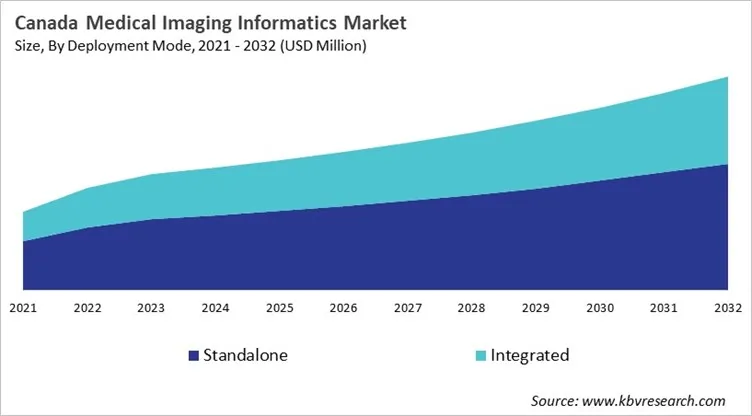
The United States has the biggest and most advanced medical imaging informatics market in North America. This is because there are a lot of images, the healthcare infrastructure is advanced, and digital health technologies are widely used. Imaging informatics is very important for managing diagnostic workflows, boosting productivity, and helping doctors make decisions. Regulatory guidance and interoperability requirements promote secure, standardized data sharing between healthcare systems. Some of the most important trends are the quick use of AI-enabled analytics, cloud and hybrid deployment models, and the growth of teleradiology and enterprise imaging in different fields. To make care coordination better, providers are putting more imaging data in one place. There is a lot of competition, with a focus on AI innovation, cloud scalability, cybersecurity, and easy integration with EHRs.

By Deployment Mode
By Component
By End User
By Application
By Country
Our team of dedicated experts can provide you with attractive expansion opportunities for your business.



 Unique Offerings