The North America Maca Extract Market would witness market growth of 7.6% CAGR during the forecast period (2025-2032).
The US market dominated the North America Maca Extract Market by Country in 2024, and would continue to be a dominant market till 2032; thereby, achieving a market value of $121.4 million by 2032. The Canada market is experiencing a CAGR of 9.6% during (2025 - 2032). Additionally, The Mexico market would exhibit a CAGR of 8.8% during (2025 - 2032). The US and Canada led the North America Maca Extract Market by Country with a market share of 73% and 14.2% in 2024.
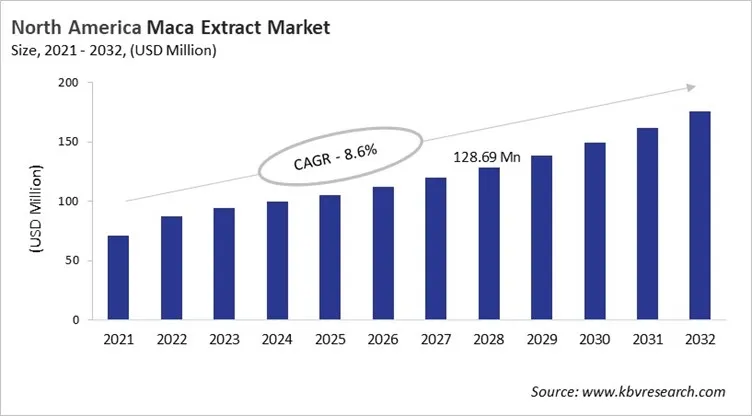
The North American maca extract market grew because more people were interested in natural botanicals and plant-based health ingredients. Maca first became popular through cultural exchange and global trade. As more health-conscious people learned about adaptogens, maca became more popular. The growth of the natural products industry and strong retail networks in the U.S. and Canada helped maca move from being a niche import to a popular supplement. The DSHEA in the U.S. and the Natural Health Product regulations in Canada made the market more legitimate by making the rules clearer. Peruvian OEM partnerships made sure that the supply was consistent and reliable. By the end of the 2010s, maca was widely linked to energy, hormonal balance, and general health. All these things helped the market keep growing.
Some important trends are an increase in demand for functional nutrition, a wider range of product formats, and a strong focus on clean sourcing and sustainability. Maca went from being a powder or capsule to being in drinks, gummies, and functional foods, which attracted more customers. Wellness media put maca in the adaptogen movement, which made it more popular for everyday use. Increasingly, customers wanted traceability, organic certification, and ethical sourcing, which pushed brands to make their supply chains more open. Top companies used farm-to-finish strategies by working directly with Peruvian farmers. Innovation, sourcing integrity, and wellness-driven lifestyles are still shaping the North American maca extract market.
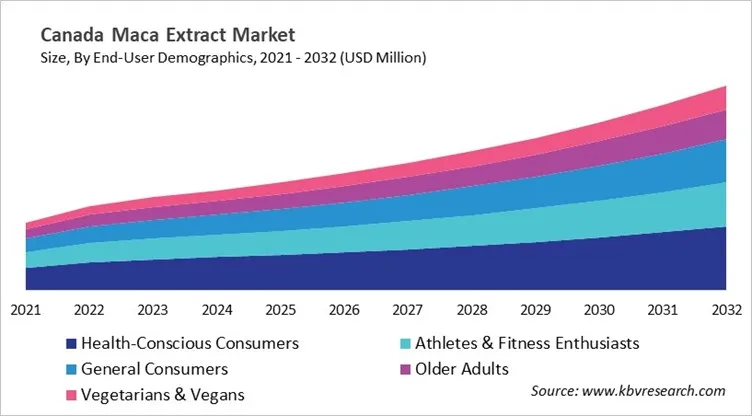
Based on End-User Demographics, the market is segmented into Health-Conscious Consumers, Athletes & Fitness Enthusiasts, General Consumers, Older Adults, and Vegetarians & Vegans. With a compound annual growth rate (CAGR) of 8.7% over the projection period, the Health-Conscious Consumers Market, dominate the Canada Maca Extract Market by End-User Demographics in 2024 and would be a prominent market until 2032. The Older Adults market is expected to witness a CAGR of 10.4% during (2025 - 2032).
Free Valuable Insights: The Maca Extract Market is Predicted to reach USD 572.62 Million by 2032, at a CAGR of 8.4%
Based on Ingredient Type, the market is segmented into Organic Maca Extract, Conventional Maca Extract, Gelatinized Maca Extract, and Raw Maca Extract & Others. The Organic Maca Extract market segment dominated the US Maca Extract Market by Ingredient Type is expected to grow at a CAGR of 6.1 % during the forecast period thereby continuing its dominance until 2032. Also, The Gelatinized Maca Extract market is anticipated to grow as a CAGR of 7.5 % during the forecast period during (2025 - 2032).
Based on Product Form, the market is segmented into Powder, Capsules, Liquid Extracts, Tinctures, and Functional Foods. Among various Mexico Maca Extract Market by Product Form; The Powder market achieved a market size of USD $3.2 Million in 2024 and is expected to grow at a CAGR of 8.1 % during the forecast period. The Functional Foods market is predicted to experience a CAGR of 9.5% throughout the forecast period from (2025 - 2032).
The United States has the largest and most active maca extract market in North America. This is because the dietary supplements industry is well-established and people are very interested in natural ways to improve their health. Maca is a popular superfood and adaptogen that is used to boost energy, improve mood, balance hormones, and help with sports nutrition. People want clean-label, organic, and sustainably sourced products, which helps demand. E-commerce and private-label manufacturing make it possible for a lot of people to buy things, and functional foods and drinks let people use them in ways other than capsules and powders. Influencers on social media and in health and wellness help people learn more and get more attention. There is a lot of competition between big supplement brands, small organic brands, and suppliers from other countries. Quality differentiation, certifications, and clear sourcing are still important for long-term growth.

By Product Form
By Application
By Ingredient Type
By End-User Demographics
By Distribution Channel
By Country
Our team of dedicated experts can provide you with attractive expansion opportunities for your business.




 Unique Offerings