The North America Legacy IT System Modernization Market is expected to reach $8.17 billion by 2027 and would witness market growth of 16.6% CAGR during the forecast period (2025-2032).
The US market dominated the North America Legacy IT System Modernization Market by Country in 2024, and would continue to be a dominant market till 2032; thereby, achieving a market value of $13,432.3 million by 2032. The Canada market is experiencing a CAGR of 19.2% during (2025 - 2032). Additionally, The Mexico market would exhibit a CAGR of 18.6% during (2025 - 2032). The US and Canada led the North America Legacy IT System Modernization Market by Country with a market share of 79.2% and 10.9% in 2024.
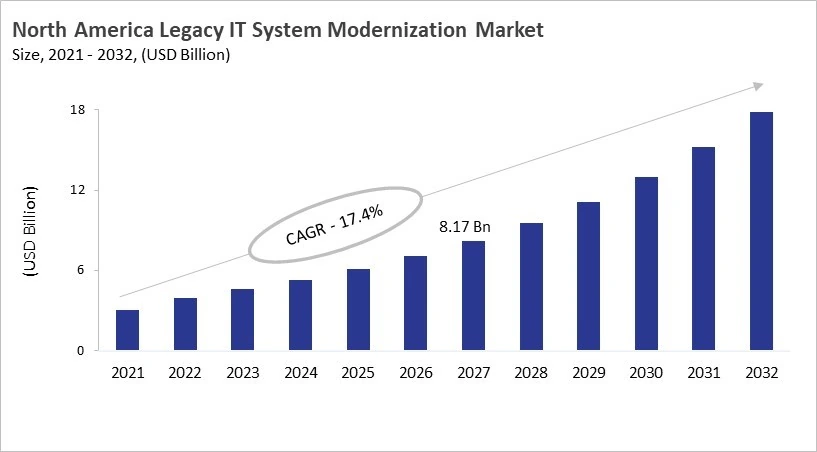
As governments strive to deliver safe, digital-first services while navigating rising cybersecurity risks and budgetary pressures, modernizing outdated IT systems has become a top priority for public sector organizations across North America. Many U.S. federal, state, and Canadian agencies still use mission-critical systems that are decades old, expensive to maintain, vulnerable to cyber threats, and not up to modern service expectations. The U.S. GAO and central agencies in Canada have both said that old infrastructure takes up too much of the IT budget and makes it harder to be flexible and innovative. In response, modernization efforts sped up in the 2010s thanks to digital government initiatives led by groups like the U.S. OMB, CIO Council, and Canada's Treasury Board Secretariat. These groups saw modernization as necessary for maintaining services, building resilience, and gaining public trust.
Today, modernization in North America is seen as a long-term, step-by-step process instead of a one-time replacement project. To lower technical debt while keeping services running smoothly, more and more governments are using cloud and hybrid cloud models, modular architectures, API enablement, and incremental modernization strategies. Modernizing cybersecurity, in line with zero-trust principles and security-by-design frameworks, is still a major goal. OEMs like IBM, Google Cloud, and AWS, as well as system integrators, help agencies by providing platforms, hybrid solutions, and agile delivery models that are compliant with government rules. In this market, the main areas of competition are secure cloud capabilities, hybrid integration, regulatory compliance, and the ability to modernize complex legacy environments with as little disruption to operations as possible.
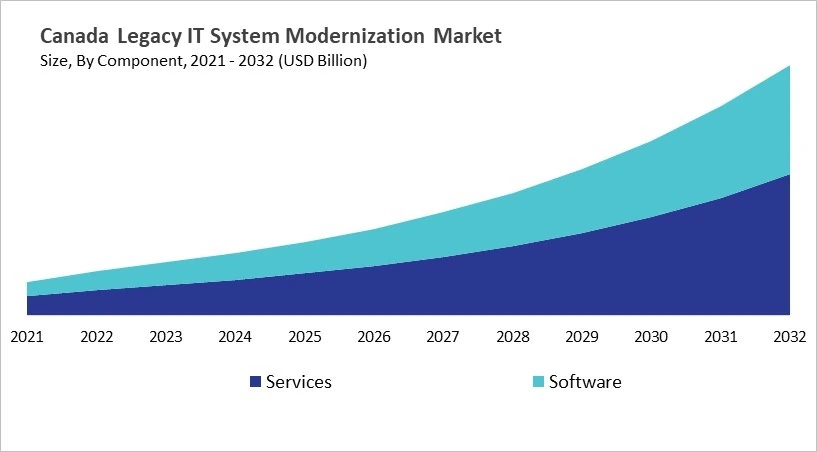
Based on Component, the market is segmented into Services and Software. The Services market segment dominated the Canada Legacy IT System Modernization Market by Component is expected to grow at a CAGR of 18.9 % during the forecast period thereby continuing its dominance until 2032. Also, The Software market is anticipated to grow as a CAGR of 19.6 % during the forecast period during (2025 - 2032).
Based on Enterprise Size, the market is segmented into Large Enterprises and Small & Medium Enterprises. With a compound annual growth rate (CAGR) of 18.3% over the projection period, the Large Enterprises Market, dominate the Mexico Legacy IT System Modernization Market by Enterprise Size in 2024 and would be a prominent market until 2032. The Small & Medium Enterprises market is expected to witness a CAGR of 19.2% during (2025 - 2032).
Based on End-User Industry, the market is segmented into BFSI, IT & Telecommunications, Manufacturing, Healthcare, Retail & E-commerce, Government & Public Sector and Other End-User Industry. Among various US Legacy IT System Modernization Market by End-User Industry; The BFSI market achieved a market size of USD $1212.3 Million in 2024 and is expected to grow at a CAGR of 14 % during the forecast period. The Healthcare market is predicted to experience a CAGR of 16.5% throughout the forecast period from (2025 - 2032).
Free Valuable Insights: The Global Legacy IT System Modernization Market will hit USD 50.32 billion by 2032, at a CAGR of 17.2%
The United States has the most advanced and complicated market for modernizing legacy IT systems in North America. This is because the government and business sectors have been using mission-critical infrastructure for decades. As cloud scalability, real-time analytics, cybersecurity resilience, and digital engagement become more important, older mainframe and monolithic systems that support defense, taxes, healthcare, BFSI, and transportation are having a harder time keeping up. Federal programs, cybersecurity requirements, and gaps in workers' skills are speeding up modernization efforts. There is a strong focus on hybrid approaches like refactoring, API enablement, and containerization to lower risk. Major OEMs and system integrators run the market by offering large-scale, multi-year transformation programs. Overall, modernization in the U.S. strikes a balance between innovation and operational stability, thanks to regulatory pressure, federal funding, and quick progress in cloud and AI technologies.

By Component
By Deployment Type
By Enterprise Size
By Modernization Approach
By End-User Industry
By Country
Our team of dedicated experts can provide you with attractive expansion opportunities for your business.



 Unique Offerings