The North America Incident Response Services Market is expected to reach $21.82 billion by 2027 and would witness market growth of 17.9% CAGR during the forecast period (2025-2032).
The US market dominated the North America Incident Response Services Market by Country in 2024, and would continue to be a dominant market till 2032; thereby, achieving a market value of $37,433.9 million by 2032. The Canada market is experiencing a CAGR of 20.5% during (2025 - 2032). Additionally, The Mexico market would exhibit a CAGR of 19.5% during (2025 - 2032). The US and Canada led the North America Incident Response Services Market by Country with a market share of 78.2% and 11% in 2024.
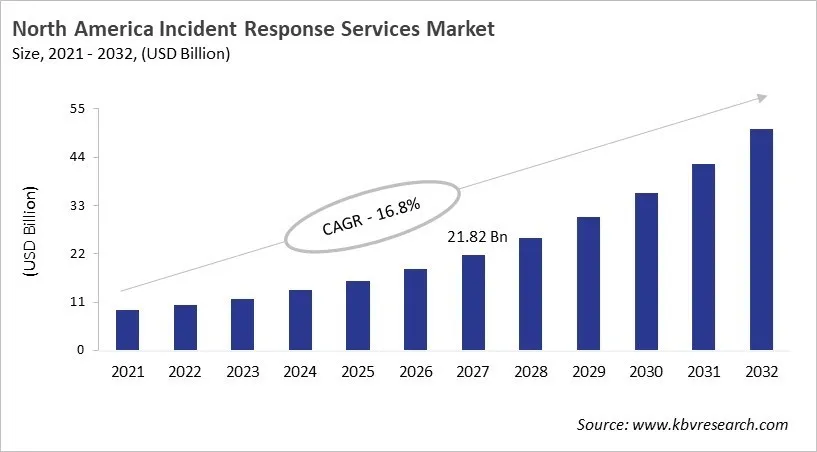
The North American Incident Response Services Market has grown in tandem with the region's early adoption of digital technologies in government, defense, financial services, healthcare, and critical infrastructure. Formal cybersecurity frameworks released by the U.S. and Canadian governments establish structured methods for identifying, mitigating, and recovering from attacks. This changed incident response from an internal IT task to a shared public-private duty. As cloud computing, mobile workforces, and interconnected ecosystems grew, incidents became more complex, leading to a need for specialized response services. High-profile cyber incidents and extensive coverage in business and technology magazines made incident response a top priority for the board, which strengthened its role in managing risk and complying with the law.
The market today is mature and expertise-driven. It closely follows government guidance, regulatory requirements, and goals for resilience. Important trends include proactive readiness models and response capabilities focused on ransomware and the cloud. Service methodologies support reporting, forensic integrity, and collaboration with authorities. Market leaders strongly emphasize public-private sector collaboration and advanced technical skills. They leverage technology to enhance response workflows and improve after-incident recovery. Long-term resilience is a priority. In the competitive landscape, speed, specialization, and compliance matter more than cost. Providers continue to work together during major or critical infrastructure incidents.
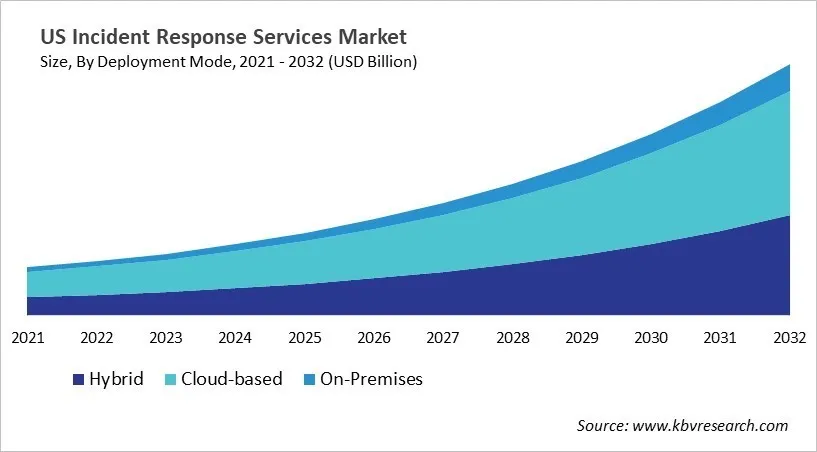
Based on Deployment Mode, the market is segmented into Hybrid, Cloud-based and On-Premises. With a compound annual growth rate (CAGR) of 17.6% over the projection period, the Hybrid Market, dominate the US Incident Response Services Market by Deployment Mode in 2024 and would be a prominent market until 2032. The On-Premises market is expected to witness a CAGR of 18.3% during (2025 - 2032).
Based on End-User Industry, the market is segmented into BFSI, IT & Telecom, Government & Defense, Healthcare & Life Sciences, Industrial Manufacturing, Energy & Utilities, Retail & E-commerce and Other End-User Industry. Among various Canada Incident Response Services Market by End-User Industry; The BFSI market achieved a market size of USD $375.7 Million in 2024 and is expected to grow at a CAGR of 18.3 % during the forecast period. The Retail & E-commerce market is predicted to experience a CAGR of 21.5% throughout the forecast period from (2025 - 2032).
Free Valuable Insights: The Incident Response Services Market is Predicted to reach USD 137.12 Billion by 2032, at a CAGR of 18.5%
The United States has the most developed and organized Incident Response Services market in North America. This is because it has a large digital economy, a lot of people use the cloud, and it is very exposed to advanced cyber threats. Frameworks from agencies like CISA help incident response services cover all the important areas, from planning and detection to containment, eradication, and recovery. High-frequency ransomware, nation-state, and supply-chain attacks, as well as federal requirements for reporting breaches, have made organizations more accountable and increased the need for formalized response capabilities. Market trends show a move toward managed and proactive incident response models that include constant monitoring, threat intelligence, and being ready for a breach. Microsoft, IBM, and Cisco are some of the biggest OEMs that include incident response in their XDR, cloud, and identity security platforms. They use AI and automation to speed up containment and remediation. Overall, the market is shaped by strict rules, a high level of threat, and service models that are based on intelligence and driven by OEMs, and focus on speed and scale.

By Enterprise Size
By Deployment Mode
By Service Type
By End-User Industry
By Country
Our team of dedicated experts can provide you with attractive expansion opportunities for your business.



 Unique Offerings