The North America HMI Sensors In Wearables Market is expected to reach $1.63 billion by 2027 and would witness market growth of 13.0% CAGR during the forecast period (2025-2032).
The US market dominated the North America Other Device Type Market by Country in 2024, and would continue to be a dominant market till 2032; thereby, achieving a market value of $120.9 million by 2032. The Canada market is exhibiting a CAGR of 17.8% during (2025 - 2032). Additionally, The Mexico market would experience a CAGR of 17.1% during (2025 - 2032). The US and Canada led the North America HMI Sensors In Wearables Market by Country with a market share of 71.2% and 14.1% in 2024.
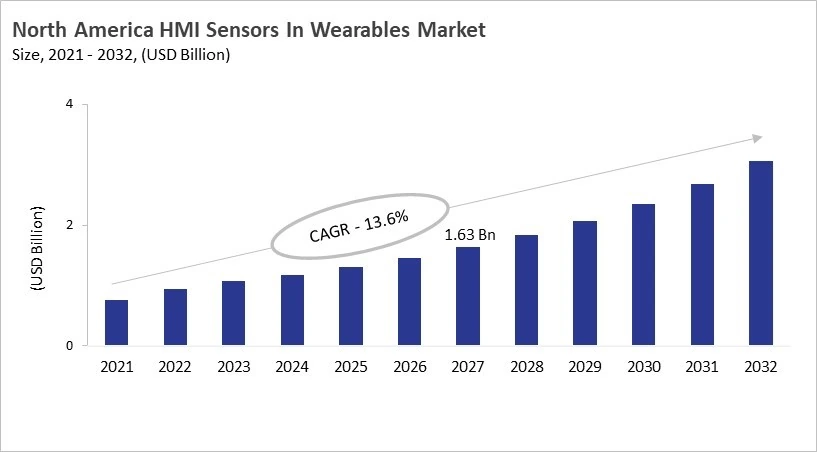
Wearable Human-Machine Interface (HMI) sensors have come a long way from basic motion and heart-rate trackers to advanced multisensor systems that let you always keep an eye on your health and interact with your devices in smart ways. Smartphones and other connected devices became very popular in the US and Canada, which helped them grow quickly. The National Institutes of Health have found that modern wearables can continuously track vital signs like heart rate and blood oxygen levels. This helps with both personal health management and clinical research. OEMs like Apple have made sensors more accurate by tightly integrating hardware and software in devices like the Apple Watch. These changes show a move away from simple activity tracking and toward health-focused, data-driven human–machine interfaces.
Machine learning and analytics are now key to making sense of data from wearable sensors. They help recognize behavior and make better health predictions. Public sector initiatives, such as extensive programs utilizing Fitbit devices, demonstrate the role of HMI sensors in facilitating population-level health studies. Reports from the Government Accountability Office show that more people are using wearables to keep an eye on their safety and performance at work. Samsung and Apple are two of the leaders in the field, and they compete on sensor accuracy, ecosystem integration, and advanced analytics. In general, HMI sensors are turning into smart health and decision-making tools instead of just data collectors.
Based on Sensor Type, the market is segmented into Touch Sensors, Motion Sensors, Biometric Sensors, Voice & Audio Sensors, and Other Sensor Type. Among various US HMI Sensors In Wearables Market by Sensor Type; The Touch Sensors market achieved a market size of USD $212.8 Million in 2024 and is expected to grow at a CAGR of 11.1 % during the forecast period. The Voice & Audio Sensors market is predicted to experience a CAGR of 13.3% throughout the forecast period from (2025 - 2032).
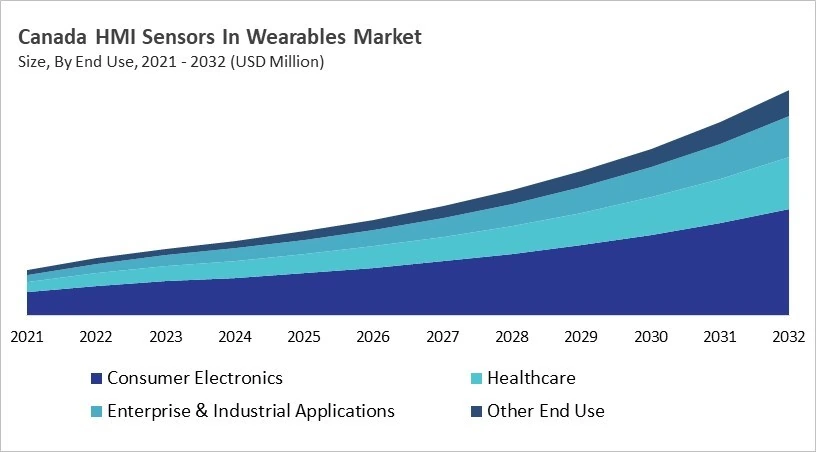
Based on End Use, the market is segmented into Consumer Electronics, Healthcare, Enterprise & Industrial Applications, and Other End Use. The Consumer Electronics market segment dominated the Canada HMI Sensors In Wearables Market by End Use is expected to grow at a CAGR of 14.1 % during the forecast period thereby continuing its dominance until 2032. Also, The Enterprise & Industrial Applications market is anticipated to grow as a CAGR of 16.3 % during the forecast period during (2025 - 2032).
Free Valuable Insights: The Global HMI Sensors In Wearables Market will hit USD 9.16 billion by 2032, at a CAGR of 13.6%
The United States is a leading market for HMI sensors in wearables, driven by strong adoption of smartwatches, fitness trackers, and medical-grade devices using sensors such as PPG, ECG, motion, temperature, and touch interfaces. The regulatory framework led by the U.S. Food and Drug Administration supports innovation while ensuring safety for medical applications. High prevalence of chronic diseases reported by the Centers for Disease Control and Prevention has increased demand for continuous monitoring solutions. OEMs such as Apple, Fitbit, and Garmin integrate advanced biosensors for preventive healthcare and remote monitoring. A key trend is convergence between consumer electronics and regulated medical devices, with cloud connectivity and AI-based analytics enhancing diagnostics. Companies like Dexcom and Medtronic link continuous monitoring sensors with smartphone interfaces. Miniaturization, energy-efficient sensor design, and workplace wellness programs further support adoption. Competition centers on ecosystem integration, proprietary algorithms, and regulatory approvals.

By Sensor Type
By Application
By End Use
By Device Type
By Country
Our team of dedicated experts can provide you with attractive expansion opportunities for your business.



 Unique Offerings