The North America Generative AI In Agriculture Market is expected to reach $195.62 million by 2028 and would witness market growth of 27.4% CAGR during the forecast period (2025-2032).
The US market dominated the North America Generative AI In Agriculture Market by Country in 2024, and would continue to be a dominant market till 2032; thereby, achieving a market value of $359.1 million by 2032. The Canada market is experiencing a CAGR of 29.8% during (2025 - 2032). Additionally, The Mexico market would exhibit a CAGR of 28.7% during (2025 - 2032). The US and Canada led the North America Generative AI In Agriculture Market by Country with a market share of 71.1% and 14% in 2024.
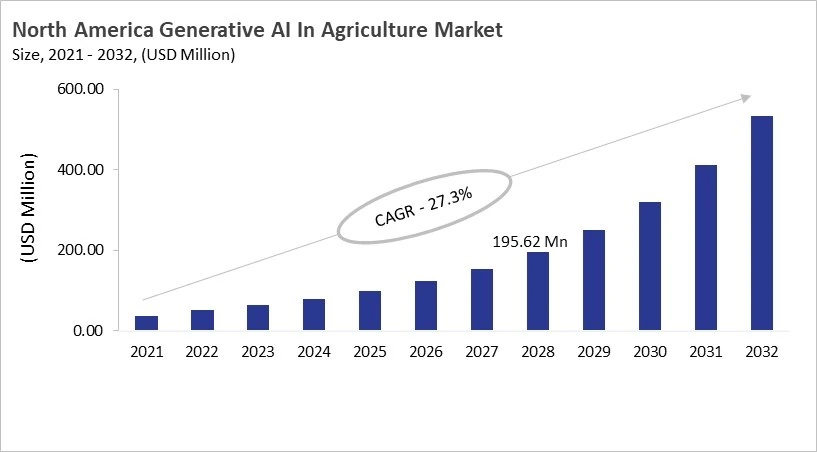
Generative AI in North American agriculture has evolved from early precision farming tools into advanced systems that can simulate crop growth, predict outcomes under different conditions, and generate optimized farming strategies. Supported by United States Department of Agriculture, land-grant universities, and major manufacturers like John Deere, AI has progressed from yield prediction and soil analysis to intelligent automation. Modern systems combine sensors, satellites, and cloud computing to deliver real-time, data-driven recommendations. This shift reflects a move from basic analytics toward generative models that guide planting, irrigation, and nutrient management.
Current trends highlight autonomous farm machinery, climate-smart agriculture, and cloud-based intelligence platforms. Companies such as Microsoft and IBM provide scalable AI frameworks that integrate weather, soil, and market data into unified systems. Competitive advantage now depends on ecosystem integration—linking hardware, software, and data services—rather than standalone tools. Public-private partnerships and sustainability goals further accelerate adoption, positioning generative AI as a central driver of productivity, resilience, and long-term growth in North American agriculture.
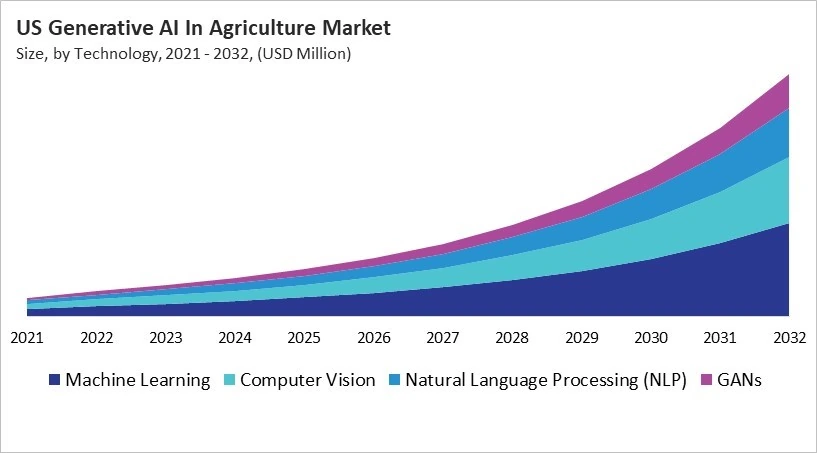
Based on technology, the generative AI In agriculture market is segmented into machine learning, computer vision, natural language processing (NLP), and GANs. With a compound annual growth rate (CAGR) of 25.7% over the projection period, the Machine Learning Market, dominate the US Generative AI In Agriculture Market by Technology in 2024 and would be a prominent market until 2032. The Natural Language Processing (NLP) market is expected to witness a CAGR of 27.3% during (2025 - 2032).
Based on application, the generative AI In agriculture market is segmented into agricultural robotics & automation, precision farming, livestock management, weather forecasting, and other application. The Agricultural Robotics & Automation market segment dominated the Canada Generative AI In Agriculture Market by Application is expected to grow at a CAGR of 28.2 % during the forecast period thereby continuing its dominance until 2032. Also, The Weather Forecasting market is anticipated to grow as a CAGR of 31.2 % during the forecast period during (2025 - 2032).
Free Valuable Insights: The Global Generative AI In Agriculture Market will hit USD 1.51 billion by 2032, at a CAGR of 28.1%
More and more, AI and generative AI are being used in the US agricultural sector to boost productivity, make better use of resources, and make decisions based on data. The United States Department of Agriculture has released its first full AI strategy for 2025–2026. This shows that the government is committed to using AI in all aspects of farming. Strong digital infrastructure, research ecosystems, and federal funding from groups like the National Institute of Food and Agriculture are speeding up the use of machine learning, remote sensing, and autonomous systems. Market trends show that people are moving away from traditional analytics and toward generative AI that can make personalized suggestions based on data about the weather, the soil, and the crops. Technology companies, equipment makers, and agritech startups are all competing to add AI to machinery and farm platforms. Generative AI is still new, but it is being actively tested in advisory and decision-support systems. For U.S. farming to be more sustainable and resilient, future growth will depend on responsible governance, a ready workforce, and ongoing cooperation between the public and private sectors.

By Technology
By Application
By Country
Our team of dedicated experts can provide you with attractive expansion opportunities for your business.



 Unique Offerings