The North America Equipment Monitoring Market is expected to reach $1.33 billion by 2027 and would witness market growth of 5.0% CAGR during the forecast period (2025-2032).
The US market dominated the North America Equipment Monitoring Market by Country in 2024, and would continue to be a dominant market till 2032; thereby, achieving a market value of $1,247.2 million by 2032. The Canada market is experiencing a CAGR of 7% during (2025 - 2032). Additionally, The Mexico market would exhibit a CAGR of 6.4% during (2025 - 2032). The US and Canada led the North America Pepperoni Foods Market by Country with a market share of 75.2% and 12.3% in 2024.
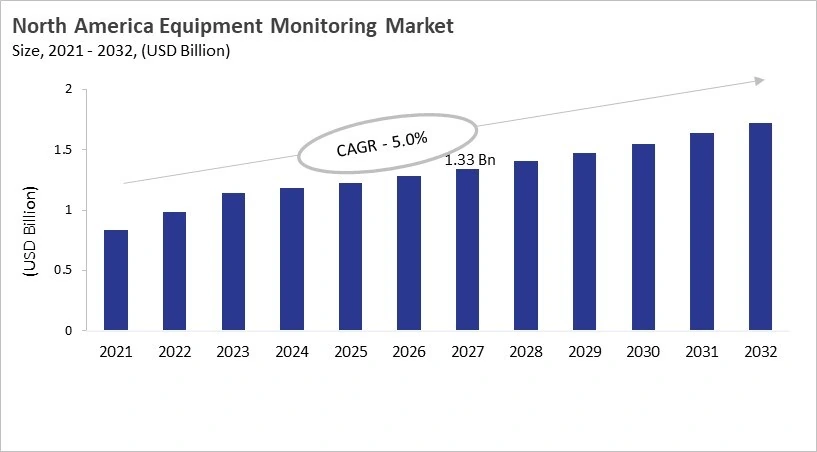
In North America, equipment monitoring has changed from manual checks to real-time condition monitoring made possible by IIoT sensors, edge computing, and cloud-based analytics. Industries such as manufacturing, energy, aerospace, and utilities utilize digital platforms to identify early signs of equipment wear and tear. They put uptime, operational efficiency, and predictive maintenance at the top of their lists. Key OEMs, such as Siemens with its SITRANS SCM IQ and Honeywell, offer integrated solutions that combine accurate sensors, AI-driven analytics, and remote monitoring capabilities. These solutions enable proactive maintenance, centralized diagnostics, and informed decision-making. This move to digital fits in with larger plans for Industry 4.0 and the modernization of industry as a whole. It helps operations that are based on data and cuts down on downtime that isn't planned.
The North American market puts a lot of emphasis on combining sensor technologies with industrial automation platforms. This lets you see real-time data on things like temperature, vibration, pressure, and motion. Remote monitoring of multiple facilities makes operations more open, safer for workers, and more responsive, especially in industries with assets spread out over a large area. OEMs use a mix of product innovation, analytics integration, and service-based solutions to create offerings that focus on outcomes and generate recurring revenue streams. The ability to provide predictive insights, domain-specific solutions, and complete monitoring ecosystems that boost equipment performance, reliability, and strategic asset management drives competition.
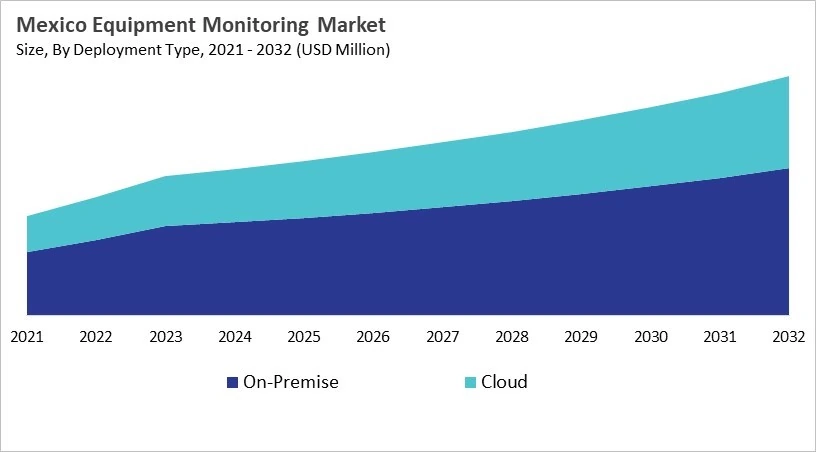
Based on Deployment Type, the market is segmented into On-Premise and Cloud. With a compound annual growth rate (CAGR) of 6% over the projection period, the On-Premise Market, dominate the Mexico Equipment Monitoring Market by Deployment Type in 2024 and would be a prominent market until 2032. The Cloud market is expected to witness a CAGR of 7.1% during (2025 - 2032).
Based on Monitoring Type, the market is segmented into Vibration Monitoring, Thermal Monitoring, Lubrication Monitoring, Motor Current Monitoring, Corrosion Monitoring, Noise & Alarm Monitoring and Other Monitoring Type. Among various Canada Equipment Monitoring Market by Monitoring Type; The Vibration Monitoring market achieved a market size of USD $52.9 Million in 2024 and is expected to grow at a CAGR of 6.2 % during the forecast period. The Corrosion Monitoring market is predicted to experience a CAGR of 7.5% throughout the forecast period from (2025 - 2032).
Free Valuable Insights: The Global Equipment Monitoring Market will hit USD 5.08 billion by 2032, at a CAGR of 5.5%
The United States Equipment Monitoring Market is one of the most digitally advanced industrial ecosystems in the world. This is because condition monitoring, predictive maintenance, IIoT sensors, and cloud-based asset performance platforms are widely used in the manufacturing, energy, oil and gas, aerospace, utilities, and transportation sectors. Some of the main reasons for this are the aging industrial infrastructure, the high costs of unplanned downtime, and the rise of shale oil and LNG operations. At the same time, federal programs and rules from agencies like NIST and the DOE encourage monitoring solutions that are safe, energy-efficient, and easy to scale. Market trends show that edge computing, AI-enabled diagnostics, 5G-enabled real-time data transmission, and monitoring for carbon tracking and emissions optimization that focuses on sustainability are all coming together. In the competitive landscape, there are big domestic OEMs and automation companies like GE Digital, Emerson, Honeywell, Rockwell Automation, and Siemens, as well as new AI-based startups. The U.S. is still the world leader in equipment monitoring innovation because it keeps investing in digitalization, AI, machine learning, and digital twins.

By Deployment Type
By Monitoring Type
By End-User
By Country
Our team of dedicated experts can provide you with attractive expansion opportunities for your business.



 Unique Offerings