The North America Electric Vehicle Tires Market would witness market growth of 12.2% CAGR during the forecast period (2025-2032).
The US market dominated the North America Electric Vehicle Tires Market by Country in 2024, and would continue to be a dominant market till 2032; thereby, achieving a market value of $3,868 million by 2032, growing at a CAGR of 11.4 % during the forecast period. The Canada market is expected to witness a CAGR of 13.9% during (2025 - 2032). Additionally, The Mexico market is expected to witness a CAGR of 13.6% during (2025 - 2032). The US and Canada led the North America Electric Vehicle Tires Market by Country with a market share of 71.2% and 15.9% in 2024.
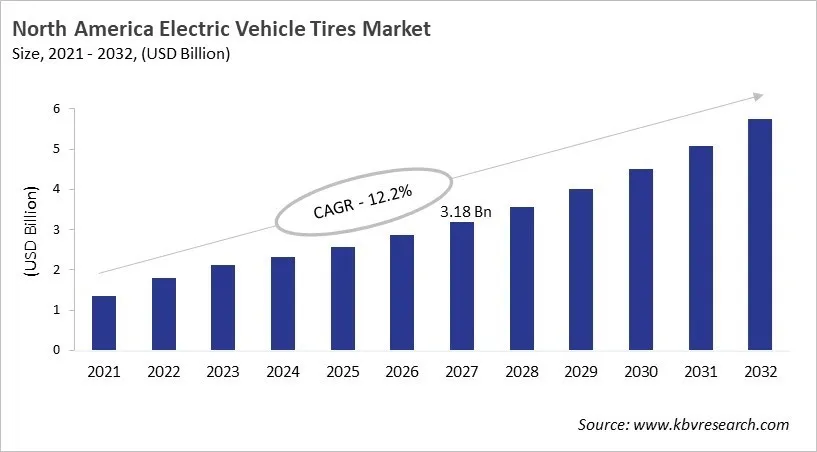
The North American EV tire market has changed quickly because more people in the U.S. and Canada are buying BEVs and PHEVs, which means they need tires that can handle heavier battery loads, more torque, and quieter cabins. Manufacturers have stopped modifying ICE-vehicle tires and instead started making EV-specific lines with stronger structures, compounds that reduce rolling resistance, and technologies that cut down on noise. This evolution is further facilitated by regulatory momentum, OEM fitment necessities, and a growing focus on sustainability, leading to the incorporation of recycled and bio-based materials, modern polymers, and EV-specific performance features.
As leaders like Bridgestone and Goodyear focus on launching EV-specific products, working with OEMs, making commitments to sustainability, and branding efforts like "EV-Ready" labels, competition is heating up. Their investments in specific compounds, acoustics technologies, manufacturing upgrades, and ENLITEN/PeakLife developments reflect a shift from basic substitute offerings to technologically distinctive portfolios. As EV sales continue to rise, the market is anticipated to further segment by vehicle type and performance needs, with future chances in smart tyres, fleet EV applications, and next-generation renewable materials.
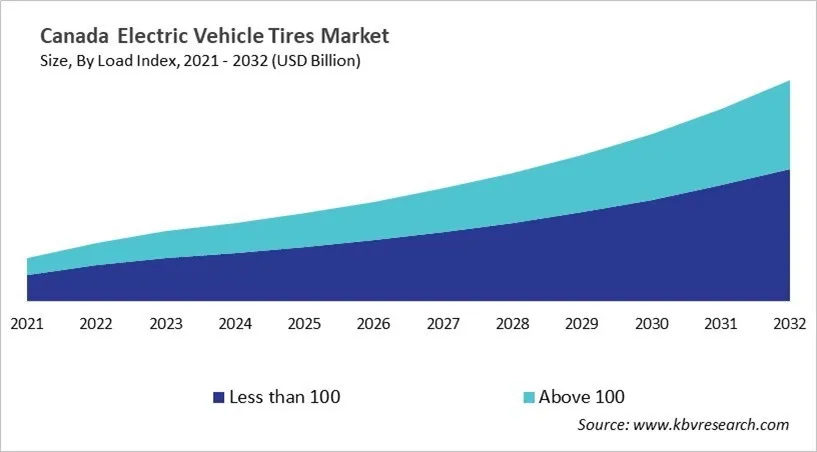
Based on Load Index, the market is segmented into Less than 100 and Above 100. With a compound annual growth rate (CAGR) of 13.6% over the projection period, the Less than 100 Market, dominate the Canada Electric Vehicle Tires Market by Load Index in 2024 and would be a prominent market until 2032. The Above 100 market is expected to witness a CAGR of 14.5% during (2025 - 2032).
Based on Sales Channel, the market is segmented into OEM and Aftermarket. The OEM market segment dominated the US Electric Vehicle Tires Market by Sales Channel is expected to grow at a CAGR of 10.9 % during the forecast period thereby continuing its dominance until 2032. Also, The Aftermarket market is anticipated to grow as a CAGR of 12.1 % during the forecast period during (2025 - 2032).
Based on Propulsion Type, the market is segmented into Battery Electric Vehicles (BEV), Hybrid Electric Vehicles (HEV), Plug-in Hybrid Electric Vehicles (PHEV) and Fuel Cell Electric Vehicles (FCEV). Among various Mexico Electric Vehicle Tires Market by Propulsion Type; The Battery Electric Vehicles (BEV) market achieved a market size of USD $89.8 Million in 2024 and is expected to grow at a CAGR of 13.1 % during the forecast period. The Fuel Cell Electric Vehicles (FCEV) market is predicted to experience a CAGR of 14.1% throughout the forecast period from (2025 - 2032).
Free Valuable Insights: The Electric Vehicle Tires Market is Predicted to reach USD 25.60 Billion by 2032, at a CAGR of 13.1%
The U.S. electric vehicle tire market is growing quickly because there are a lot of cars in the country, more people are buying EVs, and the government is making it easier for people to buy them. Because electric vehicles need special tires that can handle more torque, heavier battery loads, and quieter, more energy-efficient performance, tire makers are putting money into new materials, designs with low rolling resistance, and technologies that cut down on noise. Major companies like Goodyear, Bridgestone, and Michelin are launching product lines just for electric vehicles (EVs) and strengthening their partnerships with automakers. This is happening because there is more demand for EVs in the aftermarket as the fleet of EVs grows. Even though there are still problems like higher production costs and faster tread wear, market growth is still speeding up thanks to ongoing innovation, government incentives, and infrastructure expansion. Overall, the competitive landscape is growing more intense with both global leaders and specialty manufacturers focusing on performance, durability, and OEM integration.

By Load Index
By Sales Channel
By Application
By Vehicle Type
By Propulsion Type
By Rim Size
By Country
Our team of dedicated experts can provide you with attractive expansion opportunities for your business.



 Unique Offerings